
The application of uniaxial pressure during sintering primarily resolves the issue of structural porosity caused by inter-particle friction. specifically, applying pressures around 80 MPa forces the rearrangement and plastic deformation of particles, overcoming the natural resistance that keeps loose powder from bonding tightly. This mechanical force collapses the large voids that thermal sintering alone cannot eliminate, resulting in a denser, more conductive material.
By actively collapsing the large pores that persist during sintering neck formation, uniaxial pressure maximizes material density. This densification is the key factor that reduces electron scattering, directly enhancing both the electrical conductivity and mechanical strength of the Cu/rGO composite.
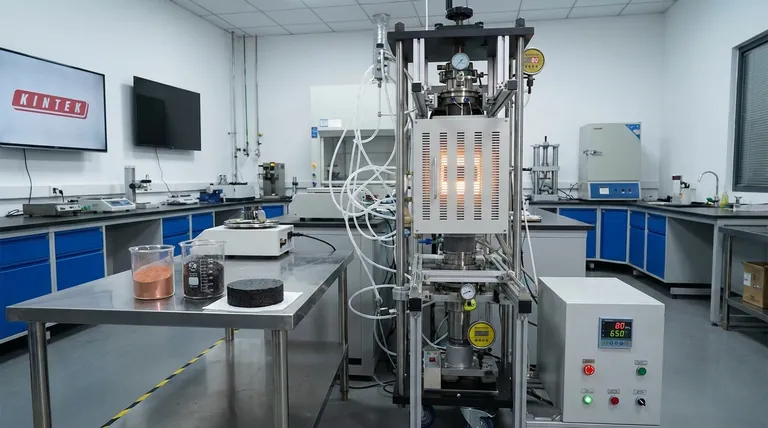
Mechanisms of Densification
Overcoming Frictional Resistance
Powder particles in a Cu/rGO composite do not naturally settle into a perfectly dense configuration. They are held apart by inter-particle friction, which creates resistance to compaction.
Uniaxial pressure provides the external force necessary to overcome this friction. It physically forces the particles to slide past one another and rearrange into a more tightly packed structure.
Inducing Plastic Deformation
Once particles are rearranged, mere contact is often insufficient for high-density applications. The applied pressure drives plastic deformation of the copper matrix.
This deformation changes the shape of the particles, allowing them to fill the interstitial gaps that would otherwise remain empty.
Eliminating Residual Pores
During the heating phase of sintering, connections known as "sintering necks" form between particles. However, large pores often remain trapped between these necks.
Pressure acts to mechanically collapse these large pores. This step is critical because standard thermal diffusion is often too slow or insufficient to remove these gross defects on its own.
The Impact on Material Performance
Reducing Electron Scattering
The primary adversary of electrical conductivity in these composites is electron scattering. Porosity acts as a barrier, causing electrons to scatter rather than flow freely.
By significantly increasing density, uniaxial pressure minimizes the void space within the material. This results in a reduction of electron scattering, thereby clearing the path for efficient charge transport.
Enhancing Mechanical Strength
Porosity also represents structural weakness. Voids act as stress concentrators where cracks can initiate and propagate.
The high density achieved through pressure-assisted sintering removes these internal flaws. The result is a substantial improvement in the mechanical integrity and strength of the final composite.
Understanding the Process Constraints
The Limits of Thermal Sintering
It is important to recognize that heat alone creates the initial bonds (sintering necks) but rarely achieves full density in this context.
Without the addition of pressure, the frictional resistance between particles prevents the total collapse of voids. Relying solely on thermal energy typically results in a porous structure with suboptimal performance characteristics.
The Role of Specific Pressure Loads
The reference specifically notes a pressure of 80 MPa. This magnitude is chosen to effectively bridge the gap between simple particle contact and actual plastic deformation.
Applying insufficient pressure may fail to overcome the yield strength of the material, leaving the large pores intact and the material properties compromised.
Making the Right Choice for Your Goal
To maximize the performance of your Cu/rGO composites, you must view pressure as a critical processing variable, not just a molding step.
- If your primary focus is Electrical Conductivity: Prioritize high uniaxial pressure to maximize density, as this is the only way to minimize electron scattering caused by voids.
- If your primary focus is Mechanical Strength: Ensure the pressure applied is sufficient to induce plastic deformation, eliminating the large pores that serve as structural failure points.
The application of uniaxial pressure is the definitive method for transforming a loosely bonded powder network into a high-performance, conductive solid.
Summary Table:
| Mechanism | Problem Solved | Impact on Performance |
|---|---|---|
| Particle Rearrangement | Inter-particle friction & loose packing | Increases initial material density |
| Plastic Deformation | Interstitial gaps between particles | Fills voids to create a solid matrix |
| Pore Collapse | Residual large-scale porosity | Minimizes electron scattering & stress points |
| Mechanical Force | Inefficiency of thermal diffusion alone | Ensures high electrical & thermal conductivity |
Maximize Your Material Performance with KINTEK
Are you struggling with structural porosity or suboptimal conductivity in your advanced composites? KINTEK provides the cutting-edge thermal technology required to master pressure-assisted sintering. Backed by expert R&D and world-class manufacturing, we offer a comprehensive range of Muffle, Tube, Rotary, Vacuum, and CVD systems, all of which can be customized to meet your precise lab requirements.
Don't let residual voids compromise your research or production. Our high-temperature furnaces are designed to deliver the uniform heat and structural integrity your Cu/rGO composites demand.
Ready to elevate your material properties? Contact KINTEK today to discuss your unique needs with our specialists!
Visual Guide

Related Products
- Small Vacuum Heat Treat and Tungsten Wire Sintering Furnace
- Chairside Dental Porcelain Zirconia Sintering Furnace with Transformer for Ceramic Restorations
- Dental Porcelain Zirconia Sintering Ceramic Vacuum Press Furnace
- Vacuum Heat Treat Sintering Furnace with Pressure for Vacuum Sintering
- Vacuum Heat Treat Sintering Furnace Molybdenum Wire Vacuum Sintering Furnace
People Also Ask
- How does vacuum sintering improve dimensional tolerances? Achieve Uniform Shrinkage and Precision
- What is the purpose of setting a mid-temperature dwell stage? Eliminate Defects in Vacuum Sintering
- What are the key components of a vacuum sintering furnace? Essential Parts for Precision Material Processing
- What are the main structural components of a vacuum sintering furnace? Unlock Precision in High-Temperature Processing
- What are the main types of sintering furnaces? Find the Perfect Match for Your Materials



















