
A vacuum hot pressing sintering furnace creates a dual-action environment characterized by high vacuum levels (often supplemented by argon gas) and the simultaneous application of mechanical pressure at elevated temperatures. Specifically for high-entropy alloy-ceramic coatings on steel, this environment prevents the oxidation of the steel substrate and alloy powders while forcing the materials into a dense, metallurgically bonded state.
By combining a high-temperature vacuum with axial pressure, the process drives elemental diffusion between the coating and the substrate, eliminating internal porosity and creating a bond strength that conventional pressureless sintering cannot achieve.
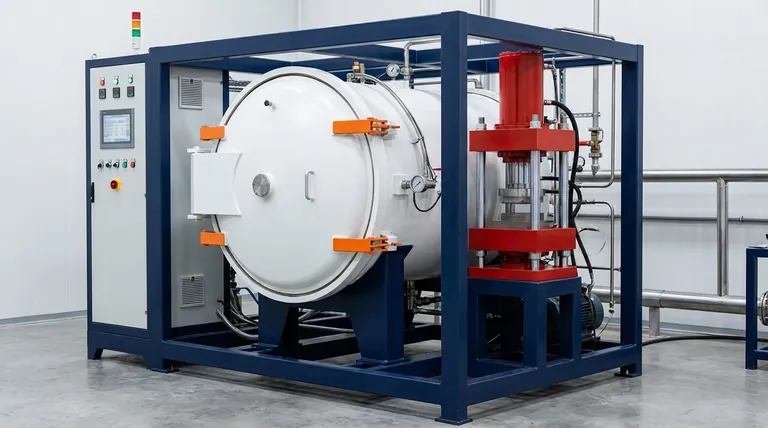
The Role of Atmospheric Control
To successfully coat steel with complex composites, controlling the chemical environment is the first priority.
Vacuum Protection
The primary function of the furnace is to establish a high vacuum environment. This isolates the steel matrix and the high-entropy alloy powders from oxygen, preventing surface oxidation that would otherwise compromise the interface.
Inert Gas Shielding
Following the initial vacuum stage, argon gas protection is frequently introduced. This secondary measure ensures that as temperatures rise to sintering levels (e.g., 1373 K), the materials remain protected from any residual reactive gases or impurities.
Elimination of Impurities
The vacuum environment actively promotes the removal of adsorbed gases from the powder particle interstices. This creates "pure" reaction conditions, ensuring that the interface between the coating and the steel remains free of brittle oxide inclusions.
The Impact of Pressure and Heat
Atmosphere alone is insufficient for densification; the mechanical application of force is the differentiating factor of this technology.
Integrated Pressurization
The furnace applies axial pressure directly to the sample while it is at its peak processing temperature. This pressure is critical for promoting the plastic flow of the material, which physically closes pores and disrupts particle agglomeration.
Elemental Diffusion Bonding
At temperatures such as 1373 K, the combination of heat and pressure accelerates elemental diffusion. This forces atoms from the high-entropy alloy and ceramic phases to interdiffuse with the steel substrate, creating a robust metallurgical bond rather than a weak mechanical adhesion.
Densification
The applied pressure overcomes the natural resistance of ceramic particles to rearrange. This results in a fully dense composite with virtually no internal porosity, significantly enhancing the wear and corrosion resistance of the coating.
Understanding the Trade-offs
While vacuum hot pressing creates superior bonds, it introduces specific processing challenges that must be managed.
Thermal Expansion Mismatch
Steel and ceramic materials expand and contract at significantly different rates. During the cooling phase, this mismatch can generate interfacial shrinkage stresses that may lead to cracking if not controlled.
Importance of Pressure-Holding
To mitigate stress fractures, the furnace must maintain pressure during the cooling phase. This pressure-holding function counteracts the tendency of the materials to pull apart, inhibiting the initiation of interfacial cracks and ensuring the final structural integrity of the composite.
Making the Right Choice for Your Goal
To maximize the performance of your high-entropy alloy-ceramic coating, align your processing parameters with your specific performance requirements.
- If your primary focus is Bonding Strength: Prioritize high axial pressure at peak temperature (e.g., 1373 K) to maximize elemental diffusion into the steel substrate.
- If your primary focus is Microstructural Purity: Ensure the highest possible vacuum levels are achieved prior to heating to prevent the oxidation of reactive elements within the high-entropy alloy.
Ultimately, the success of this process relies on leveraging the vacuum to ensure chemical purity while using pressure to force physical density.
Summary Table:
| Processing Feature | Environmental Role | Impact on Composite |
|---|---|---|
| High Vacuum/Argon | Chemical Protection | Prevents oxidation and eliminates adsorbed gas impurities. |
| Axial Pressurization | Mechanical Force | Closes internal pores and promotes material plastic flow. |
| High Temperature | Thermal Activation | Drives elemental diffusion for a strong metallurgical bond. |
| Pressure-Holding | Stress Management | Counteracts thermal expansion mismatch to prevent cracking. |
Elevate Your Composite Research with KINTEK
Achieve unparalleled coating density and bond strength with KINTEK’s advanced vacuum hot pressing solutions. Backed by expert R&D and industry-leading manufacturing, KINTEK offers high-performance Muffle, Tube, Rotary, Vacuum, and CVD systems, as well as other lab high-temp furnaces—all fully customizable to meet your unique processing needs.
Don't let oxidation or porosity compromise your materials. Partner with KINTEK to leverage precise atmospheric control and integrated pressurization for your next breakthrough.
Contact our experts today to find your custom furnace solution!
Visual Guide

Related Products
- 600T Vacuum Induction Hot Press Vacuum Heat Treat and Sintering Furnace
- Vacuum Heat Treat Sintering Furnace with Pressure for Vacuum Sintering
- 9MPa Air Pressure Vacuum Heat Treat and Sintering Furnace
- Vacuum Hot Press Furnace Machine Heated Vacuum Press Tube Furnace
- 2200 ℃ Tungsten Vacuum Heat Treat and Sintering Furnace
People Also Ask
- Why use Vacuum Hot Press (VHP) for ZnS Ceramics? Achieve Superior IR Transparency and Mechanical Strength
- How does a vacuum hot press sintering furnace mitigate copper sintering swelling? Solve Fe-Cu Expansion Issues
- What are the key advantages of vacuum hot press sintering furnaces? Achieve Superior Density and Purity in Materials
- What is the core function of a vacuum hot press sintering furnace in the preparation of high-density RuTi alloys? Achieve Maximum Density and Purity
- How does the vacuum environment in a vacuum hot press sintering furnace protect chromium-containing ceramics? Find out.



















