
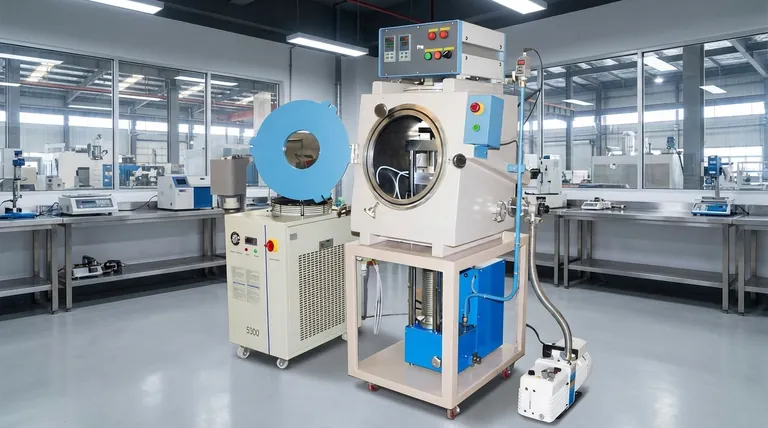
At their core, manufacturing solutions for composite materials are designed to shape and solidify the material under highly controlled conditions. The primary methods involve complete manufacturing plants centered around vacuum-thermoforming machines, which utilize both hot and cold vacuum pressing to form the final part.
The specific machine is only one part of the equation. The real goal of these manufacturing solutions is to master the interplay of heat, pressure, and time to produce consistent, high-quality composite parts while minimizing errors and cost.
The Core Process: Shaping Composites with Heat and Pressure
Modern composite manufacturing revolves around a process known as thermoforming. This technique uses a combination of temperature and vacuum to precisely shape composite sheets or preforms into a desired geometry.
What is Thermoforming?
Thermoforming is a manufacturing process where a plastic or composite sheet is heated to a pliable forming temperature. Once malleable, it is formed to a specific shape in a mold and then trimmed to create a usable product.
The Critical Role of Vacuum
A vacuum is applied to pull the heated material tightly against the mold's surface. This ensures every detail and contour of the mold is perfectly replicated, removing trapped air and ensuring a dense, void-free part.
How Vacuum-Thermoforming Machines Work
These machines integrate the heating and vacuum stages into a single, controlled process. The composite material is heated, transferred to the molding station, and then a vacuum is applied to draw it into or over the mold, forming the final part.
Key Manufacturing Solutions Explained
The choice of solution depends on the material, the complexity of the part, and production goals. The two main approaches are hot and cold pressing.
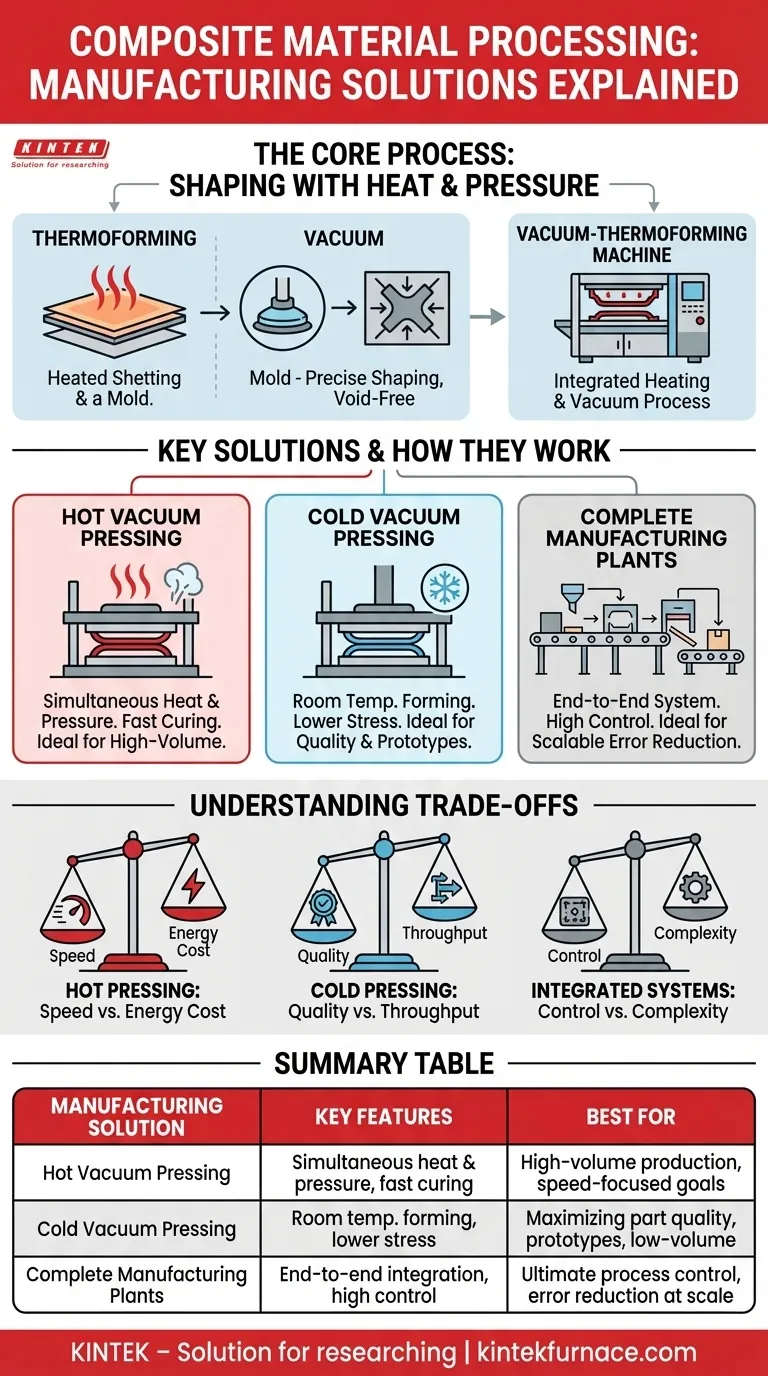
Hot Vacuum Pressing
In this method, both heat and pressure are applied simultaneously. The press heats the composite material to its curing temperature while the vacuum removes air and a press applies mechanical force. This accelerates the curing cycle significantly.
This process is ideal for high-volume production where cycle time is a critical factor.
Cold Vacuum Pressing
In cold pressing, the initial forming and vacuum application may happen at or near room temperature. The part is consolidated under vacuum and may be cured later in an oven without direct pressure from the press itself.
This approach is often used for larger structures or materials that are sensitive to rapid temperature changes, prioritizing material integrity over speed.
Complete Manufacturing Plants
The most advanced solutions are complete, integrated manufacturing plants. These are not just individual machines but end-to-end systems that handle material preparation, forming, curing, and finishing.
These "individual solutions" are custom-built to optimize a specific production process, aiming to maximize quality and minimize cost for a particular composite part.
Understanding the Trade-offs
Every manufacturing decision involves balancing competing factors. Understanding these is key to selecting the right process.
Hot Pressing: Speed vs. Energy Cost
The primary advantage of hot pressing is speed, leading to higher throughput. However, these systems have higher upfront capital costs and consume more energy, which can increase the cost per part.
Cold Pressing: Quality vs. Throughput
Cold pressing is generally slower due to longer curing cycles. The trade-off is often lower internal stress on the part and lower energy costs. It is well-suited for prototypes or low-volume production where dimensional stability is paramount.
Integrated Systems: Control vs. Complexity
A complete manufacturing plant offers unparalleled control over the entire process, drastically reducing the potential for human error. The downside is significant initial investment and complexity, requiring specialized knowledge to operate and maintain.
Making the Right Choice for Your Goal
Your optimal solution depends entirely on your project's primary objective.
- If your primary focus is high-volume production: Hot vacuum pressing is the most effective solution due to its fast cycle times.
- If your primary focus is maximizing part quality and minimizing internal stress: A cold vacuum pressing process is often the superior choice.
- If your primary focus is ultimate process control and minimizing errors at scale: An integrated, complete manufacturing plant provides the most robust and repeatable results.
By aligning your manufacturing process with your specific goals, you can unlock the full performance and economic potential of composite materials.
Summary Table:
| Manufacturing Solution | Key Features | Best For |
|---|---|---|
| Hot Vacuum Pressing | Simultaneous heat and pressure, fast curing | High-volume production, speed-focused goals |
| Cold Vacuum Pressing | Room temperature forming, lower stress | Maximizing part quality, prototypes, low-volume |
| Complete Manufacturing Plants | End-to-end integration, high control | Ultimate process control, error reduction at scale |
Ready to enhance your composite material processing? At KINTEK, we leverage exceptional R&D and in-house manufacturing to provide advanced high-temperature furnace solutions tailored for diverse laboratories. Our product line includes Muffle, Tube, Rotary Furnaces, Vacuum & Atmosphere Furnaces, and CVD/PECVD Systems, supported by strong deep customization capabilities to precisely meet your unique experimental requirements. Contact us today to discuss how we can optimize your production with reliable, customized solutions!
Visual Guide
Related Products
- Vacuum Hot Press Furnace Machine for Lamination and Heating
- Vacuum Hot Press Furnace Machine Heated Vacuum Press
- 600T Vacuum Induction Hot Press Vacuum Heat Treat and Sintering Furnace
- Vacuum Hot Press Furnace Machine Heated Vacuum Press Tube Furnace
- Small Vacuum Heat Treat and Tungsten Wire Sintering Furnace
People Also Ask
- What are the primary components of a vacuum hot press furnace? Master the Core Systems for Precise Material Processing
- What safety features are incorporated in vacuum hot press furnaces? Ensure Operator and Equipment Protection
- What are the benefits of the vacuum environment system in a vacuum hot press furnace? Unlock High-Density Sintering
- What industries benefit from the use of vacuum hot press furnaces? Unlock High-Performance Materials for Your Industry
- Why is a high vacuum environment crucial when preparing copper-carbon nanotube composites in a vacuum hot press furnace? Achieve Superior Composite Integrity







