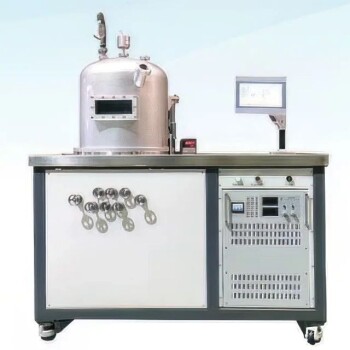
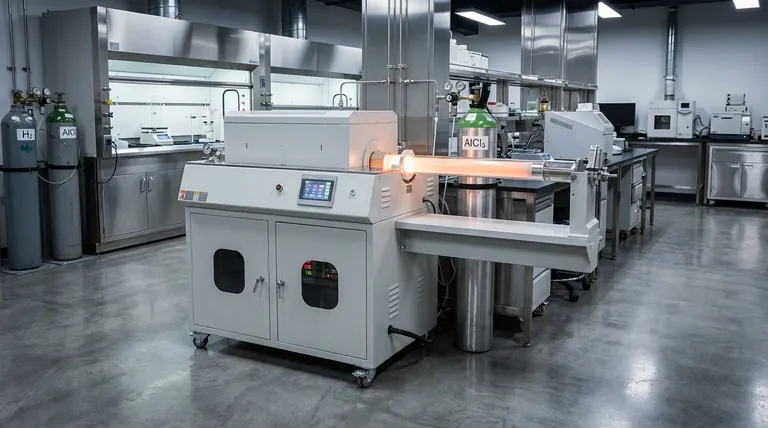
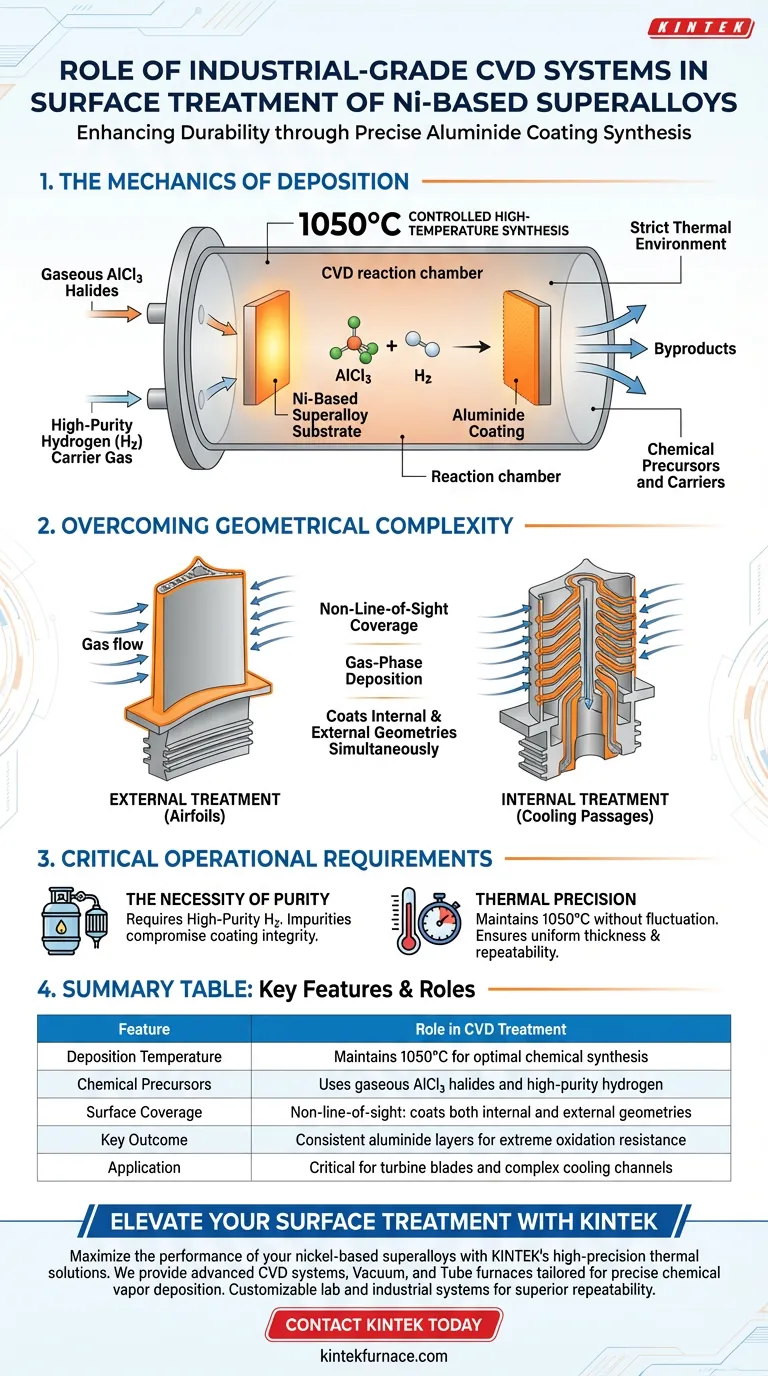
An industrial-grade CVD system serves as the critical reaction chamber for enhancing the durability of nickel-based superalloys. Its primary role is to synthesize aluminide coatings by reacting gaseous aluminum halides (AlCl3) with high-purity hydrogen at extremely high temperatures (1050°C). This process ensures that protective aluminum layers are deposited with precision, creating a barrier that protects the underlying alloy.
The system solves the challenge of coating complex geometries by using gas-phase deposition to treat both internal cooling channels and external surfaces simultaneously, guaranteeing consistent thickness and production repeatability.
The Mechanics of Deposition
Controlled High-Temperature Synthesis
The industrial CVD system provides a strictly regulated thermal environment essential for chemical bonding.
It maintains a specific reaction temperature of 1050°C.
At this temperature, the thermodynamic conditions are ideal for synthesizing aluminide coatings directly onto the nickel-based substrate.
Chemical Precursors and Carriers
The system does not simply coat the part; it facilitates a chemical reaction using specific agents.
It utilizes gaseous AlCl3 halides as the primary source of aluminum.
To transport this aluminum to the surface of the alloy, the system employs high-purity hydrogen as a carrier gas.
Overcoming Geometrical Complexity
Non-Line-of-Sight Coverage
Unlike physical spray methods, the CVD system utilizes gas flow to deliver coating materials.
This allows the aluminum to reach areas that are not in the direct line of sight of an applicator.
Internal vs. External Treatment
The most distinct advantage of this system is its ability to coat complex components like turbine blades comprehensively.
It deposits aluminum uniformly on external surfaces (airfoils).
Simultaneously, it coats the internal surfaces (cooling passages), ensuring the entire component is protected against oxidation and corrosion.
Critical Operational Requirements
The Necessity of Purity
While the system is powerful, it demands rigorous input quality to function correctly.
The reference emphasizes the use of high-purity hydrogen.
Using gases with impurities can compromise the integrity of the aluminide coating and the substrate bond.
Thermal Precision
The specific temperature of 1050°C is not a suggestion; it is a synthesis requirement.
The industrial-grade nature of the system is defined by its ability to hold this temperature without fluctuation.
Inconsistent heat distribution would lead to uneven coating thickness and reduced repeatability in a production environment.
Making the Right Choice for Your Goal
If you are evaluating surface treatment options for nickel-based superalloys, consider your specific constraints:
- If your primary focus is complex geometry: The CVD system is essential for coating internal channels and blind holes that line-of-sight methods cannot reach.
- If your primary focus is process consistency: An industrial-grade system is required to maintain the strict 1050°C environment needed for high production repeatability.
By leveraging gas-phase reactions at precise temperatures, industrial CVD systems turn standard superalloys into high-performance components capable of surviving extreme operational stress.
Summary Table:
| Feature | Role in CVD Treatment of Ni-Based Superalloys |
|---|---|
| Deposition Temperature | Maintains 1050°C for optimal chemical synthesis |
| Chemical Precursors | Uses gaseous AlCl3 halides and high-purity hydrogen |
| Surface Coverage | Non-line-of-sight: coats both internal and external geometries |
| Key Outcome | Consistent aluminide layers for extreme oxidation resistance |
| Application | Critical for turbine blades and complex cooling channels |
Elevate Your Surface Treatment with KINTEK
Maximize the performance of your nickel-based superalloys with KINTEK’s high-precision thermal solutions. Backed by expert R&D and world-class manufacturing, we provide advanced CVD systems, Vacuum, and Tube furnaces tailored for precise chemical vapor deposition and high-temperature synthesis. Whether you need uniform internal coatings for complex turbine geometries or superior thermal stability at 1050°C, our customizable lab and industrial systems deliver the repeatability your project demands.
Ready to optimize your material durability? Contact KINTEK today for a consultation!
Visual Guide
References
- Effect of Ni-Based Superalloy on the Composition and Lifetime of Aluminide Coatings. DOI: 10.3390/ma18133138
This article is also based on technical information from Kintek Furnace Knowledge Base .
Related Products
- HFCVD Machine System Equipment for Drawing Die Nano Diamond Coating
- Cylindrical Resonator MPCVD Machine System for Lab Diamond Growth
- Custom Made Versatile CVD Tube Furnace Chemical Vapor Deposition CVD Equipment Machine
- MPCVD Machine System Reactor Bell-jar Resonator for Lab and Diamond Growth
- 915MHz MPCVD Diamond Machine Microwave Plasma Chemical Vapor Deposition System Reactor
People Also Ask
- What is Hot-filament Chemical Vapor Deposition (HFCVD)? Achieve High-Quality Thin Films with Precision Control
- What are the equipment for chemical vapor deposition? A Guide to the 5 Essential Components
- What is the significance of the vacuum pressure control system in the CVD coating process for powders?
- What is the function of high-purity Argon (Ar) gas during CVD? Optimize Your Thin Film Uniformity and Purity
- What are the advantages of using Chemical Vapor Deposition (CVD) for coating turbine blades? Enhance Life & Performance