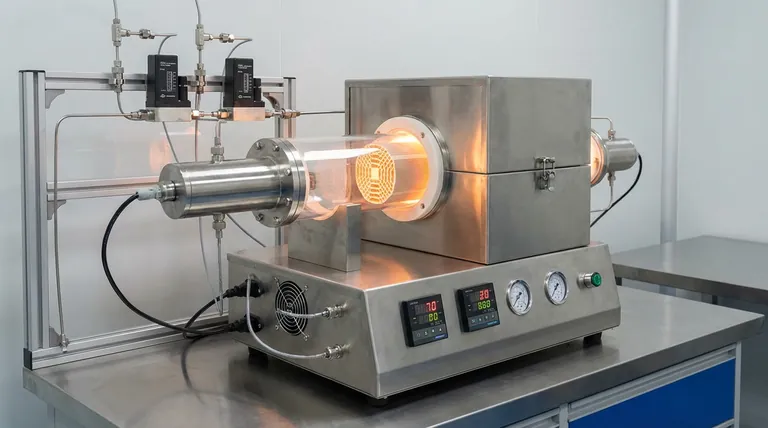
Chemical Vapor Infiltration (CVI) equipment optimizes performance by precisely regulating gas pressure and precursor flow rates to modify the internal structure of ceramic honeycombs. By managing these variables, the equipment facilitates the deep penetration of gas-phase precursors into the ceramic skeleton, ensuring the deposition of solid phases occurs uniformly within the pores rather than just on the exterior.
The primary advantage of CVI is its ability to deposit microwave-absorbing coatings onto complex internal cavities without altering the original geometry of the printed structure. This process enhances absorption by creating multiple internal reflection paths for electromagnetic waves.
The Mechanics of Infiltration Control
Utilizing Gas-Phase Precursors
CVI equipment operates by introducing gas-phase precursors into the reaction chamber. These gases are chemically designed to react and deposit specific solid phases, such as carbon or Silicon Carbide.
Regulating Pressure and Flow
The critical process conditions provided by the equipment are the control of gas pressure and flow rates. These settings determine how effectively the gas penetrates the porous ceramic skeleton before depositing the solid material.
Achieving Uniform Deposition
By fine-tuning these atmospheric conditions, the equipment ensures uniform growth of coatings. This uniformity is essential for covering the surfaces of complex internal cavities that line-of-sight coating methods cannot reach.
Optimizing Microwave Absorption
Creating Internal Reflection Paths
The deposition of solid phases within the pores serves a specific functional purpose: adjusting the material's electromagnetic properties. The coatings enable the adjustment of multiple reflection paths for electromagnetic waves.
Enhancing Energy Dissipation
By increasing the number of internal reflections, the structure traps electromagnetic waves more effectively. This mechanism significantly improves the microwave-absorbing performance of the ceramic component.
Preserving Structural Geometry
A distinct feature of the CVI process is that it enhances performance without altering the original printed structure. The equipment modifies the material's internal chemistry and physics while maintaining the precise dimensions of the ceramic honeycomb.
Critical Process Dependencies
The Necessity of Precise Control
The success of CVI relies entirely on the stability of the pressure and flow rate parameters. If these conditions fluctuate, the deposition may become uneven, leading to inconsistent absorption performance across the component.
Complexity of Internal Cavities
While CVI is designed for complex shapes, the geometry of the internal cavities dictates the required process settings. Highly intricate pore structures require more rigorous optimization of flow and pressure to prevent blockage before the coating is fully formed.
Making the Right Choice for Your Goal
To maximize the capabilities of Chemical Vapor Infiltration for your ceramic structures, consider the following application strategies:
- If your primary focus is Electromagnetic Performance: Prioritize the precise adjustment of reflection paths by tuning the thickness and composition of the carbon or Silicon Carbide layers.
- If your primary focus is Dimensional Accuracy: Rely on CVI to enhance material properties, as it strictly maintains the original geometry of your printed skeleton without physical deformation.
Mastering the balance of gas pressure and flow rate is the key to transforming a passive ceramic skeleton into an active, high-performance microwave absorber.
Summary Table:
| Parameter | Influence on Performance | Result for Ceramic Honeycomb |
|---|---|---|
| Gas Pressure | Controls precursor penetration depth | Uniform deposition in internal cavities |
| Flow Rate | Dictates solid-phase deposition speed | Consistent coating thickness across skeleton |
| Gas Precursors | Determines chemical composition (C or SiC) | Optimized electromagnetic wave reflection |
| Atmospheric Stability | Ensures growth uniformity | Maintains original printed geometry |
Elevate Your Advanced Material Processing with KINTEK
Unlock the full potential of your ceramic structures with our industry-leading Chemical Vapor Infiltration (CVI) solutions. Backed by expert R&D and world-class manufacturing, KINTEK provides high-precision laboratory systems—including Muffle, Tube, Rotary, Vacuum, and CVD/CVI systems—all specifically designed to be customizable for your unique material needs.
Whether you are looking to optimize electromagnetic performance or require uniform deposition for complex internal geometries, our team is ready to provide the specialized equipment you need. Contact us today to discuss your project requirements and see how our expertise can drive your innovation forward.
References
- Wenqing Wang, Rujie He. Advanced 3D printing accelerates electromagnetic wave absorption from ceramic materials to structures. DOI: 10.1038/s44334-024-00013-w
This article is also based on technical information from Kintek Furnace Knowledge Base .
Related Products
- Custom Made Versatile CVD Tube Furnace Chemical Vapor Deposition CVD Equipment Machine
- Multi Heating Zones CVD Tube Furnace Machine for Chemical Vapor Deposition Equipment
- HFCVD Machine System Equipment for Drawing Die Nano Diamond Coating
- MPCVD Machine System Reactor Bell-jar Resonator for Lab and Diamond Growth
- Slide PECVD Tube Furnace with Liquid Gasifier PECVD Machine
People Also Ask
- Why are CVD tube furnace sintering systems indispensable for 2D material research and production? Unlock Atomic-Scale Precision
- What is a CVD tube furnace and what is its primary function? Discover Precision Thin-Film Deposition
- How does CVD tube furnace sintering enhance graphene growth? Achieve Superior Crystallinity and High Electron Mobility
- Which industries and research fields benefit from CVD tube furnace sintering systems for 2D materials? Unlock Next-Gen Tech Innovations
- How can integrating CVD tube furnaces with other technologies benefit device fabrication? Unlock Advanced Hybrid Processes