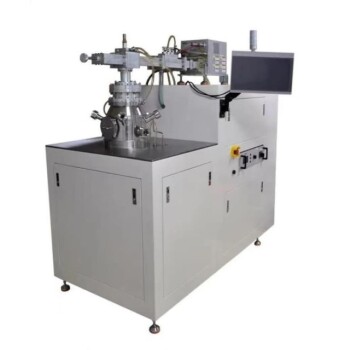
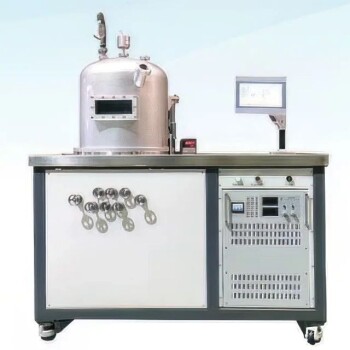
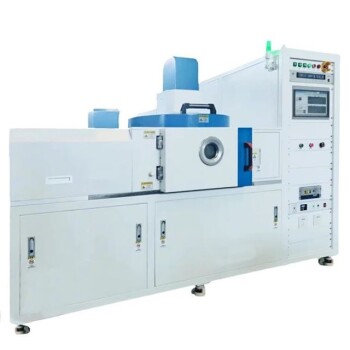
The Metal-Organic Chemical Vapor Deposition (MOCVD) system functions as a high-precision reactor designed to grow monolayer Tungsten Disulfide (WS2) through strict environmental controls. Unlike standard methods that may rely on the sublimation of solid powders, MOCVD utilizes precise gas-flow management of metal-organic precursors to ensure uniform deposition on substrates like Si/SiO2.
The MOCVD system distinguishes itself by providing a highly stable thermal and chemical flow field, which is the prerequisite for facilitating the nucleation and lateral growth necessary to produce high-quality, large-area two-dimensional semiconductor films.
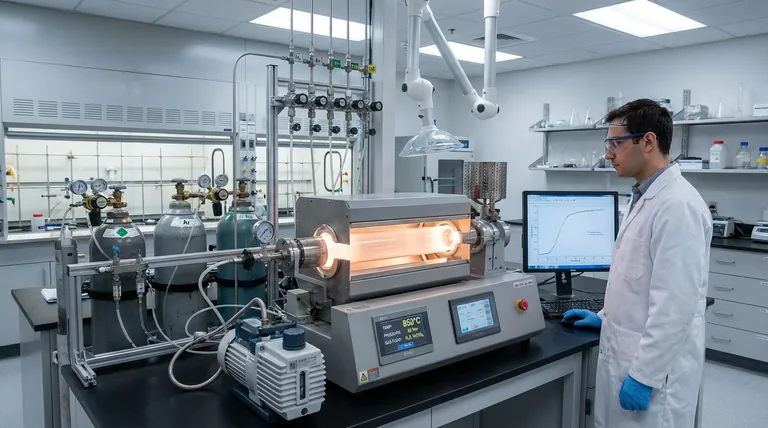
Controlling the Chemical Inputs
Precision Precursor Management
The core role of the MOCVD system is to manage the introduction of specific chemical agents.
It utilizes metal-organic precursors such as W(CO)6 (tungsten hexacarbonyl) as the tungsten source.
For the sulfur component, the system precisely controls the flow of gas-phase sulfur sources, specifically H2S (hydrogen sulfide).
Regulating Chemical Flow Fields
The system creates a stable "chemical component flow field."
This ensures that the ratio of tungsten to sulfur is constant and uniform across the substrate.
Managing Critical Environmental Parameters
Strict Thermal Requirements
To facilitate the chemical reaction, the MOCVD system maintains a high-temperature environment.
The system must hold the processing zone between 750°C and 900°C.
This thermal field supplies the energy required for the decomposition of precursors and the subsequent crystallization of the material.
Pressure Dynamics
Controlling the chamber pressure is vital for determining the growth rate and film quality.
The MOCVD system operates within a specific pressure range, typically varying between 150 Torr and 20 Torr.
Facilitating the Growth Process
Nucleation Control
The combination of pressure, temperature, and gas flow enables precise nucleation on the substrate.
This is the initial stage where the WS2 crystal seeds begin to form on the Si/SiO2 substrate.
Lateral Epitaxial Growth
Once nucleation occurs, the system promotes lateral epitaxial growth.
This allows the WS2 domains to expand horizontally across the surface, coalescing into a continuous monolayer film.
Operational Requirements and Trade-offs
Necessity of Stability
The primary challenge in MOCVD is the absolute necessity of stability.
Fluctuations in the thermal field or gas flow can disrupt the lateral growth, leading to defects or multi-layer buildup rather than the desired monolayer.
Complexity of Precursors
Unlike basic CVD tube furnaces that might sublime solid sulfur powder, MOCVD relies on handling complex metal-organics and gases like H2S.
This requires robust safety and handling protocols due to the nature of the chemical inputs involved.
Making the Right Choice for Your Goal
The MOCVD process is a sophisticated method tailored for specific high-performance outcomes.
- If your primary focus is large-area uniformity: The MOCVD system is essential because its stable chemical flow field prevents the uneven deposition often seen with solid-source sublimation.
- If your primary focus is high-quality crystallization: You must ensure your equipment can maintain the strict 750°C–900°C temperature window and 20–150 Torr pressure range to facilitate proper epitaxial growth.
Success in growing monolayer WS2 relies not just on the ingredients, but on the MOCVD system's ability to maintain an unyielding environment of thermal and chemical stability.
Summary Table:
| Parameter | Specification/Role in WS2 Growth |
|---|---|
| Tungsten Precursor | W(CO)6 (Tungsten Hexacarbonyl) |
| Sulfur Source | H2S (Hydrogen Sulfide) Gas |
| Temperature Range | 750°C to 900°C for precursor decomposition |
| Pressure Range | 20 Torr to 150 Torr for growth rate control |
| Primary Substrate | Si/SiO2 for nucleation and lateral epitaxy |
| Core Advantage | Uniform chemical flow field for large-area films |
Achieve Atomic Precision with KINTEK Solutions
Success in monolayer WS2 growth demands absolute thermal and chemical stability. KINTEK provides industry-leading MOCVD and CVD systems, including high-performance tube and vacuum furnaces, designed specifically for researchers who require uniform deposition and repeatable results.
Backed by expert R&D and manufacturing, our systems are fully customizable to meet your unique semiconductor and 2D material synthesis needs. Ready to elevate your material science? Contact our technical specialists today to find the perfect high-temperature solution for your lab.
References
- Pieter‐Jan Wyndaele, Stefan De Gendt. Enhancing dielectric passivation on monolayer WS2 via a sacrificial graphene oxide seeding layer. DOI: 10.1038/s41699-024-00464-x
This article is also based on technical information from Kintek Furnace Knowledge Base .
Related Products
- Cylindrical Resonator MPCVD Machine System for Lab Diamond Growth
- 915MHz MPCVD Diamond Machine Microwave Plasma Chemical Vapor Deposition System Reactor
- MPCVD Machine System Reactor Bell-jar Resonator for Lab and Diamond Growth
- Multi Heating Zones CVD Tube Furnace Machine for Chemical Vapor Deposition Equipment
- HFCVD Machine System Equipment for Drawing Die Nano Diamond Coating
People Also Ask
- How does MPCVD achieve stable temperature control during diamond growth? Master Precise Thermal Management
- What are the essential components of an MPCVD reactor system? Build a Pristine Environment for High-Purity Materials
- How do carbon-containing groups contribute to diamond growth in the MPCVD method? Unlock High-Quality Diamond Synthesis
- How does pressure affect the MPCVD growth process? Master Plasma Control for Superior Film Quality
- What factors influence the quality of diamond deposition in the MPCVD method? Master the Critical Parameters for High-Quality Diamond Growth