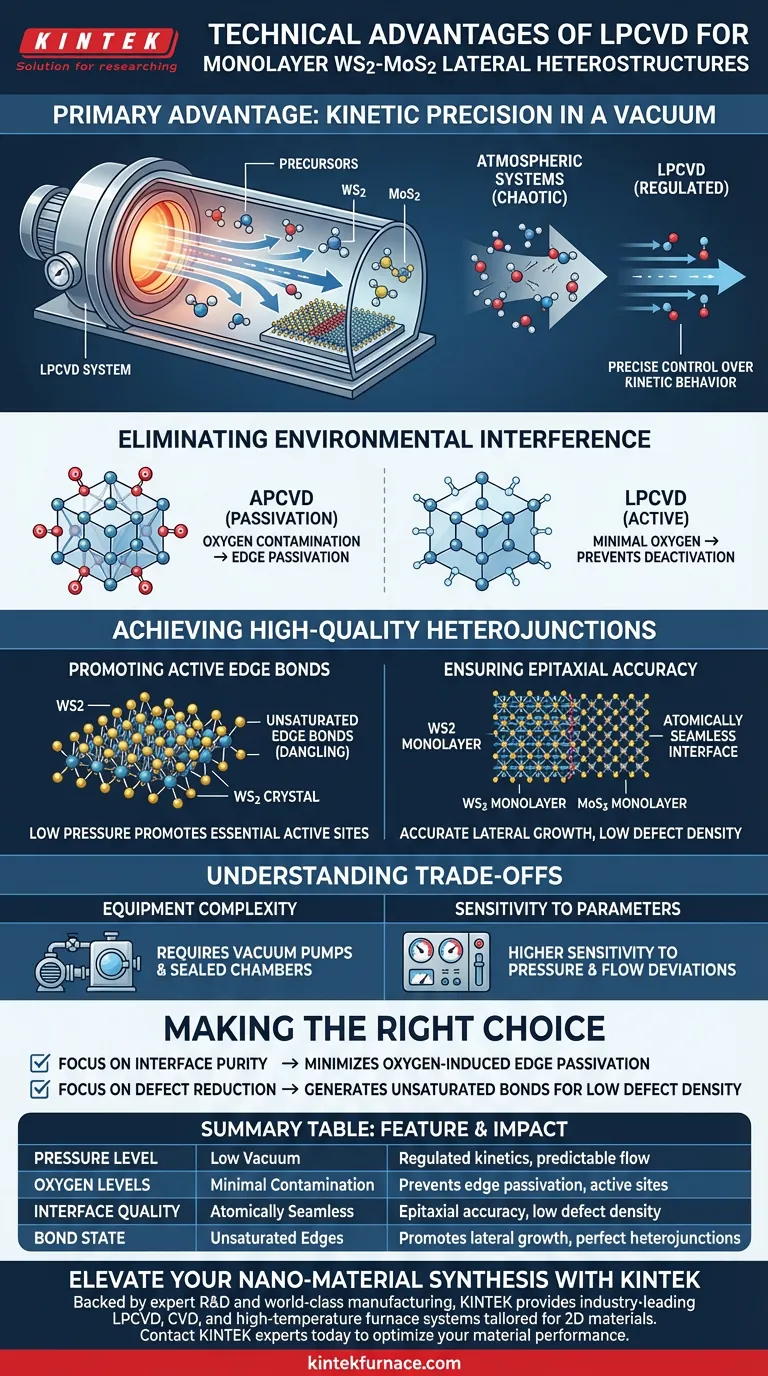
The primary advantage of Low-Pressure Chemical Vapor Deposition (LPCVD) is kinetic precision. By operating in a vacuum environment, this system allows you to strictly regulate precursor behavior, minimizing the interference of environmental oxygen to ensure high-quality crystal growth.
The core value of LPCVD lies in its ability to prevent edge passivation. By maintaining a low-pressure environment, the system preserves unsaturated edge bonds, enabling the growth of atomically seamless interfaces with exceptionally low defect densities.
The Mechanism of Growth Control
Regulating Kinetic Behavior
In an LPCVD system, the reduced pressure alters the mean free path of gas molecules. This environment provides the operator with precise control over the kinetic behavior of the precursor vapors.
Unlike atmospheric systems, where gas interactions can be chaotic, the low-pressure setting ensures that the movement and reaction of precursors are predictable and directed.
Eliminating Environmental Interference
A critical technical advantage is the significant reduction of environmental oxygen within the chamber.
Oxygen is a primary contaminant that leads to edge passivation—a process where the edges of a crystal become chemically inert. By removing oxygen, LPCVD prevents this deactivation from occurring.
Achieving High-Quality Heterojunctions
Promoting Active Edge Bonds
For a lateral heterostructure to form correctly, the edge of the first material (e.g., WS2) must remain chemically active to accept the second material (e.g., MoS2).
The low-pressure conditions in LPCVD promote the generation of unsaturated edge bonds. These "dangling" bonds are the essential active sites required for continued lateral growth.
Ensuring Epitaxial Accuracy
Because the edges remain active and unpassivated, the system facilitates accurate edge epitaxial growth.
This precision results in a heterojunction interface that is atomically seamless. The final structure exhibits a low defect density, which is critical for the electronic and optical performance of the device.
Understanding the Trade-offs
Equipment Complexity
While LPCVD offers superior control, it requires a vacuum environment. This necessitates the use of vacuum pumps and vacuum-sealed chambers, making the hardware more complex than Atmospheric Pressure CVD (APCVD) systems.
Sensitivity to Process Parameters
The "precise control" mentioned as an advantage also implies a higher sensitivity to variables. Because the process relies on specific kinetic behaviors, deviations in pressure or precursor flow rates can disrupt the formation of unsaturated bonds.
Making the Right Choice for Your Goal
When deciding if LPCVD is the correct method for your specific heterostructure application, consider the following:
- If your primary focus is interface purity: LPCVD is the definitive choice because it minimizes oxygen-induced edge passivation, ensuring a seamless junction.
- If your primary focus is defect reduction: The ability to generate unsaturated edge bonds makes this system ideal for achieving low defect densities in lateral growth.
LPCVD transforms the challenge of edge passivation into an opportunity for precise, atomically perfect structural growth.
Summary Table:
| Feature | LPCVD Advantage | Impact on WS2-MoS2 Growth |
|---|---|---|
| Pressure Level | Low Vacuum | Regulated kinetic behavior and predictable precursor flow |
| Oxygen Levels | Minimal Contamination | Prevents edge passivation for active growth sites |
| Interface Quality | Atomically Seamless | Ensures epitaxial accuracy with low defect density |
| Bond State | Unsaturated Edges | Promotes lateral growth for perfect heterojunctions |
Elevate Your Nano-Material Synthesis with KINTEK
Precision at the atomic level requires more than just high temperatures; it demands a controlled environment. Backed by expert R&D and world-class manufacturing, KINTEK provides industry-leading LPCVD, CVD, and high-temperature furnace systems tailored for the growth of 2D materials like WS2 and MoS2.
Whether you need customizable vacuum systems or high-precision lab equipment, our solutions are designed to eliminate defects and ensure seamless epitaxial growth. Contact KINTEK experts today to discuss your unique research needs and discover how our advanced furnace technology can optimize your material performance.
Visual Guide
References
- Pargam Vashishtha, Sumeet Walia. Epitaxial Interface‐Driven Photoresponse Enhancement in Monolayer WS<sub>2</sub>–MoS<sub>2</sub> Lateral Heterostructures. DOI: 10.1002/adfm.202512962
This article is also based on technical information from Kintek Furnace Knowledge Base .
Related Products
- 915MHz MPCVD Diamond Machine Microwave Plasma Chemical Vapor Deposition System Reactor
- RF PECVD System Radio Frequency Plasma Enhanced Chemical Vapor Deposition
- MPCVD Machine System Reactor Bell-jar Resonator for Lab and Diamond Growth
- HFCVD Machine System Equipment for Drawing Die Nano Diamond Coating
- Custom Made Versatile CVD Tube Furnace Chemical Vapor Deposition CVD Equipment Machine
People Also Ask
- What is the MPCVD method and why is it considered effective for diamond deposition? Superior Purity & High Growth Rates
- What factors influence the quality of diamond deposition in the MPCVD method? Master the Critical Parameters for High-Quality Diamond Growth
- What are some key features and benefits of the microwave plasma chemical vapor deposition system? Achieve Unmatched Material Synthesis
- What is the purpose of a microwave plasma chemical vapor deposition system? Grow High-Purity Diamonds and Advanced Materials
- What is the basic principle of operation for the microwave plasma chemical vapor deposition system? Unlock High-Purity Material Growth