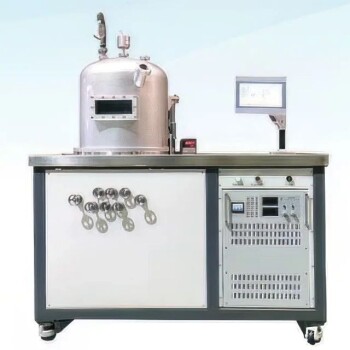
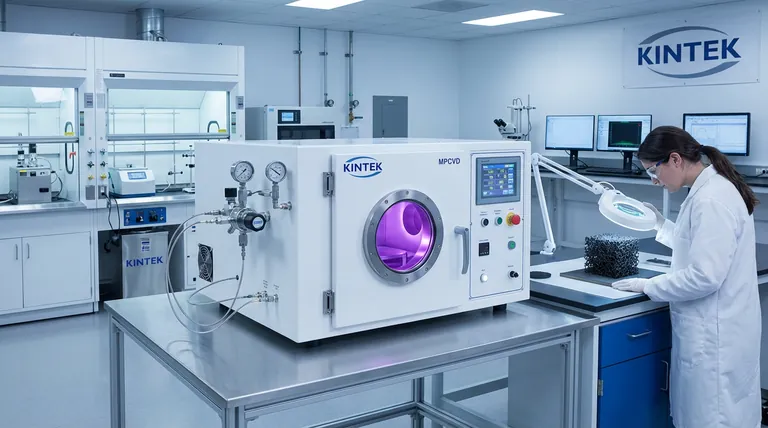
A Chemical Vapor Deposition (CVD) system serves as the primary engineering platform for synthesizing high-quality three-dimensional graphene (3DG). It creates a strictly controlled, high-temperature environment where carbon-rich gases are thermally decomposed and restructured into a continuous, monolithic graphene framework.
Core Takeaway Unlike simple coating methods, the CVD process for 3D graphene facilitates a complex dissolution and precipitation mechanism on a catalyst. This allows for the creation of a seamless, high-purity 3D network with intrinsic physical properties that far exceed those of graphene composites produced via chemical reduction.
The Mechanism of Synthesis
Thermal Decomposition of Precursors
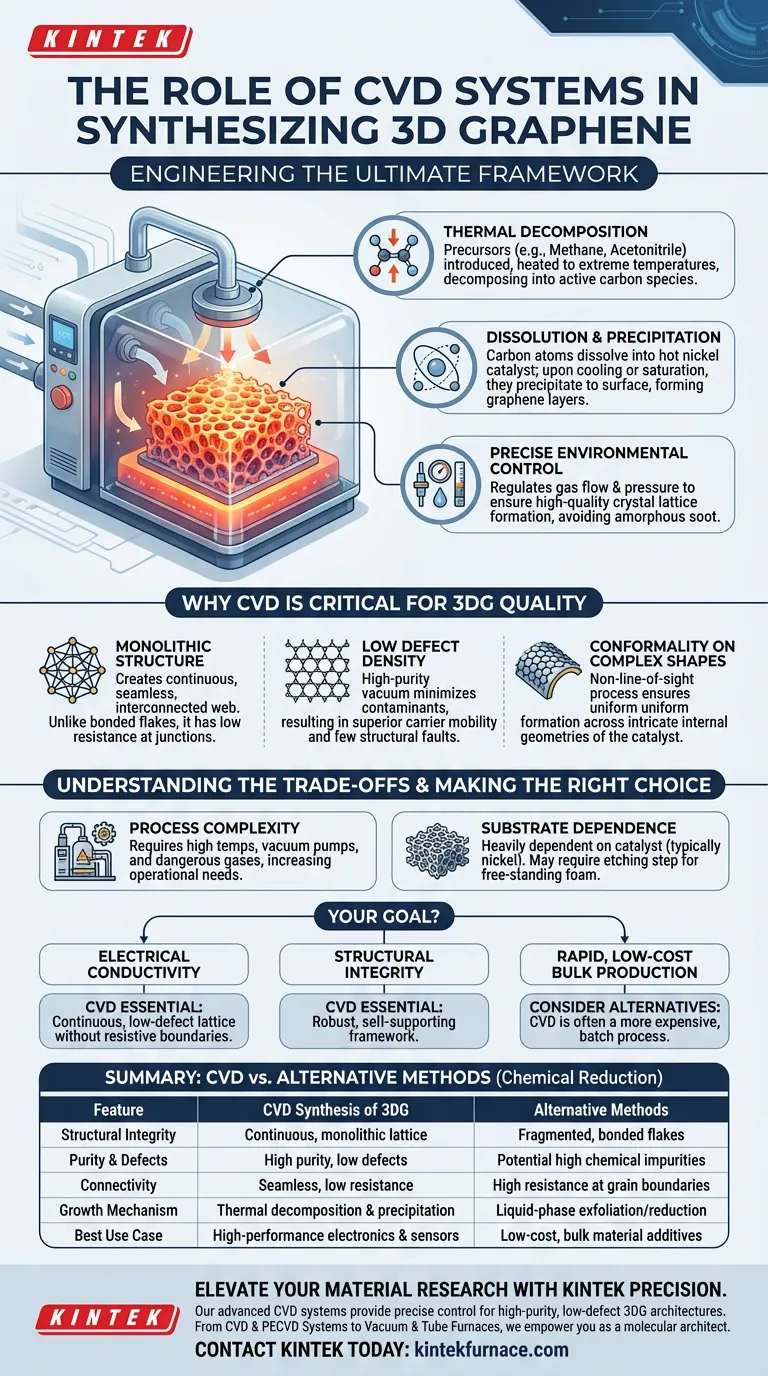
The fundamental role of the CVD system is to break down carbon precursors. Volatile gases, such as methane or acetonitrile, are introduced into the reaction chamber. The system heats these gases to extreme temperatures, causing them to thermally decompose into active carbon species.
Dissolution and Precipitation
Once the carbon is released, the system facilitates its interaction with a catalyst, specifically a nickel substrate (often a nickel foam to provide the 3D structure). The carbon atoms dissolve into the hot nickel and, upon cooling or saturation, precipitate out to the surface. This process is what forms the graphene layers.
Precise Environmental Control
The CVD system regulates gas flow delivery and pressure with high precision. This control is vital to ensure the carbon precipitates at a rate that forms a high-quality crystal lattice rather than amorphous soot.
Why CVD is Critical for 3DG Quality
Creating a Monolithic Structure
The primary advantage of using a CVD system is the ability to create a continuous monolithic structure. Rather than bonding separate flakes of graphene together (which creates resistance at the junctions), CVD grows the graphene as a single, interconnected web.
Achieving Low Defect Density
CVD systems operate in high-purity vacuum environments. This minimizes the introduction of contaminants that disrupt the electrical and mechanical properties of the material. The result is 3DG with low defect density and superior carrier mobility.
Conformality on Complex Shapes
CVD is inherently a non-line-of-sight process. Because the precursors are gaseous, the system can ensure uniform formation across intricate internal geometries. This allows the graphene to perfectly replicate the complex, porous architecture of the 3D nickel catalyst.
Understanding the Trade-offs
Process Complexity
While CVD yields superior quality, it requires significantly more infrastructure than chemical reduction methods. The need for high temperatures, vacuum pumps, and dangerous precursor gases increases the operational complexity and safety requirements.
Substrate Dependence
The CVD process for 3DG is heavily dependent on the catalyst material. You cannot simply grow 3DG on any surface; the substrate (typically nickel) plays an active chemical role in the synthesis. This often requires an additional processing step to etch away the nickel if a free-standing graphene foam is required.
Making the Right Choice for Your Goal
To determine if a CVD-based approach is right for your graphene application, consider your specific performance metrics:
- If your primary focus is electrical conductivity: The CVD system is essential because it produces a continuous, low-defect lattice without the resistive grain boundaries found in chemically reduced graphene.
- If your primary focus is structural integrity: The monolithic nature of CVD-grown 3DG provides a robust, self-supporting framework that powder-based methods cannot match.
- If your primary focus is rapid, low-cost bulk production: You may encounter bottlenecks with CVD, as it is generally a batch process that is more expensive per gram than liquid-phase exfoliation.
The CVD system acts not just as a furnace, but as a molecular architect, transforming gas into a sophisticated, high-performance 3D material.
Summary Table:
| Feature | CVD Synthesis of 3DG | Alternative Methods (Chemical Reduction) |
|---|---|---|
| Structural Integrity | Continuous, monolithic lattice | Fragmented, bonded graphene flakes |
| Purity & Defects | High purity, low defect density | Potential for high chemical impurities |
| Connectivity | Seamless, low resistance at junctions | High resistance at grain boundaries |
| Growth Mechanism | Thermal decomposition & precipitation | Liquid-phase exfoliation or reduction |
| Best Use Case | High-performance electronics & sensors | Low-cost, bulk material additives |
Elevate Your Material Research with KINTEK Precision
Don't compromise on the quality of your three-dimensional graphene. KINTEK’s advanced CVD systems are engineered to provide the precise temperature and gas flow control necessary to synthesize high-purity, low-defect 3DG architectures.
Backed by expert R&D and world-class manufacturing, we offer a comprehensive range of lab solutions including:
- CVD & PECVD Systems for uniform carbon synthesis.
- Vacuum & Tube Furnaces for high-temperature thermal processing.
- Customizable Lab High-Temp Furnaces tailored to your unique catalyst and substrate needs.
Whether you are focusing on electrical conductivity or structural integrity, our systems empower you to become a molecular architect. Contact KINTEK today to discuss your customized furnace solution!
Visual Guide
References
- Kavitha Mulackampilly Joseph, Vesselin Shanov. Modified 3D Graphene for Sensing and Electrochemical Capacitor Applications. DOI: 10.3390/nano14010108
This article is also based on technical information from Kintek Furnace Knowledge Base .
Related Products
- 915MHz MPCVD Diamond Machine Microwave Plasma Chemical Vapor Deposition System Reactor
- Custom Made Versatile CVD Tube Furnace Chemical Vapor Deposition CVD Equipment Machine
- RF PECVD System Radio Frequency Plasma Enhanced Chemical Vapor Deposition
- MPCVD Machine System Reactor Bell-jar Resonator for Lab and Diamond Growth
- HFCVD Machine System Equipment for Drawing Die Nano Diamond Coating
People Also Ask
- What factors influence the quality of diamond deposition in the MPCVD method? Master the Critical Parameters for High-Quality Diamond Growth
- What is the MPCVD method and why is it considered effective for diamond deposition? Superior Purity & High Growth Rates
- What are some key features and benefits of the microwave plasma chemical vapor deposition system? Achieve Unmatched Material Synthesis
- What is the purpose of a microwave plasma chemical vapor deposition system? Grow High-Purity Diamonds and Advanced Materials
- What is the basic principle of operation for the microwave plasma chemical vapor deposition system? Unlock High-Purity Material Growth