
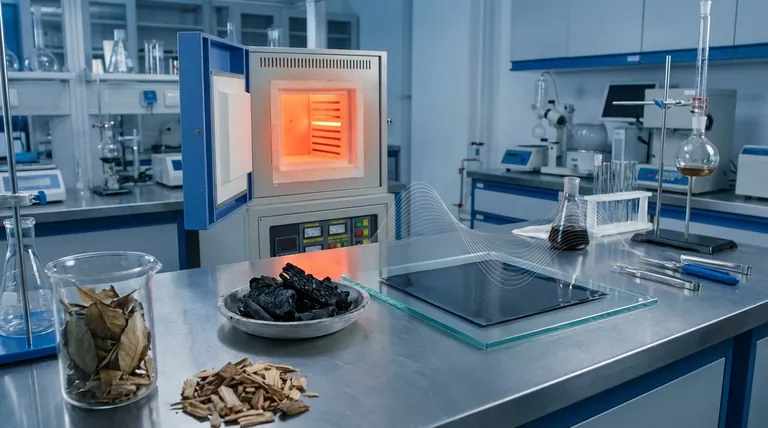
High-temperature furnace processing serves as the fundamental architect for converting organic biomass into effective electromagnetic interference (EMI) shielding materials. By subjecting biomass to extreme heat, the furnace drives carbonization and graphitization, transforming a naturally insulating material into a highly conductive carbon network capable of blocking electromagnetic signals.
Core Takeaway The furnace is not merely a heating element; it is a structural tool that forces carbon atoms to rearrange into an electrically conductive $sp^2$ hybridized structure. Without this specific high-temperature transformation, biomass lacks the conductivity required to absorb or reflect electromagnetic waves effectively.
The Physics of Structural Transformation
Carbonization and Graphitization
The primary function of the high-temperature furnace is to induce deep chemical changes within the biomass.
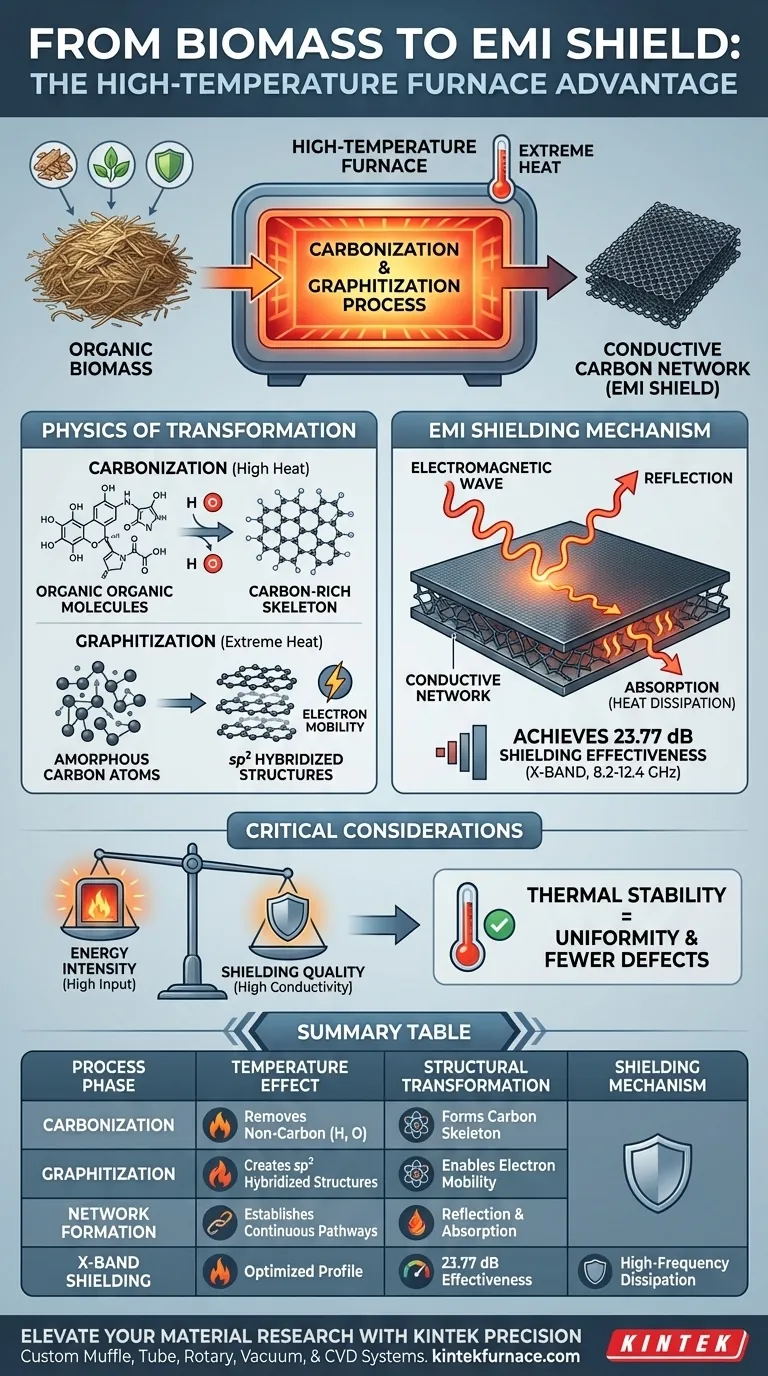
Through carbonization, the heat strips away non-carbon elements like hydrogen and oxygen.
This leaves behind a carbon-rich skeleton, which is the precursor to a functional shielding material.
Formation of $sp^2$ Hybridized Structures
Heat alone is not enough; the specific arrangement of atoms matters.
High temperatures facilitate the formation of an $sp^2$ hybridized carbon structure.
This specific atomic configuration allows electrons to move freely, creating the electrical conductivity necessary for EMI shielding.
Creating a Conductive Network
For a film to act as a shield, it cannot have isolated conductive patches.
The furnace ensures the formation of a continuous conductive network throughout the material.
This continuity is essential for intercepting and dissipating electromagnetic energy.
Performance and Shielding Effectiveness
Dual-Mechanism Defense
The conductive structure created by the furnace utilizes two distinct methods to stop interference.
First, it reflects incoming electromagnetic waves off the surface.
Second, it absorbs energy as it passes through the material, dissipating it as heat.
Quantifiable Results in the X-Band
The impact of this processing is measurable and significant.
Research indicates that biomass films processed in this manner can achieve a shielding effectiveness of 23.77 dB.
This performance is specifically noted in the X-band frequency range (8.2–12.4 GHz), a critical spectrum for telecommunications.
Critical Considerations and Trade-offs
The Necessity of Thermal Stability
While high heat is the catalyst, stability is the control variable.
As noted in broader material processing contexts, high-temperature furnaces provide the stable environment required for precise physicochemical reactions.
Inconsistent temperatures can lead to structural defects, reducing the uniformity and effectiveness of the conductive network.
Energy Intensity vs. Material Performance
There is an inherent trade-off between energy consumption and shielding quality.
Achieving the graphitized state required for high conductivity demands significant energy input.
However, attempting to process at lower temperatures to save energy will result in a material that is insufficiently conductive for EMI applications.
Making the Right Choice for Your Goal
When developing biomass-based EMI shields, the furnace parameters define your final product's capability.
- If your primary focus is Maximum Shielding Effectiveness: Prioritize higher temperatures to maximize graphitization and the density of the $sp^2$ carbon network.
- If your primary focus is Material Consistency: Ensure your furnace maintains a rigorously stable environment to prevent defects in the conductive network.
The furnace is the decisive factor that elevates biomass from agricultural waste to a functional electronic component.
Summary Table:
| Process Phase | Temperature Effect | Structural Transformation | Shielding Mechanism |
|---|---|---|---|
| Carbonization | High Heat | Removes non-carbon elements (H, O) | Forms carbon-rich skeleton |
| Graphitization | Extreme Heat | Creates $sp^2$ hybridized structures | Enables electron mobility |
| Network Formation | Controlled Cooling | Establishes continuous pathways | Reflection & Absorption |
| X-Band Shielding | Optimized Profile | Achievement of 23.77 dB effectiveness | High-frequency dissipation |
Elevate Your Material Research with KINTEK Precision
Transforming raw biomass into high-performance EMI shielding requires more than just heat; it requires absolute thermal precision. At KINTEK, we understand that the density of your $sp^2$ carbon network depends on the stability of your processing environment.
Backed by expert R&D and manufacturing, KINTEK offers a comprehensive range of Muffle, Tube, Rotary, Vacuum, and CVD systems. Whether you are scaling up carbonization or refining graphitization, our lab high-temp furnaces are fully customizable to meet your unique research needs.
Ready to achieve superior conductivity and 23.77 dB+ shielding effectiveness? Contact us today to find your custom furnace solution!
Visual Guide
References
- Junchao Ren, Qingfa Zhang. All‐Biomass Nanocomposite Films via Facile and Sustainable Design Procedure for Thermal Management and Electromagnetic Interference Shielding. DOI: 10.1002/advs.202510372
This article is also based on technical information from Kintek Furnace Knowledge Base .
Related Products
- 2200 ℃ Graphite Vacuum Heat Treat Furnace
- 1800℃ High Temperature Muffle Oven Furnace for Laboratory
- 1200℃ Muffle Oven Furnace for Laboratory
- 1700℃ High Temperature Muffle Oven Furnace for Laboratory
- 1700℃ High Temperature Laboratory Tube Furnace with Alumina Tube
People Also Ask
- Why are vacuum heat treating furnaces essential for aerospace? Ensure Superior Material Integrity for High-Stakes Applications
- What is the primary application of vacuum heat treating furnaces in aerospace? Enhance Component Performance with Precision
- What is the process of vacuum heat treating? Achieve Superior Metallurgical Properties
- How does vacuum heat treating work in terms of temperature and time control? Master Precise Material Transformations
- How does a vacuum heat treating furnace improve the condition of metal alloys? Achieve Superior Metal Performance



















