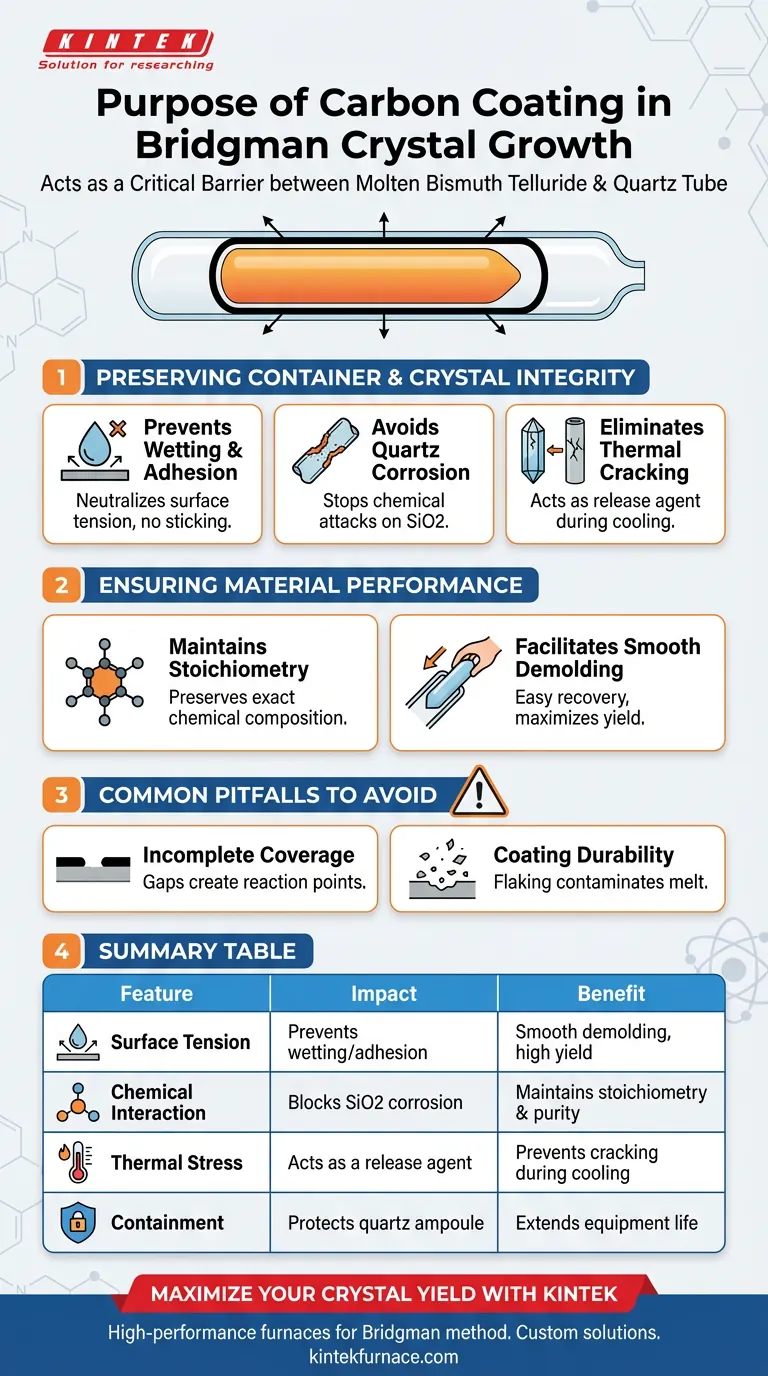
The primary purpose of applying a carbon coating to the inner wall of quartz tubes is to act as a critical barrier between the molten bismuth telluride alloy and the silica (SiO2) container. This coating prevents the molten material from wetting or chemically reacting with the tube, which safeguards the vessel against corrosion and ensures the crystal can be removed intact.
By isolating the melt from the quartz wall, carbon coating prevents chemical adhesion and container failure. This simple step preserves the precise stoichiometric ratio of the material and allows for smooth demolding without damaging the crystal or the ampoule.
Preserving Container and Crystal Integrity
The Bridgman method relies on precise thermal control and containment. Without a protective interface, the interaction between bismuth telluride and quartz compromises the entire growth process.
Preventing Wetting and Adhesion
Molten bismuth telluride has a natural tendency to wet (adhere to) silica glass surfaces.
A carbon layer effectively neutralizes this surface tension interaction. By preventing the melt from sticking to the wall, the material behaves as a contained liquid rather than a bonded coating.
Avoiding Quartz Corrosion
Direct contact between the alloy and the tube can lead to chemical attacks on the silica.
This reaction causes corrosion of the quartz tube, weakening its structural integrity. A carbon barrier creates an inert shield that stops this chemical degradation at the source.
Eliminating Thermal Cracking
When an alloy bonds to the quartz wall, the cooling phase becomes dangerous.
As the crystal and the tube contract at different rates, the adhesion creates immense stress. This leads to cracking in the quartz tube or, worse, the crystal itself. Carbon coating acts as a release agent, preventing this stress accumulation.
Ensuring Material Performance
The quality of a thermoelectric material is defined by its chemical composition. The carbon coating plays a vital role in maintaining this chemistry.
Maintaining Stoichiometry
Bismuth telluride requires a precise stoichiometric ratio to function effectively as a thermoelectric material.
If the melt reacts with the quartz, the chemical composition shifts. Elements may be lost to the reaction or impurities from the silica may enter the melt. The carbon coating ensures the melt remains chemically isolated, preserving the exact formulation required.
Facilitating Smooth Demolding
Recovery of the crystal is the final, critical step.
Because the carbon prevents wetting, the solidified crystal does not bond to the ampoule. This allows for smooth demolding, maximizing the yield and reducing the risk of mechanically damaging the crystal during extraction.
Common Pitfalls to Avoid
While carbon coating is standard practice, understanding the risks of failure is essential for consistent results.
Incomplete Coverage
The protective benefits rely entirely on a continuous, unbroken layer.
Any gap or scratch in the carbon coating creates a nucleation point for reaction. The molten alloy will attack the exposed silica, leading to localized sticking and potential tube failure even if 99% of the tube is coated.
Coating Durability
The coating must withstand the duration of the growth cycle without flaking.
If the carbon layer detaches into the melt, it can introduce particulate inclusions. While carbon is chemically inert relative to the reaction with quartz, physical inclusions can disrupt the single-crystal structure.
Making the Right Choice for Your Growth Process
The application of carbon is not just a safety measure; it is a quality control necessity.
- If your primary focus is Crystal Yield: Prioritize the uniformity of the coating to ensure the ingot creates no mechanical bonds with the wall, allowing for effortless extraction.
- If your primary focus is Material Purity: View the coating as a chemical seal that locks the stoichiometry in place and prevents silica contamination.
A consistent, high-quality carbon coating is the single most effective variable for ensuring both the survival of your equipment and the thermoelectric efficiency of your final product.
Summary Table:
| Feature | Impact of Carbon Coating | Benefit to Crystal Growth |
|---|---|---|
| Surface Tension | Prevents wetting/adhesion | Smooth demolding and high crystal yield |
| Chemical Interaction | Blocks silica (SiO2) corrosion | Maintains precise stoichiometry and purity |
| Thermal Stress | Acts as a release agent | Prevents cracking during cooling phase |
| Containment | Protects quartz ampoule | Extends equipment life and prevents failure |
Maximize Your Crystal Yield with KINTEK
Don't let container failure or material contamination compromise your research. Backed by expert R&D and manufacturing, KINTEK offers high-performance Muffle, Tube, Rotary, Vacuum, and CVD systems—all fully customizable to meet the rigorous demands of the Bridgman method and beyond.
Our lab high-temperature furnaces provide the precision and reliability needed to maintain the integrity of your bismuth telluride-based crystals. Contact us today to find your custom solution!
Visual Guide
References
- Hung‐Wei Chen, Hsin‐Jay Wu. Dilute Sb Doping Yields Softer <i>p</i>‐Type Bi<sub>2</sub>Te<sub>3</sub> Thermoelectrics. DOI: 10.1002/aelm.202300793
This article is also based on technical information from Kintek Furnace Knowledge Base .
Related Products
- Laboratory Quartz Tube Furnace RTP Heating Tubular Furnace
- Vertical Laboratory Quartz Tube Furnace Tubular Furnace
- Multi Zone Laboratory Quartz Tube Furnace Tubular Furnace
- 1200℃ Split Tube Furnace Laboratory Quartz Tube Furnace with Quartz Tube
- High Pressure Laboratory Vacuum Tube Furnace
People Also Ask
- What physical conditions does a laboratory Tube Furnace provide for SOEC? Precision Heat for Solid Oxide Characterization
- What are the main features and functions of a laboratory tube furnace? Unlock Precise High-Temp Control for Your Lab
- What conditions do tube furnaces provide for Au-Seeded TiO2 nanowires? Master Precision Thermal Synthesis
- What parameters must be controlled when calcining freeze-dried oxide precursors in a laboratory tube furnace? A Guide
- What role does a laboratory tube furnace play in geological and mineralogical research? Unlock Earth's Secrets with Precision