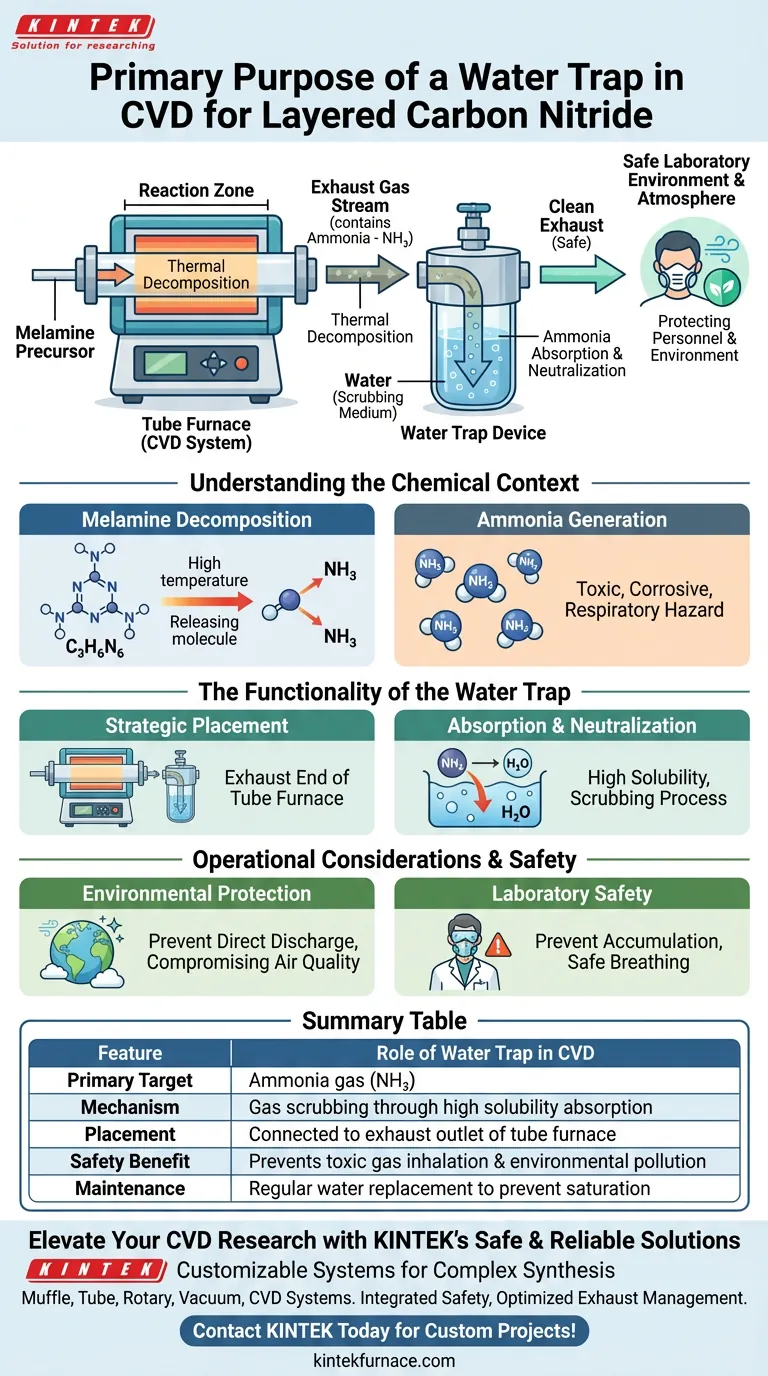
The primary purpose of a water trap device in the chemical vapor deposition (CVD) of layered carbon nitride is to serve as a safety filtration system that captures hazardous exhaust gases. Specifically, it is connected to the tube furnace's outlet to absorb and neutralize ammonia byproducts generated during the thermal decomposition of precursors like melamine, preventing their release into the laboratory or atmosphere.
During the high-temperature synthesis of carbon nitride, toxic waste gases are an unavoidable byproduct. The water trap acts as a critical environmental shield, scrubbing these gases from the exhaust stream to ensure operator safety and preventing atmospheric pollution.
Understanding the Chemical Context
To understand the necessity of the water trap, one must first look at the chemical reactions occurring inside the furnace. The device is not merely an accessory; it addresses a specific chemical by-product of the synthesis process.
Thermal Decomposition of Melamine
The CVD process for creating layered carbon nitride often relies on specific precursors, such as melamine. When subjected to the high temperatures required for deposition, these precursors undergo thermal decomposition.
The Generation of Ammonia
As the melamine breaks down to form the desired carbon nitride structure, it releases volatile waste gases. The most significant byproduct in this reaction is ammonia. This gas is toxic, corrosive, and poses a respiratory hazard if left unmanaged.
The Functionality of the Water Trap
The water trap provides a simple yet effective physical and chemical barrier between the reaction chamber and the open environment.
Strategic Placement
The device is connected directly to the exhaust end of the tube furnace. This ensures that all gas leaving the reaction zone must pass through the trap before exiting the system.
Absorption and Neutralization
Ammonia is highly soluble in water. As the exhaust gases bubble through the water trap, the water absorbs the ammonia, effectively neutralizing the waste stream. This "scrubbing" process removes the harmful components from the gas flow.
Operational Considerations and Safety
While the concept is simple, the role of the water trap is vital for compliance and health standards in a research setting.
Environmental Protection
The primary goal is to prevent the direct discharge of harmful gases. Releasing untreated ammonia into the atmosphere violates environmental safety protocols and compromises air quality.
Laboratory Safety
By containing the exhaust, the trap protects laboratory personnel. It prevents the accumulation of noxious fumes within the workspace, maintaining a safe breathing environment for researchers handling the equipment.
Ensuring Process Integrity
Identifying Saturation Limits
While water is an effective solvent for ammonia, it has a finite capacity. Over time, the water in the trap will become saturated with ammonia, reducing its absorption efficiency.
Monitoring Precursor Loads
The amount of waste gas produced is directly proportional to the amount of melamine precursor used. Larger synthesis batches will require more vigilant monitoring of the trap to ensure it does not become overwhelmed.
Implementing Effective Exhaust Management
When setting up your CVD system for layered carbon nitride, consider your specific operational priorities:
- If your primary focus is Laboratory Safety: Ensure the connection between the furnace exhaust and the water trap is completely airtight to prevent gas leakage before filtration occurs.
- If your primary focus is Environmental Compliance: Regularly refresh the water in the trap to maintain maximum absorption capacity for the specific volume of ammonia your process generates.
The water trap is the defining boundary between a controlled chemical reaction and an environmental hazard.
Summary Table:
| Feature | Role of Water Trap in CVD |
|---|---|
| Primary Target | Ammonia gas (NH3) produced from melamine decomposition |
| Mechanism | Gas scrubbing through high solubility absorption |
| Placement | Connected to the exhaust outlet of the tube furnace |
| Safety Benefit | Prevents toxic gas inhalation and environmental pollution |
| Maintenance | Regular water replacement to prevent saturation |
Elevate Your CVD Research with KINTEK's Safe & Reliable Solutions
Don't let toxic byproducts compromise your laboratory safety or environmental compliance. Backed by expert R&D and manufacturing, KINTEK offers a comprehensive range of Muffle, Tube, Rotary, Vacuum, and CVD systems, all precision-engineered to handle complex layered carbon nitride synthesis. Our systems are fully customizable to your unique research needs, ensuring integrated safety features like optimized exhaust management.
Ready to upgrade your high-temperature furnace setup?
Contact KINTEK today to discuss your custom project!
Visual Guide
References
- Kota Higuchi, Yoshio Hashimoto. Layered carbon nitride films deposited under an oxygen-containing atmosphere and their electronic properties. DOI: 10.1063/5.0193419
This article is also based on technical information from Kintek Furnace Knowledge Base .
Related Products
- Custom Made Versatile CVD Tube Furnace Chemical Vapor Deposition CVD Equipment Machine
- Cylindrical Resonator MPCVD Machine System for Lab Diamond Growth
- HFCVD Machine System Equipment for Drawing Die Nano Diamond Coating
- Multi Heating Zones CVD Tube Furnace Machine for Chemical Vapor Deposition Equipment
- Slide PECVD Tube Furnace with Liquid Gasifier PECVD Machine
People Also Ask
- What is a CVD tube furnace and what is its primary function? Discover Precision Thin-Film Deposition
- Why are CVD tube furnace sintering systems indispensable for 2D material research and production? Unlock Atomic-Scale Precision
- How does CVD tube furnace sintering enhance graphene growth? Achieve Superior Crystallinity and High Electron Mobility
- Which industries and research fields benefit from CVD tube furnace sintering systems for 2D materials? Unlock Next-Gen Tech Innovations
- What are the key features of CVD tube furnaces for 2D material processing? Unlock Precision Synthesis for Superior Materials