Knowledge What is the function of a radio frequency (RF) plasma sputtering system? Precision PtNP Underlayer Fabrication
Author avatar

Tech Team · Kintek Furnace

Updated 2 days ago

What is the function of a radio frequency (RF) plasma sputtering system? Precision PtNP Underlayer Fabrication


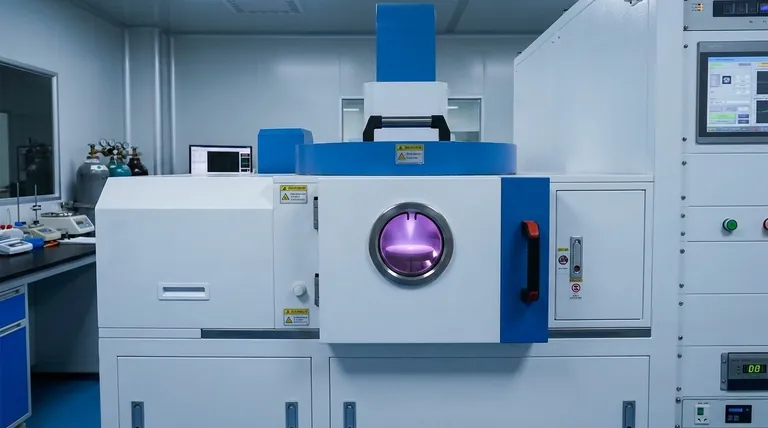
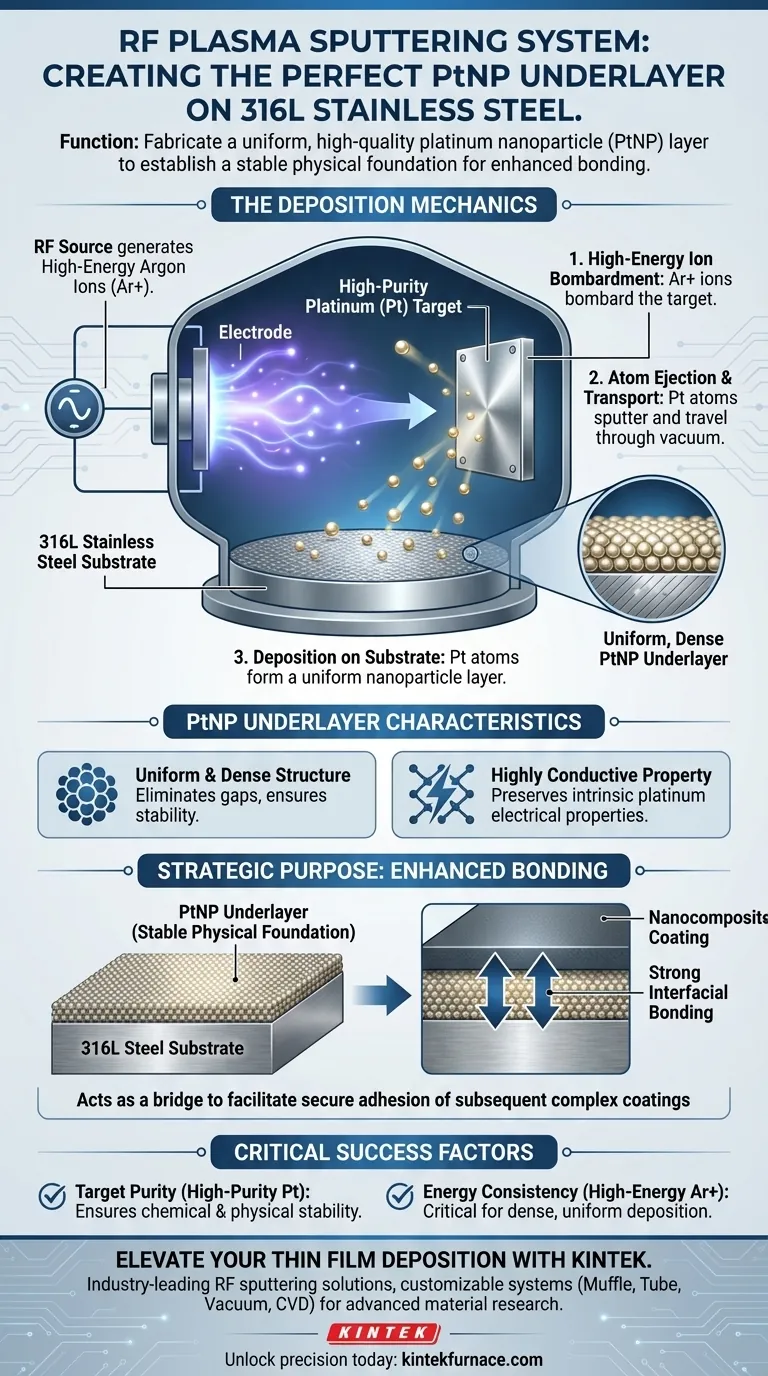
The primary function of a radio frequency (RF) plasma sputtering system in this context is to fabricate a specific, high-quality intermediate layer on 316L stainless steel. By utilizing high-energy argon ions to bombard a high-purity platinum target, the system ejects platinum atoms that deposit onto the steel, creating a uniform platinum nanoparticle (PtNP) underlayer.

Core Takeaway The RF sputtering system acts as an interface engineer. Its purpose is not just to coat the steel, but to establish a stable physical foundation that significantly enhances interfacial bonding, ensuring that subsequent nanocomposite coatings adhere securely to the substrate.
What is the function of a radio frequency (RF) plasma sputtering system? Precision PtNP Underlayer Fabrication

The Mechanics of Deposition

High-Energy Ion Bombardment

The process begins with the generation of high-energy argon ions within the system.

These ions are directed to bombard a target made of high-purity platinum.

Atom Ejection and Settlement

Upon impact, the energy transfer causes platinum atoms to sputter (eject) from the target.

These atoms travel through the vacuum chamber and deposit directly onto the surface of the 316L stainless steel substrate.

Characteristics of the PtNP Underlayer

Structural Uniformity

The RF sputtering process is tuned to ensure the deposited platinum atoms form a uniform and dense layer.

This uniformity is critical, as it eliminates gaps or weak points on the steel surface that could compromise future coating layers.

Functional Conductivity

Beyond structure, the deposition creates a highly conductive nanoparticle layer.

This electrical property is intrinsic to the platinum material and is preserved through the sputtering process.

The Strategic Purpose: Solving the Adhesion Problem

Creating a Physical Foundation

The ultimate goal of this system is to modify the surface properties of the raw stainless steel.

The resulting PtNP underlayer provides a stable physical foundation that the original steel surface lacks on its own.

Enhancing Interfacial Bonding

This foundation serves a specific downstream purpose: facilitating the application of nanocomposite coatings.

By acting as a bridge, the underlayer significantly enhances the interfacial bonding between the steel substrate and these subsequent complex coatings.

Critical Success Factors

Dependency on Target Purity

The quality of the underlayer is directly tied to the input materials.

The system relies on a high-purity platinum target to ensure the deposited layer maintains the necessary chemical and physical stability.

The Role of Energy Consistency

The density of the coating depends on the consistent application of high-energy argon ions.

Insufficient ion energy would fail to sputter the platinum effectively, leading to a sparse or uneven underlayer that cannot support subsequent coatings.

Making the Right Choice for Your Goal

The RF plasma sputtering system is a precise tool designed to bridge the gap between a raw substrate and a functional coating.

  • If your primary focus is Durability: Ensure the system settings prioritize a dense and uniform deposition to create the most stable physical foundation possible.
  • If your primary focus is Adhesion: Recognize that the PtNP layer is the key to enhanced interfacial bonding, making it strictly necessary before applying nanocomposite coatings.

The RF sputtering system transforms 316L stainless steel from a simple metal substrate into a primed, conductive surface ready for advanced composite applications.

Summary Table:

Process Component Role in PtNP Fabrication
Energy Source High-energy argon ions bombard the platinum target
Target Material High-purity platinum for chemical and physical stability
Deposition Result Uniform, dense platinum nanoparticle (PtNP) underlayer
Primary Function Enhances interfacial bonding for nanocomposite coatings
Substrate 316L Stainless Steel substrate surface modification

Elevate Your Thin Film Deposition with KINTEK

Are you looking to achieve superior interfacial bonding and high-purity nanoparticle underlayers? KINTEK provides industry-leading RF sputtering solutions tailored for advanced material research. Backed by expert R&D and manufacturing, we offer customizable Muffle, Tube, Rotary, Vacuum, and CVD systems, along with specialized lab high-temp furnaces to meet your unique thin-film requirements.

Unlock precision in your lab today—Contact our technical experts for a custom quote!

Visual Guide
What is the function of a radio frequency (RF) plasma sputtering system? Precision PtNP Underlayer Fabrication Visual Guide

References

  1. Noor Waleed Ibrahim, Layla M. Hasan. Corrosion protection of stainless steel by Nanocomposite coating prepared by Pulsed laser ablation in liquid. DOI: 10.21203/rs.3.rs-7263886/v1

This article is also based on technical information from Kintek Furnace Knowledge Base .

Related Products

People Also Ask

Related Products

RF PECVD System Radio Frequency Plasma Enhanced Chemical Vapor Deposition

RF PECVD System Radio Frequency Plasma Enhanced Chemical Vapor Deposition

KINTEK RF PECVD System: Precision thin-film deposition for semiconductors, optics & MEMS. Automated, low-temperature process with superior film quality. Custom solutions available.

Slide PECVD Tube Furnace with Liquid Gasifier PECVD Machine

Slide PECVD Tube Furnace with Liquid Gasifier PECVD Machine

KINTEK Slide PECVD Tube Furnace: Precision thin film deposition with RF plasma, rapid thermal cycling, and customizable gas control. Ideal for semiconductors and solar cells.

Inclined Rotary Plasma Enhanced Chemical Deposition PECVD Tube Furnace Machine

Inclined Rotary Plasma Enhanced Chemical Deposition PECVD Tube Furnace Machine

KINTEK's PECVD coating machine delivers precision thin films at low temperatures for LEDs, solar cells & MEMS. Customizable, high-performance solutions.

Inclined Rotary Plasma Enhanced Chemical Deposition PECVD Tube Furnace Machine

Inclined Rotary Plasma Enhanced Chemical Deposition PECVD Tube Furnace Machine

Advanced PECVD Tube Furnace for precise thin film deposition. Uniform heating, RF plasma source, customizable gas control. Ideal for semiconductor research.

Cylindrical Resonator MPCVD Machine System for Lab Diamond Growth

Cylindrical Resonator MPCVD Machine System for Lab Diamond Growth

KINTEK MPCVD Systems: Grow high-quality diamond films with precision. Reliable, energy-efficient, and beginner-friendly. Expert support available.

MPCVD Machine System Reactor Bell-jar Resonator for Lab and Diamond Growth

MPCVD Machine System Reactor Bell-jar Resonator for Lab and Diamond Growth

KINTEK MPCVD Systems: Precision diamond growth machines for high-purity lab-grown diamonds. Reliable, efficient, and customizable for research and industry.

915MHz MPCVD Diamond Machine Microwave Plasma Chemical Vapor Deposition System Reactor

915MHz MPCVD Diamond Machine Microwave Plasma Chemical Vapor Deposition System Reactor

KINTEK MPCVD Diamond Machine: High-quality diamond synthesis with advanced MPCVD technology. Faster growth, superior purity, customizable options. Boost production now!

Custom Made Versatile CVD Tube Furnace Chemical Vapor Deposition CVD Equipment Machine

Custom Made Versatile CVD Tube Furnace Chemical Vapor Deposition CVD Equipment Machine

KINTEK's CVD Tube Furnace offers precision temperature control up to 1600°C, ideal for thin film deposition. Customizable for research and industrial needs.

Spark Plasma Sintering SPS Furnace

Spark Plasma Sintering SPS Furnace

Discover KINTEK's advanced Spark Plasma Sintering (SPS) Furnace for rapid, precise material processing. Customizable solutions for research and production.

Multi Heating Zones CVD Tube Furnace Machine for Chemical Vapor Deposition Equipment

Multi Heating Zones CVD Tube Furnace Machine for Chemical Vapor Deposition Equipment

KINTEK's Multi-Zone CVD Tube Furnaces offer precision temperature control for advanced thin film deposition. Ideal for research and production, customizable for your lab needs.

Split Chamber CVD Tube Furnace with Vacuum Station CVD Machine

Split Chamber CVD Tube Furnace with Vacuum Station CVD Machine

Split Chamber CVD Tube Furnace with Vacuum Station - High precision 1200°C lab furnace for advanced materials research. Customizable solutions available.

Ultra High Vacuum CF Flange Stainless Steel Sapphire Glass Observation Sight Window

Ultra High Vacuum CF Flange Stainless Steel Sapphire Glass Observation Sight Window

CF sapphire viewing window for ultra-high vacuum systems. Durable, clear, and precise for semiconductor and aerospace applications. Explore specs now!

Vertical Laboratory Quartz Tube Furnace Tubular Furnace

Vertical Laboratory Quartz Tube Furnace Tubular Furnace

Precision KINTEK Vertical Tube Furnace: 1800℃ heating, PID control, customizable for labs. Ideal for CVD, crystal growth & materials testing.

High Temperature Muffle Oven Furnace for Laboratory Debinding and Pre Sintering

High Temperature Muffle Oven Furnace for Laboratory Debinding and Pre Sintering

KT-MD Debinding & Pre-Sintering Furnace for ceramics - precise temperature control, energy-efficient design, customizable sizes. Boost your lab efficiency today!

1400℃ High Temperature Laboratory Tube Furnace with Quartz and Alumina Tube

1400℃ High Temperature Laboratory Tube Furnace with Quartz and Alumina Tube

KINTEK's Tube Furnace with Alumina Tube: Precision high-temperature processing up to 2000°C for labs. Ideal for material synthesis, CVD, and sintering. Customizable options available.

Mesh Belt Controlled Atmosphere Furnace Inert Nitrogen Atmosphere Furnace

Mesh Belt Controlled Atmosphere Furnace Inert Nitrogen Atmosphere Furnace

KINTEK Mesh Belt Furnace: High-performance controlled atmosphere furnace for sintering, hardening & heat treatment. Customizable, energy-efficient, precise temperature control. Get a quote now!

1700℃ High Temperature Laboratory Tube Furnace with Quartz or Alumina Tube

1700℃ High Temperature Laboratory Tube Furnace with Quartz or Alumina Tube

KINTEK's Tube Furnace with Alumina Tube: Precision heating up to 1700°C for material synthesis, CVD, and sintering. Compact, customizable, and vacuum-ready. Explore now!

1200℃ Controlled Inert Nitrogen Atmosphere Furnace

1200℃ Controlled Inert Nitrogen Atmosphere Furnace

KINTEK 1200℃ Controlled Atmosphere Furnace: Precision heating with gas control for labs. Ideal for sintering, annealing, and material research. Customizable sizes available.

1400℃ Controlled Inert Nitrogen Atmosphere Furnace

1400℃ Controlled Inert Nitrogen Atmosphere Furnace

KT-14A Controlled Atmosphere Furnace for labs & industry. 1400°C max temp, vacuum sealing, inert gas control. Customizable solutions available.

1700℃ Controlled Inert Nitrogen Atmosphere Furnace

1700℃ Controlled Inert Nitrogen Atmosphere Furnace

KT-17A Controlled Atmosphere Furnace: Precise 1700°C heating with vacuum & gas control. Ideal for sintering, research & material processing. Explore now!


Leave Your Message