
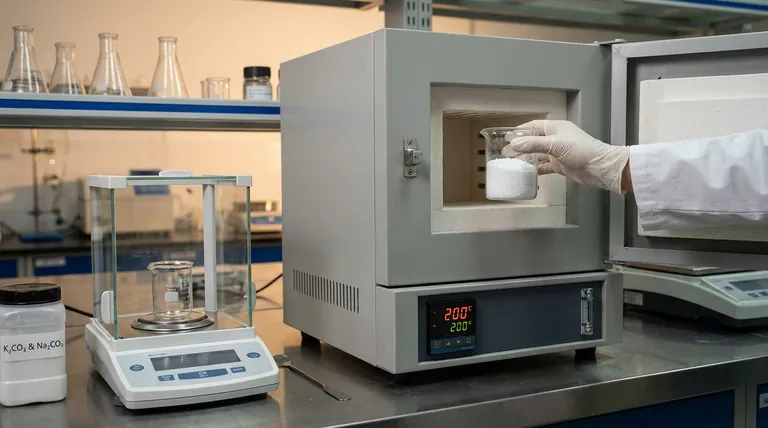
The primary function of a precision laboratory oven in the pretreatment of KNN-based ceramic raw materials is to neutralize the effects of hygroscopicity. Materials such as potassium carbonate and sodium carbonate naturally absorb moisture from the air, which alters their weight. The oven provides a controlled thermal environment to completely remove this adsorbed water prior to the critical weighing stage.
By maintaining a constant temperature of 200°C, the oven ensures that the raw materials are weighed based on their actual chemical mass rather than water weight. This step is the foundation for achieving the strict stoichiometric ratios required for high-performance piezoelectric ceramics.
The Challenge of Hygroscopic Raw Materials
The Nature of KNN Ingredients
In the production of Potassium Sodium Niobate (KNN) ceramics, key raw materials like potassium carbonate and sodium carbonate are highly hygroscopic.
This means they actively attract and hold water molecules from the surrounding environment.
The Weighing Discrepancy
If these materials are weighed without pretreatment, the measurement includes the weight of the adsorbed bound water.
This results in adding less actual reactive material than the formula requires, throwing off the chemical balance of the final ceramic.
The Role of Precision Heating
Removing Bound Water
The laboratory oven creates a stable environment, typically set to 200°C, to drive off moisture.
This temperature is sufficient to thoroughly remove adsorbed water without decomposing the carbonate raw materials themselves.
Ensuring Stoichiometric Precision
The ultimate goal of this drying process is to guarantee a strict stoichiometric ratio.
In solid-state reactions, the ratio of atoms must be exact. Even a slight deviation caused by moisture weight can degrade the piezoelectric properties of the final product.
Understanding the Critical Process Controls
Temperature Uniformity
While the target is 200°C, the precision of the oven is vital.
Fluctuations in temperature could result in incomplete drying or, conversely, uneven heating that affects the material's physical state.
Process Timing
The duration of heating must be sufficient to ensure the material reaches a steady, dry state.
Cutting this process short risks leaving residual moisture, reintroducing the weighing errors the process is meant to eliminate.
Making the Right Choice for Your Goal
If your primary focus is Formulation Accuracy: Ensure your oven is calibrated to maintain 200°C precisely, as this eliminates the moisture variable that distorts your chemical recipe.
If your primary focus is Material Performance: Prioritize this pretreatment step to guarantee the correct solid-state reaction, which is the prerequisite for high piezoelectric activity.
Precise environmental control during the raw material stage is the invisible variable that determines the success or failure of advanced ceramic engineering.
Summary Table:
| Process Step | Requirement | Purpose |
|---|---|---|
| Target Temperature | 200°C | Removes adsorbed water without decomposing carbonates |
| Material Focus | K₂CO₃ & Na₂CO₃ | Neutralizes high hygroscopicity of lead-free precursors |
| Control Priority | Thermal Uniformity | Prevents weighing discrepancies and ensures chemical balance |
| Final Outcome | Stoichiometric Precision | Foundation for high-performance piezoelectric activity |
Elevate Your Ceramic Engineering with KINTEK
Precision is the foundation of high-performance KNN ceramics. At KINTEK, we understand that even a minor weighing discrepancy can compromise your research. Backed by expert R&D and manufacturing, we offer a comprehensive range of Muffle, Tube, Rotary, Vacuum, and CVD systems, alongside our precision laboratory ovens, all customizable to your unique pretreatment needs.
Don't let moisture compromise your stoichiometry. Ensure absolute consistency in your solid-state reactions with our industry-leading thermal solutions. Contact us today to find the perfect precision oven for your lab!
References
- Michaela Roudnická, Dalibor Vojtěch. Hydrogen Embrittlement of Ti-Al6-V4 Alloy Manufactured by Laser Powder Bed Fusion Induced by Electrochemical Charging. DOI: 10.3390/met14020251
This article is also based on technical information from Kintek Furnace Knowledge Base .
Related Products
- 1400℃ Muffle Oven Furnace for Laboratory
- 1200℃ Muffle Oven Furnace for Laboratory
- Laboratory Muffle Oven Furnace with Bottom Lifting
- 1800℃ High Temperature Muffle Oven Furnace for Laboratory
- 1700℃ High Temperature Muffle Oven Furnace for Laboratory
People Also Ask
- What is the primary function of a high-temperature laboratory muffle furnace in chemical synthesis? Achieve Precision.
- How does a high-temperature laboratory muffle furnace affect material properties? Transform Anodic Oxide Films Fast
- How does a laboratory high-temperature muffle furnace facilitate the homogenization of borosilicate glass samples? Expert Insights
- How is a laboratory high-temperature muffle furnace utilized to achieve the specific crystalline structure of LaFeO3 catalysts?
- What are the primary objectives of using a muffle furnace in zirconia synthesis? Achieve precision phase control.













