
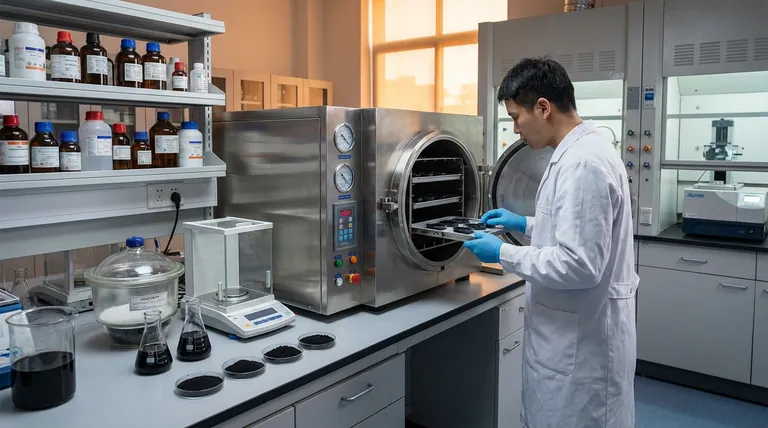
The laboratory vacuum drying oven functions as a precision tool for controlling nanoparticle dispersion. It is used to pre-treat porous carbon particles impregnated with metal salt solutions by creating a low-pressure environment. This facilitates the rapid removal of solvents, ensuring that metal ions are deposited uniformly on internal pore surfaces rather than migrating to the exterior and clumping together.
The core value of this process is the prevention of metal aggregation. By removing solvents rapidly under vacuum, you "freeze" the metal ions in place deep within the pores, creating a uniform distribution that is impossible to achieve with slow, atmospheric drying.
Mechanisms of Particle Control
Preventing Solvent Migration
In standard atmospheric drying, as the solvent evaporates from the surface of the carbon particle, capillary forces draw more liquid—and the dissolved metal ions—from the center to the exterior.
This phenomenon, often called the "coffee-ring effect," leads to a concentration of metal on the outer shell of the carbon particle.
The vacuum drying oven disrupts this process. By lowering the pressure, it forces the solvent to evaporate rapidly from all areas simultaneously, locking the metal ions onto the internal pore surfaces where they are needed.
Ensuring Uniform Deposition
The ultimate goal of loading porous carbon is to utilize the vast internal surface area of the material.
Vacuum drying ensures that the metal precursors coat the internal walls of the pores.
This preparation is critical for the subsequent reduction steps, resulting in the formation of fine, highly dispersed metal nanocatalysts rather than large, inactive clusters.
Preservation of Material Integrity
Lowering Thermal Stress
Vacuum drying allows for effective moisture and solvent removal at significantly lower temperatures (typically 60°C to 80°C) compared to standard ovens.
Because water and organic solvents boil at lower temperatures under reduced pressure, the carbon material is not exposed to excessive heat.
This prevents the thermal degradation or collapse of the porous carbon structure, keeping the pore channels open for catalytic activity.
Protecting Surface Functional Groups
Porous carbon materials often possess specific surface functional groups that are vital for electrochemical performance.
Extended heating in an air-filled environment can oxidize or destroy these active groups.
By operating in a vacuum, the oven excludes oxygen and minimizes thermal exposure, preserving the chemical activity of the support material.
Understanding the Trade-offs
Process Sensitivity
While vacuum drying prevents the aggregation associated with slow drying, the parameters must be tuned carefully.
If the pressure reduction is too aggressive, it could potentially disrupt delicate physical coatings before they set.
Batch Limitations
Unlike continuous conveyor ovens used in industrial drying, laboratory vacuum ovens are typically batch-process units.
This limits throughput, making them ideal for high-precision, high-value catalyst synthesis, but less suitable for mass production without scaling up to specialized industrial vacuum systems.
Making the Right Choice for Your Goal
When setting up your catalyst preparation workflow, consider how the drying step influences your final material properties.
- If your primary focus is Maximizing Catalytic Surface Area: Prioritize vacuum drying to prevent the agglomeration of particles that would otherwise block pore channels and reduce active sites.
- If your primary focus is Preserving Chemical Activity: Use vacuum drying to lower the processing temperature, ensuring that surface functional groups on the carbon are not deactivated by heat or oxidation.
Summary: The vacuum drying oven is not merely a drying device; it is a structural control tool that ensures metal nanoparticles remain dispersed, small, and chemically active within the carbon support.
Summary Table:
| Feature | Impact on Nanoparticle Loading |
|---|---|
| Mechanism | Disrupts capillary forces to prevent the "coffee-ring effect" |
| Particle Control | Ensures metal precursors coat internal pore walls uniformly |
| Thermal Stress | Low boiling points (60°C-80°C) prevent pore structure collapse |
| Chemical Integrity | Oxygen-free environment preserves surface functional groups |
| Primary Goal | Maximizes catalytic surface area by preventing metal clumping |
Elevate Your Catalyst Synthesis with KINTEK Precision
Achieving perfect nanoparticle dispersion requires more than just heat—it requires the precise atmospheric control found in KINTEK laboratory systems. Backed by expert R&D and manufacturing, KINTEK offers specialized Muffle, Tube, Rotary, Vacuum, and CVD systems tailored for advanced material science. Whether you are loading catalysts or synthesizing complex carbon structures, our customizable high-temp furnaces provide the thermal stability and vacuum integrity your research demands.
Ready to optimize your lab's efficiency? Contact us today to find your custom furnace solution.
References
- Betül Ari, Nurettin Şahiner. Optimized Porous Carbon Particles from Sucrose and Their Polyethyleneimine Modifications for Enhanced CO2 Capture. DOI: 10.3390/jcs8090338
This article is also based on technical information from Kintek Furnace Knowledge Base .
Related Products
- 1200℃ Muffle Oven Furnace for Laboratory
- High Temperature Muffle Oven Furnace for Laboratory Debinding and Pre Sintering
- 1700℃ High Temperature Muffle Oven Furnace for Laboratory
- Laboratory Vacuum Tilt Rotary Tube Furnace Rotating Tube Furnace
- High Pressure Laboratory Vacuum Tube Furnace
People Also Ask
- What is the primary function of a high-temperature laboratory muffle furnace in chemical synthesis? Achieve Precision.
- How does a high-temperature laboratory muffle furnace affect material properties? Transform Anodic Oxide Films Fast
- How is a laboratory muffle furnace used in 3D-printed PP-CF cross-linking? Achieve Thermal Stability at 150 °C
- What is the critical role of a laboratory high-temperature muffle furnace in TiO2/LDH? Unlock Superior Crystallization
- What is the role of a laboratory high-temperature muffle furnace in iron analysis? Key to Precise Sample Mineralization











