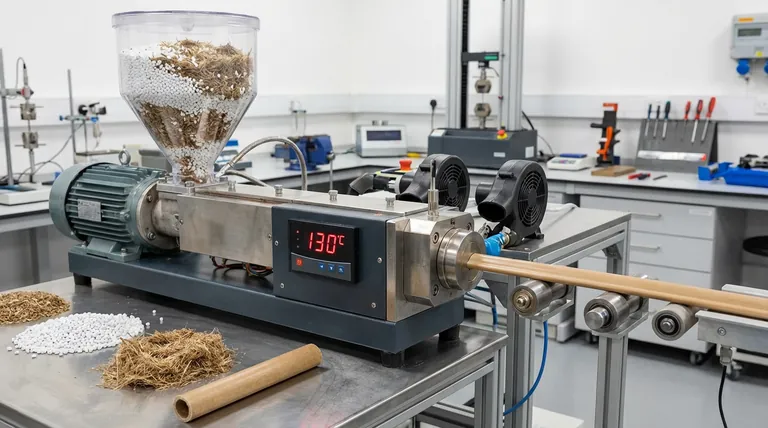
The specific temperature of 130°C acts as a thermal "sweet spot" between matrix flow and filler preservation. It ensures the Polyvinyl Chloride (PVC) becomes fluid enough for consistent extrusion while preventing the biological filler—specifically protein-based materials like keratin—from burning or denaturing.
Setting the extrusion temperature to approximately 130°C balances the opposing thermal needs of the composite materials. It achieves the necessary plasticization of PVC for molding without triggering the thermal degradation of organic reinforcement fillers, which would otherwise compromise the structural integrity of the final product.
The Balancing Act of Biocomposite Processing
Processing PVC biocomposites requires navigating a narrow thermal window. You must satisfy the flow requirements of the polymer matrix while respecting the biological limits of the additive.
Achieving PVC Plasticization
PVC is a thermoplastic that is rigid at room temperature. To process it effectively, it must be heated until it reaches a plasticized state.
At 130°C, the PVC polymer chains gain enough mobility to slide past one another. This allows the material to flow smoothly through the extruder and fill the mold continuously without clogging.
Preserving Biological Stability
Biological fillers, such as bovine horn particles, contain organic components like keratin. Unlike synthetic fillers (e.g., glass fiber), these materials are highly sensitive to heat.
If the temperature rises significantly above 130°C, these proteins begin to denature. This chemical change alters the fundamental structure of the filler, often rendering it useless as a reinforcement agent.
Ensuring Mechanical Reinforcement
The primary reason for adding biological fillers is to improve the mechanical properties of the composite. The filler acts as a structural reinforcement within the PVC matrix.
By maintaining the process at 130°C, you ensure the keratin components remain intact. This allows the filler to effectively transfer stress and reinforce the composite, rather than becoming a weak point due to thermal damage.
Understanding the Trade-offs
Deviating from this specific temperature set-point introduces significant risks to both the process and the product quality.
The Risk of Overheating
Pushing the temperature beyond 130°C to improve flowability is a common mistake. This leads to the "scorching" or thermal degradation of the biological filler.
Degraded filler loses its strength, causes discoloration in the final product, and can release volatile gases that create voids in the material.
The Risk of Underheating
Conversely, operating well below 130°C prevents the PVC from fully plasticizing. The material will remain too viscous.
This results in high torque on the extruder motor, poor mixing homogeneity, and a brittle final product because the PVC matrix has not properly fused around the filler particles.
Optimizing Your Extrusion Parameters
To achieve consistent results, you must prioritize the thermal sensitivity of your biological ingredients.
- If your primary focus is mechanical integrity: strictly cap your temperature at 130°C to prevent keratin denaturation, as the structural integrity of the filler dictates the strength of the composite.
- If your primary focus is process consistency: Monitor the melt pressure closely; if the pressure spikes, ensure you are maintaining at least 130°C to guarantee sufficient PVC flowability.
Precision in thermal management is the single most important factor in producing high-quality, durable PVC biocomposites.
Summary Table:
| Factor | At < 130°C (Underheated) | At 130°C (Optimal) | At > 130°C (Overheated) |
|---|---|---|---|
| PVC State | High viscosity, poor fusion | Fully plasticized, smooth flow | Risk of polymer degradation |
| Bio-Filler | Intact but poorly bonded | Structurally preserved | Denatured, scorched, brittle |
| Extruder Impact | High torque, potential clog | Consistent melt pressure | Low pressure, volatile gas release |
| Result | Brittle, non-homogeneous | High-strength biocomposite | Discolored, weak structure |
Optimize Your Biocomposite Research with KINTEK Precision
Success in advanced material processing depends on the exact thermal management described above. KINTEK provides the high-performance lab equipment necessary to hit those critical "sweet spots" consistently. Backed by expert R&D and manufacturing, we offer a comprehensive range of Muffle, Tube, Rotary, Vacuum, and CVD systems, along with other lab high-temp furnaces—all fully customizable to your unique PVC and biocomposite processing needs.
Don't let thermal instability compromise your structural integrity. Contact KINTEK today to discuss how our specialized heating solutions can bring professional-grade precision to your laboratory or production line.
References
- Hamza Ennadafy, Naoual Belouaggadia. Thermogravimetric Analysis of Rigid PVC and Animal-Origin Bio-Composite: Experimental Study and Comparative Analysis. DOI: 10.18280/ijht.420105
This article is also based on technical information from Kintek Furnace Knowledge Base .
Related Products
- Vacuum Hot Press Furnace Machine Heated Vacuum Press
- Multi Heating Zones CVD Tube Furnace Machine for Chemical Vapor Deposition Equipment
- Slide PECVD Tube Furnace with Liquid Gasifier PECVD Machine
- Vacuum Dental Porcelain Sintering Furnace for Dental Laboratories
- Vacuum Hot Press Furnace Machine Heated Vacuum Press Tube Furnace
People Also Ask
- What are the primary components of a vacuum hot press furnace? Master the Core Systems for Precise Material Processing
- What are the benefits of the vacuum environment system in a vacuum hot press furnace? Unlock High-Density Sintering
- What safety features are incorporated in vacuum hot press furnaces? Ensure Operator and Equipment Protection
- What types of heating elements are used in vacuum hot press furnaces? Optimize for High-Temp Performance
- What are the core advantages of using a vacuum hot press furnace? Achieve Near-Forged Density for Ti-6Al-4V Alloys