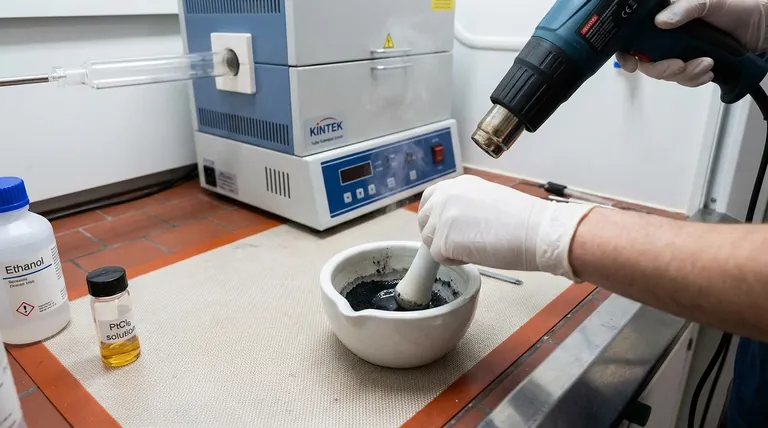
The combination of mortar grinding and heat gun processing serves as a critical regulation step to ensure the uniform distribution of platinum precursors on Fe-N-C supports. This manual technique synchronizes physical mixing with thermal evaporation control, specifically preventing local accumulation of chloroplatinic acid to yield ultra-fine, dispersed catalyst particles.
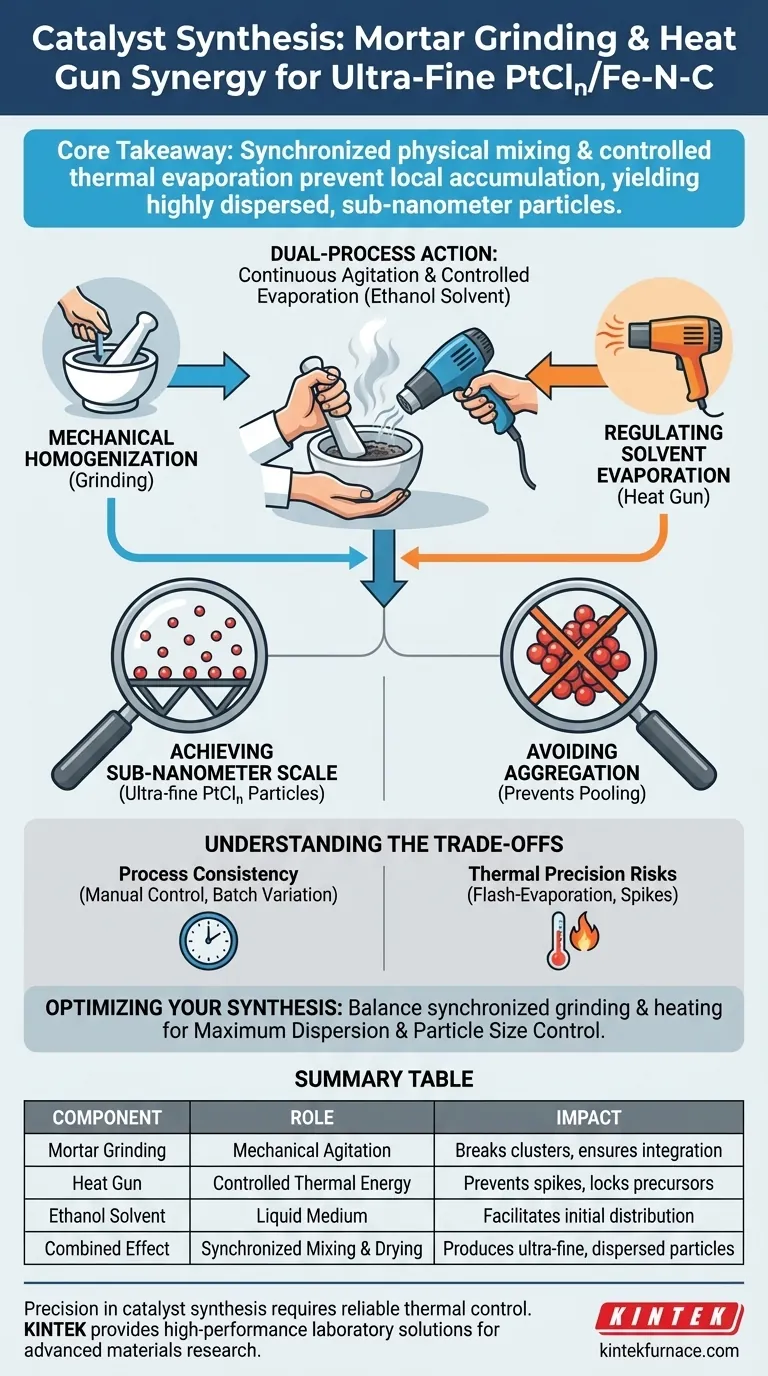
Core Takeaway By controlling the evaporation rate of ethanol while simultaneously agitating the mixture, this method prevents the formation of local concentration spikes. This precise regulation is the defining factor in achieving highly dispersed, sub-nanometer PtCln particles and avoiding precursor aggregation.
Mechanisms of Dispersion Control
Regulating Solvent Evaporation
The primary role of the heat gun in this synthesis is to provide controlled thermal energy to the ethanol solvent.
Without active thermal management, solvents may evaporate unevenly or too slowly, allowing time for precursors to migrate and pool.
The heat gun ensures the ethanol evaporates at a steady, manageable rate, locking the precursor in place as the liquid volume decreases.
Preventing Concentration Spikes
As solvents evaporate, dissolved solids naturally tend to precipitate out of the solution.
If this process is uncontrolled, it creates local concentration spikes, where the chloroplatinic acid gathers in dense clusters.
Continuous grinding combined with heat mitigates this risk by keeping the mixture dynamic until the solvent is removed, forcing a uniform spread rather than localized dumping.
Mechanical Homogenization
The mortar grinding provides the physical agitation necessary to expose the Fe-N-C support surfaces to the precursor solution continuously.
This ensures that the chloroplatinic acid does not just sit on top of the support but is physically integrated into the texture of the material.
The mechanical action breaks up potential clusters before they can solidify during the drying phase.
Impact on Catalyst Morphology
Achieving Sub-nanometer Scale
The ultimate goal of this dual-processing technique is to define the size of the final platinum species.
By preventing the precursor from pooling, the synthesis achieves ultra-fine PtCln particles.
These particles are maintained at the sub-nanometer scale, which is often critical for maximizing the active surface area of the catalyst.
Avoiding Aggregation
Aggregation is the enemy of catalyst efficiency, as it hides valuable platinum atoms inside the bulk of a particle.
This method specifically targets the liquid-phase stage to stop precursor aggregation before it starts.
The result is a highly dispersed material where the platinum is utilized efficiently across the support surface.
Understanding the Trade-offs
Process Consistency
Because this method relies on manual grinding, it introduces a variable of human control.
Unlike automated stirring, the uniformity of the grind depends on the operator's technique, which can lead to batch-to-batch variations if not strictly standardized.
Thermal Precision Risks
While the heat gun controls evaporation, incorrect distance or temperature settings can backfire.
If the heat is applied too aggressively, the solvent may flash-evaporate, potentially causing the very concentration spikes the process aims to prevent.
Success requires a balance where the evaporation is faster than natural drying but slow enough to allow thorough grinding.
Optimizing Your Synthesis Strategy
To maximize the effectiveness of your catalyst preparation, consider the following regarding your specific goals:
- If your primary focus is Maximum Dispersion: Prioritize the synchronization of grinding and heating to ensure no "wet spots" remain where precursors can aggregate.
- If your primary focus is Particle Size Control: Monitor the ethanol evaporation rate closely to prevent rapid drying, which locks in sub-nanometer dimensions.
The quality of your final catalyst depends entirely on how effectively you prevent the precursor from clustering during the critical transition from liquid to solid phase.
Summary Table:
| Process Component | Functional Role | Impact on Catalyst Morphology |
|---|---|---|
| Mortar Grinding | Mechanical homogenization & physical agitation | Breaks up clusters; ensures integration into support texture |
| Heat Gun | Controlled thermal energy & solvent evaporation | Prevents local concentration spikes; locks precursors in place |
| Ethanol Solvent | Liquid-phase medium | Facilitates initial distribution before controlled removal |
| Combined Effect | Synchronized mixing and drying | Produces ultra-fine, sub-nanometer, highly dispersed particles |
Precision in catalyst synthesis requires reliable thermal control. KINTEK provides high-performance laboratory solutions—including Muffle, Tube, and Vacuum furnaces—engineered to meet the rigorous demands of advanced materials research. Backed by expert R&D and manufacturing, our systems are fully customizable for your unique Fe-N-C or PtCln synthesis needs. Contact us today to optimize your laboratory workflow!
Visual Guide
References
- Hiroshi Yano. Sustainable activation of the PtCl <sub> <i>n</i> </sub> /Fe–N–C cathode for PEFCs through repeated subnanometer sizing and coarsening. DOI: 10.1039/d5lf00185d
This article is also based on technical information from Kintek Furnace Knowledge Base .
Related Products
- High Temperature Muffle Oven Furnace for Laboratory Debinding and Pre Sintering
- Electric Rotary Kiln Continuous Working Small Rotary Furnace Kiln for Pyrolysis Plant Heating
- Electric Rotary Kiln Pyrolysis Furnace Plant Machine Small Rotary Kiln Calciner
- Spark Plasma Sintering SPS Furnace
- Electric Rotary Kiln Small Rotary Furnace Biomass Pyrolysis Plant Rotating Furnace
People Also Ask
- What thermal phenomena occur during polymer binder burnout in ceramic green bodies? Lab Furnace Guide
- Why is controlled heat treatment in a muffle furnace necessary for calcined clay? Achieve Optimal Pozzolanic Activity
- What role does a high-temperature muffle furnace play in STFO synthesis? Achieve Pure Perovskite Results
- How does a high-temperature muffle furnace facilitate the formation of LaNbxAl1−xO3+δ perovskite structures? Key Roles
- What role does a high-temperature muffle furnace play in the multi-stage synthesis of Li0.5MnFe1.5O4? Key to Pure Spinel