
Vacuum heating pretreatment is the absolute prerequisite for generating valid data on zeolite materials. By subjecting the sample to high heat (e.g., 200 °C) under a vacuum, you actively strip away adsorbed water molecules and residual gases that naturally occupy the micropores. Without this specific "cleaning" step, these contaminants remain lodged in the structure, blocking the pores and rendering subsequent surface area and volume measurements fundamentally inaccurate.
The Core Reality Accurate characterization relies entirely on measuring the "empty space" within a material. A vacuum heating system ensures the zeolite’s intrinsic pore structure is accessible by removing environmental contaminants that otherwise distort Brunauer-Emmett-Teller (BET) and micropore volume data.
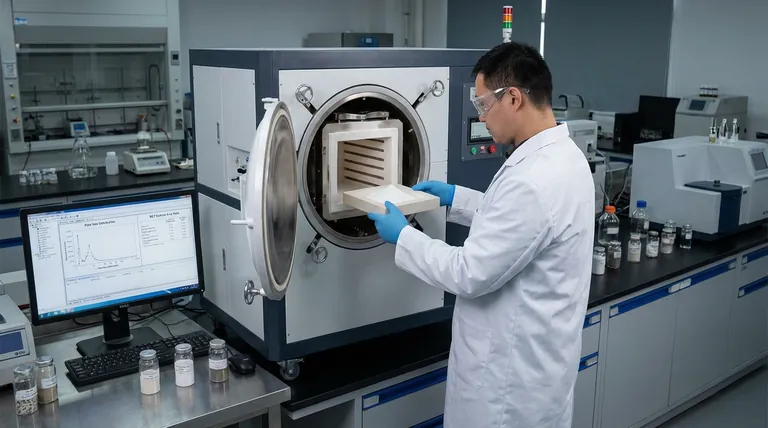
The Mechanics of Degassing
Removing Adsorbed Contaminants
Zeolites are highly hydrophilic, meaning they naturally attract and hold moisture and gases from the atmosphere.
Before any analysis can occur, this "occupied" space must be cleared. Vacuum heating applies thermal energy to break the physical bonds holding these water molecules and gases inside the crystal lattice.
The Role of Vacuum Pressure
Heat alone is often insufficient to fully clear the deepest micropores.
The vacuum environment lowers the boiling point of trapped liquids and creates a pressure gradient. This facilitates the mass transfer of gas out of the intricate pore channels more efficiently than heat applied at atmospheric pressure.
The Impact on Data Integrity
Ensuring Accurate BET Surface Area
The Brunauer-Emmett-Teller (BET) method calculates surface area by measuring how probe gas molecules (like argon or nitrogen) coat the material.
If the surface is already covered by residual water, the probe gas cannot land there. This leads to falsely low surface area calculations that do not reflect the true nature of the material.
Validating Micropore Volume
Micropores are the defining feature of zeolites, but they are easily obstructed.
Even trace amounts of residual gas can block the entrance to these tiny cavities. High-heat vacuum degassing is the only method rigorous enough to ensure the measured adsorption capacity reflects the intrinsic pore characteristics rather than the level of contamination.
Understanding the Trade-offs
Balancing Purity with Stability
While high heat is necessary for cleaning, excessive temperature can damage the zeolite structure.
Vacuum systems allow for effective drying at lower temperatures compared to atmospheric drying. This protects the material from pore collapse or structural degradation that might occur if you attempted to achieve the same dryness using heat alone.
Preparation vs. Characterization Temperatures
It is critical to distinguish between synthesis drying and analytical degassing.
During the initial preparation (washing) phase, lower temperatures (around 100°C) in a vacuum are used to ensure physicochemical stability. However, for final characterization, the higher temperatures (e.g., 200°C) cited in standard protocols are usually required to achieve the deep level of cleanliness needed for atomic-level measurement.
Optimizing Your Characterization Strategy
To ensure your data is both reproducible and accurate, align your pretreatment protocol with your specific analytical goals.
- If your primary focus is obtaining accurate BET data: Prioritize a high-temperature degassing step (e.g., 200 °C) under vacuum to fully evacuate water from micropores prior to gas adsorption.
- If your primary focus is preserving structural integrity during synthesis: Utilize vacuum drying at lower temperatures (typically 100 °C) to remove bulk moisture without risking the collapse of the pore structure.
By effectively clearing the "noise" of contamination through vacuum heating, you allow the true signal of the zeolite's structure to be measured.
Summary Table:
| Pretreatment Factor | Impact on Zeolite Analysis | Benefit of Vacuum Heating |
|---|---|---|
| Adsorbed Moisture | Blocks micropores; distorts BET results | Strips water molecules to expose true surface area |
| Residual Gases | Causes falsely low surface area readings | Creates pressure gradient to evacuate deep channels |
| Structural Heat | High air heat risks pore collapse | Allows effective degassing at safer, lower temperatures |
| Data Validity | Inaccurate 'occupied' space measurement | Ensures measurements reflect intrinsic pore volume |
Unlock the Precision of Your Material Analysis
Don’t let residual contaminants compromise your research data. KINTEK’s advanced laboratory thermal solutions are engineered to provide the rigorous vacuum environments and precise temperature control required for elite material characterization.
Backed by expert R&D and manufacturing, KINTEK offers Muffle, Tube, Rotary, Vacuum, and CVD systems—all fully customizable to meet the unique degassing and pretreatment needs of your laboratory. Whether you are characterizing zeolites or developing novel catalysts, we bring the expertise to help you achieve valid, reproducible results every time.
Contact KINTEK Experts Today to Optimize Your Lab Workflow
References
- Aryandson da Silva, Sibele B. C. Pergher. Synthesis and Cation Exchange of LTA Zeolites Synthesized from Different Silicon Sources Applied in CO2 Adsorption. DOI: 10.3390/coatings14060680
This article is also based on technical information from Kintek Furnace Knowledge Base .
Related Products
- 2200 ℃ Graphite Vacuum Heat Treat Furnace
- Vacuum Heat Treat Sintering and Brazing Furnace
- Vacuum Heat Treat Sintering Furnace with Pressure for Vacuum Sintering
- Molybdenum Vacuum Heat Treat Furnace
- Vacuum Heat Treat Furnace with Ceramic Fiber Liner
People Also Ask
- Why are vacuum heat treating furnaces essential for aerospace? Ensure Superior Material Integrity for High-Stakes Applications
- What is the primary application of vacuum heat treating furnaces in aerospace? Enhance Component Performance with Precision
- How does a vacuum heat treating furnace improve the condition of metal alloys? Achieve Superior Metal Performance
- How does vacuum heat treating work in terms of temperature and time control? Master Precise Material Transformations
- What is the process of vacuum heat treating? Achieve Superior Metallurgical Properties










