
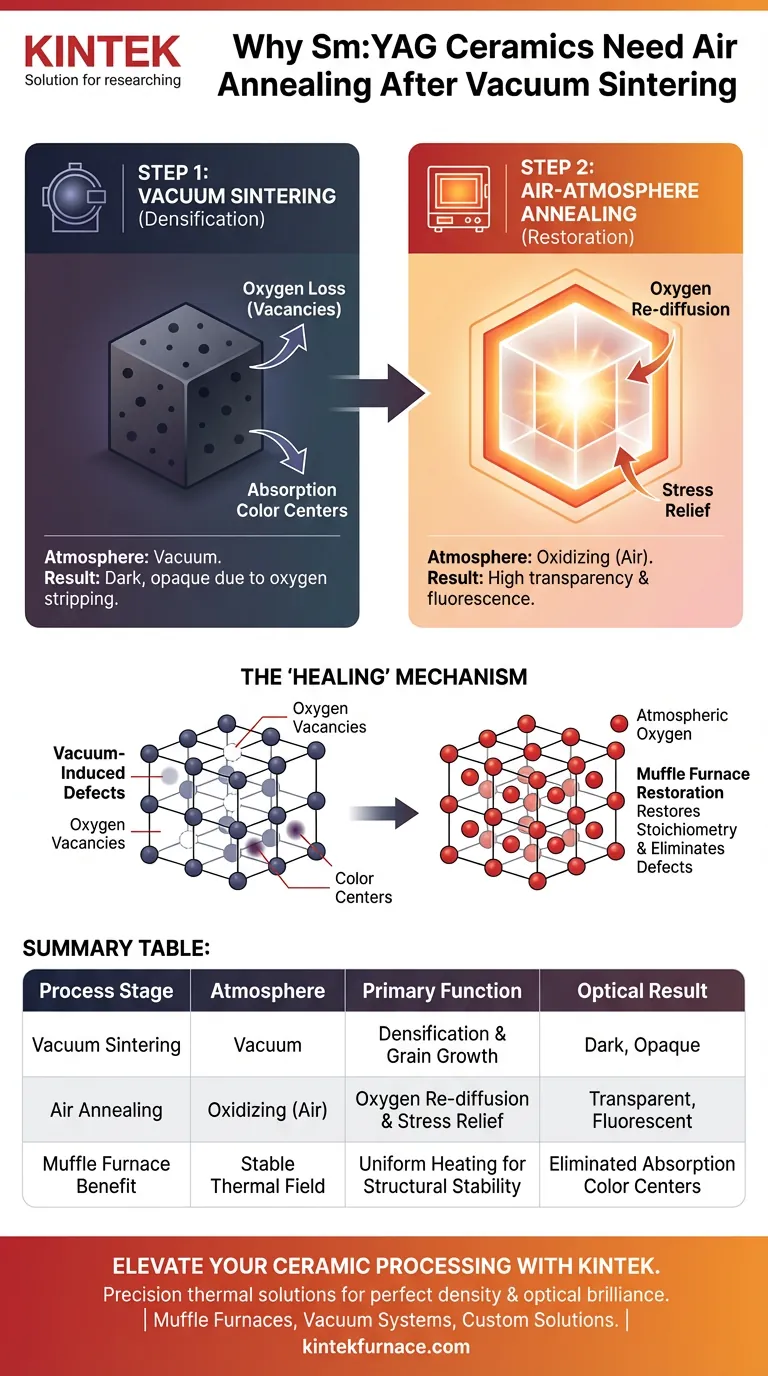
The annealing of Sm:YAG ceramics in an air-atmosphere muffle furnace is required to repair the chemical and optical damage caused by vacuum sintering. While vacuum sintering is necessary for densification, it strips oxygen from the material, creating oxygen vacancies and absorption color centers. Annealing in an air atmosphere provides the necessary oxidizing environment to reverse this process, re-diffusing oxygen into the lattice and restoring transparency.
Core Takeaway Vacuum sintering disrupts the stoichiometric ratio of Sm:YAG ceramics, resulting in dark, opaque materials due to oxygen loss. Air annealing acts as a corrective "healing" phase, eliminating these vacancies and releasing internal stresses to ensure the ceramic achieves high light transmission and optimal fluorescence.
Understanding the Vacuum-Induced Defects
The Formation of Oxygen Vacancies
When Sm:YAG ceramics are processed in a vacuum environment, the lack of atmospheric oxygen causes oxygen ions to escape the crystal lattice. This results in significant oxygen vacancies, effectively altering the chemical balance (stoichiometry) of the material.
Appearance of Absorption Color Centers
These oxygen vacancies lead to the formation of absorption color centers within the ceramic structure. Instead of passing light through, these centers absorb it, which compromises the optical performance of the material.
The Restoration Process in the Muffle Furnace
Restoring Stoichiometry via Oxidation
The muffle furnace provides a high-temperature, stable oxidizing environment. This atmosphere forces oxygen ions to diffuse back into the ceramic, filling the vacancies created during the vacuum stage and restoring the material's correct stoichiometric ratio.
Regaining Optical Properties
As the oxygen vacancies are eliminated, the absorption color centers disappear. This allows the Sm:YAG ceramic to regain its critical light transmission properties and excellent fluorescence emission characteristics.
Releasing Internal Stresses
Beyond chemical repair, the annealing process serves a mechanical function. The controlled thermal environment allows for the release of sintering stresses that accumulated during the initial densification, ensuring the material is structurally stable.
Ensuring Uniform Heating
The muffle furnace prevents direct exposure to flames and ensures a uniform thermal field. This uniformity promotes synchronized grain growth (as noted in general oxide ceramic processing), resulting in a dense, equiaxed grain structure that supports optical clarity.
Understanding the Trade-offs
The Cost of Optical Clarity
Achieving high optical performance in Sm:YAG ceramics prevents the use of a single-step sintering process. Manufacturers must accept the operational "cost" of a two-step cycle: using a vacuum to achieve density, followed by a separate, time-consuming air annealing step to correct the resulting chemical defects.
Atmosphere vs. Density
You cannot achieve both full densification and perfect stoichiometry in a single vacuum step. The vacuum environment that aids in densification inherently promotes reduction reactions (oxygen loss). Therefore, the process relies on the muffle furnace to act as a distinct chemical stabilizer after the physical structure is formed.
Making the Right Choice for Your Goal
To optimize the production of Sm:YAG ceramics, align your process parameters with your specific performance requirements:
- If your primary focus is Optical Transparency: Ensure the annealing duration in the muffle furnace is sufficient to allow complete oxygen re-diffusion throughout the entire volume of the ceramic.
- If your primary focus is Mechanical Stability: Prioritize the uniformity of the thermal field in the muffle furnace to effectively release sintering stresses without inducing new thermal gradients.
By separating the densification and oxidation stages, you ensure the final ceramic possesses both the structural density and the optical brilliance required for high-performance applications.
Summary Table:
| Process Stage | Atmosphere | Primary Function | Optical Result |
|---|---|---|---|
| Vacuum Sintering | Vacuum | Material densification & grain growth | Dark, opaque due to oxygen loss |
| Air Annealing | Oxidizing (Air) | Re-diffusion of oxygen & stress relief | High transparency & fluorescence |
| Benefit of Muffle Furnace | Stable Thermal Field | Uniform heating for structural stability | Eliminated absorption color centers |
Elevate Your Ceramic Processing with KINTEK
Achieving the perfect balance between density and optical brilliance in Sm:YAG ceramics requires precise control over your thermal environment. At KINTEK, we specialize in providing high-performance, customizable heating solutions designed to meet the rigorous demands of advanced material science.
Why choose KINTEK for your lab?
- Expert R&D & Manufacturing: Our systems are engineered for uniform thermal fields and stable oxidizing atmospheres.
- Versatile Systems: From specialized Muffle Furnaces and Vacuum Systems to CVD and Rotary Furnaces, we offer the full spectrum of high-temp equipment.
- Customized Solutions: We tailor our lab furnaces to your unique sintering and annealing requirements.
Don't let oxygen vacancies compromise your material performance. Contact us today to discover how KINTEK's precision technology can optimize your production and ensure superior optical results!
Visual Guide
References
- Lahbib Abbas, Zahra Ramzi. Graphite Carbone Structure. DOI: 10.4236/csta.2024.121001
This article is also based on technical information from Kintek Furnace Knowledge Base .
Related Products
- 1400℃ Muffle Oven Furnace for Laboratory
- 1700℃ High Temperature Muffle Oven Furnace for Laboratory
- 1800℃ High Temperature Muffle Oven Furnace for Laboratory
- High Temperature Muffle Oven Furnace for Laboratory Debinding and Pre Sintering
- Laboratory Muffle Oven Furnace with Bottom Lifting
People Also Ask
- How does a high-temperature laboratory muffle furnace affect material properties? Transform Anodic Oxide Films Fast
- What is the primary function of a high-temperature laboratory muffle furnace in chemical synthesis? Achieve Precision.
- What is the muffle furnace function in ilmenite oxidative roasting? Enhance Phase Change & Magnetic Separation
- What are the primary objectives of using a muffle furnace in zirconia synthesis? Achieve precision phase control.
- How does a laboratory high-temperature muffle furnace facilitate the homogenization of borosilicate glass samples? Expert Insights













