Zinc Oxide (ZnO) acts as a high-efficiency catalyst that fundamentally alters the thermal degradation of Polyethylene Terephthalate (PET). It accelerates the decomposition process, significantly shortens reaction times, and shifts the final product distribution toward valuable liquids and waxes while minimizing solid waste.
Zinc Oxide does more than speed up reactions; it promotes "directional molecular cleavage," allowing operators to target specific product morphologies like molten wax while drastically reducing furnace maintenance by limiting carbon residue.
Enhancing Process Efficiency
Accelerated Decomposition Rate
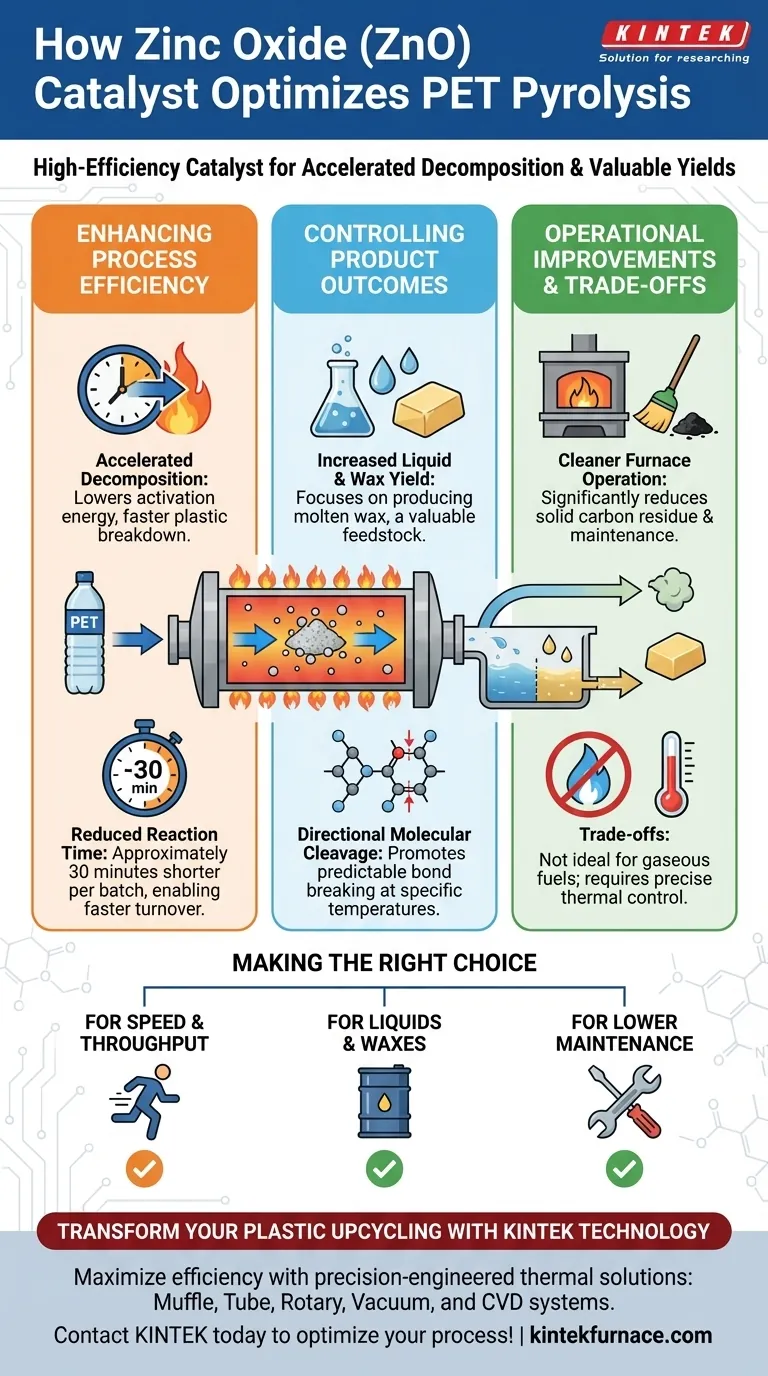
ZnO significantly increases the rate at which plastic polymers break down. By lowering the activation energy required for pyrolysis, it allows the PET chains to crack more readily.
Reduction in Reaction Time
The presence of ZnO has a measurable impact on operational throughput. It can reduce the total reaction time by approximately 30 minutes, allowing for faster batch turnover.
Improved Heating Efficiency
Beyond chemical kinetics, ZnO improves the overall heating efficiency of the system. This ensures that thermal energy is utilized more effectively during the breakdown of the polymer matrix.
Controlling Product Outcomes
Directional Molecular Cleavage
Unlike non-catalytic pyrolysis, which can be chaotic, ZnO promotes directional cleavage. This means the molecular bonds break in a more predictable pattern at specific temperatures.
Increased Liquid and Wax Yield
This catalyst is specifically effective for maximizing liquid yields or modifying product morphology. It is particularly noted for generating molten wax, a valuable feedstock for various industrial applications.
Operational Improvements
Reduction of Solid Residue
One of the most practical benefits of using ZnO is the reduction of solid waste. The catalyst effectively lowers the amount of solid carbon residue remaining in the furnace after the process is complete.
Cleaner Furnace Operation
By minimizing char formation, ZnO helps maintain a cleaner reactor environment. This directly correlates to reduced downtime for cleaning and maintenance.
Understanding the Operational Trade-offs
Product Specificity Limitations
The "directional" nature of ZnO is a double-edged sword. Because it promotes specific morphologies like molten wax or liquid, it may not be suitable if your primary goal is maximizing gaseous fuel production.
Thermal Dependency
The effectiveness of ZnO in promoting directional cleavage is tied to specific temperatures. Operators must maintain precise thermal control to ensure the catalyst activates the desired molecular breakdown rather than leading to incomplete decomposition.
Making the Right Choice for Your Goals
To determine if Zinc Oxide is the right catalyst for your PET pyrolysis setup, consider your specific production targets:
- If your primary focus is Speed and Throughput: Utilizing ZnO is highly recommended to leverage the approximate 30-minute reduction in reaction time per batch.
- If your primary focus is Product Morphology: Choose ZnO if you specifically intend to produce liquids or molten waxes rather than gaseous fuels.
- If your primary focus is Equipment Maintenance: Implement ZnO to significantly reduce solid carbon residue and minimize the frequency of furnace cleaning.
By integrating Zinc Oxide, you move from simple waste destruction to a targeted, efficient chemical recovery process.
Summary Table:
| Feature | Impact of ZnO on PET Pyrolysis |
|---|---|
| Decomposition Speed | Significantly accelerated via lower activation energy |
| Reaction Time | Reduced by approximately 30 minutes per batch |
| Primary Product | High-quality liquid oils and molten waxes |
| Solid Residue | Minimal carbon char; cleaner furnace operation |
| Molecular Control | Directional cleavage for predictable outcomes |
Transform Your Plastic Upcycling with KINTEK Technology
Maximize your PET pyrolysis efficiency and product quality with precision-engineered thermal solutions. Backed by expert R&D and manufacturing, KINTEK offers high-performance Muffle, Tube, Rotary, Vacuum, and CVD systems—all fully customizable to meet your specific catalytic requirements.
Whether you are targeting molten wax production or seeking to minimize carbon residue, our lab high-temp furnaces provide the thermal stability and control needed for advanced Zinc Oxide catalysis. Contact KINTEK today to discuss your unique research or production needs and let our experts help you optimize your chemical recovery process!
Visual Guide
References
- Hitesh Panchal. Fuel Extraction from Plastic Waste. DOI: 10.22214/ijraset.2025.66489
This article is also based on technical information from Kintek Furnace Knowledge Base .
Related Products
- 1700℃ Controlled Inert Nitrogen Atmosphere Furnace
- Controlled Inert Nitrogen Hydrogen Atmosphere Furnace
- Molybdenum Disilicide MoSi2 Thermal Heating Elements for Electric Furnace
- 1200℃ Controlled Inert Nitrogen Atmosphere Furnace
- Magnesium Extraction and Purification Condensing Tube Furnace
People Also Ask
- How do controlled-atmosphere furnaces support polymer pyrolysis? Master SiC & Si3N4 Ceramic Conversion
- Why is thorough binder burnout necessary before sintering advanced ceramics? Ensure Peak Density & Zero Defects
- How does oxygen partial pressure control affect ceramic sintering? Master Defect Chemistry
- How does real-time dilatometric analysis in a controlled-atmosphere furnace optimize PZT ceramic sintering?
- Why is controlled-atmosphere heating required for functional ceramics and sensors? Master Defect Engineering