
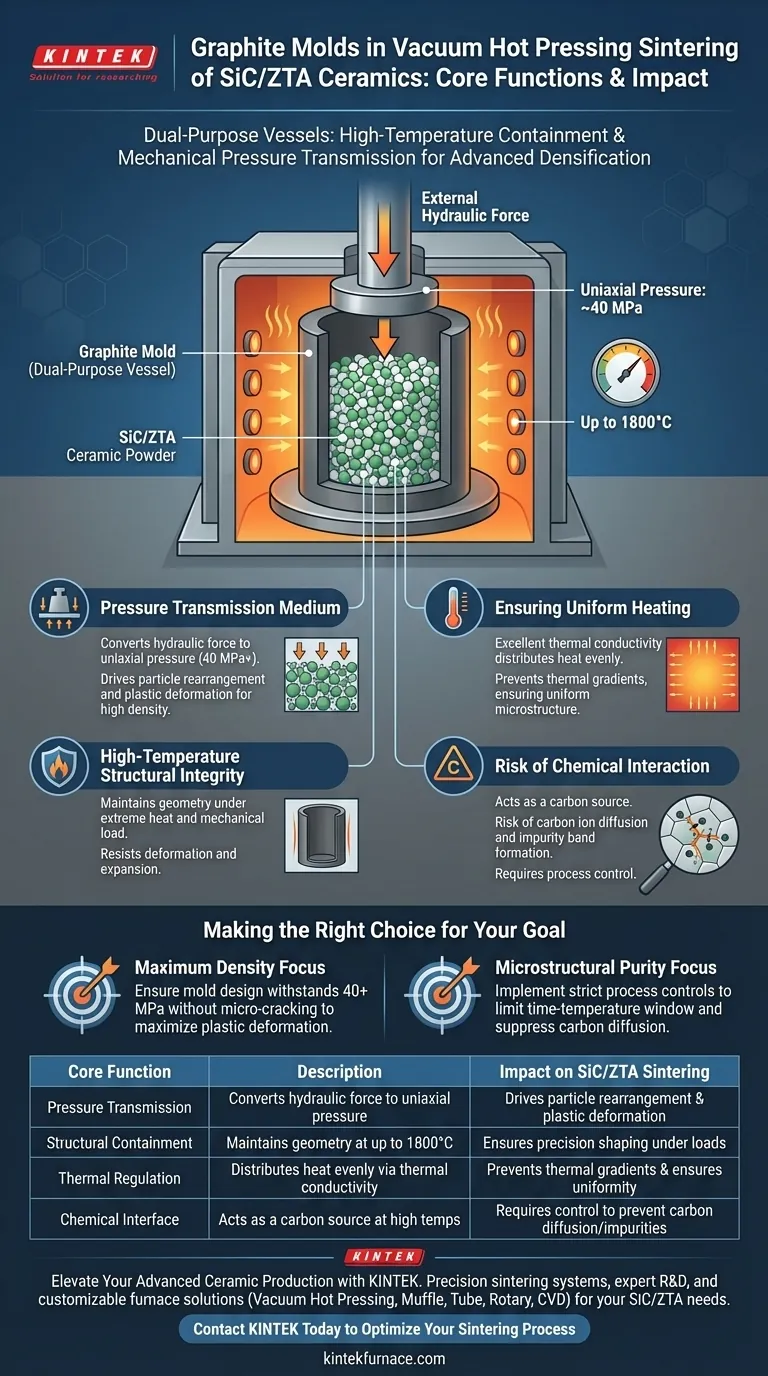
Graphite molds function primarily as dual-purpose vessels that act as both high-temperature resistant containers and mechanical pressure transmitters. During the vacuum hot pressing of SiC/ZTA ceramics, they facilitate densification by effectively converting external hydraulic force into the internal uniaxial pressure required to fuse hard-to-sinter powders.
Core Takeaway: Beyond simply holding the shape, the graphite mold serves as an active process component. It enables the simultaneous application of extreme heat and mechanical force—essential for triggering the particle rearrangement and plastic deformation necessary to achieve full density in advanced ceramics.
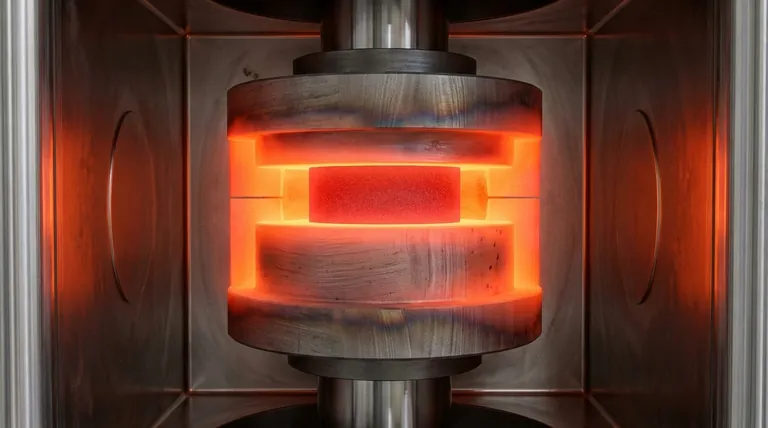
The Mechanics of Densification
Acting as a Pressure Transmission Medium
The most critical role of the graphite mold is to serve as a pressure transmission medium. It acts as the physical interface between the external hydraulic system and the ceramic powder.
By withstanding significant uniaxial pressures (typically around 40 MPa), the mold forces the internal powder to undergo particle rearrangement. This pressure is the catalyst for plastic deformation, allowing the material to achieve high density even before reaching its theoretical melting point.
High-Temperature Structural Integrity
To sinter materials like SiC (Silicon Carbide) and ZTA (Zirconia Toughened Alumina), the environment must reach extreme temperatures, often up to 1800°C.
The graphite mold operates as a robust container that maintains the specific geometry of the component under these conditions. It must possess high hot-strength to resist expanding or deforming under the combined load of thermal stress and mechanical pressure.
Thermal Regulation Roles
Ensuring Uniform Heating
Graphite is selected for this process due to its excellent thermal conductivity.
As heat is applied, the mold distributes thermal energy evenly across the surface of the ceramic sample. This prevents thermal gradients—hot spots or cold spots—that could lead to uneven microstructures or internal stresses in the final sintered product.
Understanding the Trade-offs
The Risk of Chemical Interaction
While graphite is mechanically ideal, it introduces a chemical variable: it acts as a carbon source.
At elevated temperatures, there is a risk that carbon ions may diffuse from the mold into the ceramic material. This can lead to the formation of impurity bands along the grain boundaries of the ceramic. Process control must account for this diffusion to prevent the degradation of the ceramic's electrical or optical properties.
Making the Right Choice for Your Goal
To optimize your sintering process, consider how the mold functions relative to your specific targets:
- If your primary focus is Maximum Density: Ensure your mold design and grade can withstand uniaxial pressures exceeding 40 MPa without micro-cracking, to maximize plastic deformation.
- If your primary focus is Microstructural Purity: Implement strict process controls to manage grain growth and limit the time-temperature window, suppressing the diffusion of carbon ions into the ceramic matrix.
The graphite mold is not merely a consumable tool; it is a critical process variable that dictates the structural integrity and uniformity of your final ceramic component.
Summary Table:
| Core Function | Description | Impact on SiC/ZTA Sintering |
|---|---|---|
| Pressure Transmission | Converts hydraulic force to uniaxial pressure (40 MPa+) | Drives particle rearrangement and plastic deformation |
| Structural Containment | Maintains component geometry at temperatures up to 1800°C | Ensures precision shaping under high thermal and mechanical loads |
| Thermal Regulation | Distributes heat evenly via high thermal conductivity | Prevents thermal gradients and ensures uniform microstructure |
| Chemical Interface | Acts as a carbon source at high temperatures | Requires process control to prevent carbon ion diffusion and impurities |
Elevate Your Advanced Ceramic Production with KINTEK
Precision sintering requires more than just high temperatures; it demands the right equipment to manage pressure and thermal uniformity. Backed by expert R&D and manufacturing, KINTEK offers state-of-the-art Vacuum Hot Pressing systems, Muffle, Tube, Rotary, and CVD furnaces—all fully customizable to your unique SiC/ZTA processing needs.
Whether you are aiming for maximum material density or superior microstructural purity, our technical team is ready to provide the specialized lab solutions your research deserves.
Contact KINTEK Today to Optimize Your Sintering Process
Visual Guide
Related Products
- 2200 ℃ Graphite Vacuum Heat Treat Furnace
- Vacuum Heat Treat Sintering Furnace with Pressure for Vacuum Sintering
- Vacuum Heat Treat Sintering Furnace Molybdenum Wire Vacuum Sintering Furnace
- 600T Vacuum Induction Hot Press Vacuum Heat Treat and Sintering Furnace
- Vacuum Hot Press Furnace Machine Heated Vacuum Press Tube Furnace
People Also Ask
- Why are vacuum heat treating furnaces essential for aerospace? Ensure Superior Material Integrity for High-Stakes Applications
- What is the primary application of vacuum heat treating furnaces in aerospace? Enhance Component Performance with Precision
- What is the process of vacuum heat treating? Achieve Superior Metallurgical Properties
- How does a vacuum heat treating furnace improve the condition of metal alloys? Achieve Superior Metal Performance
- How does vacuum heat treating work in terms of temperature and time control? Master Precise Material Transformations













