
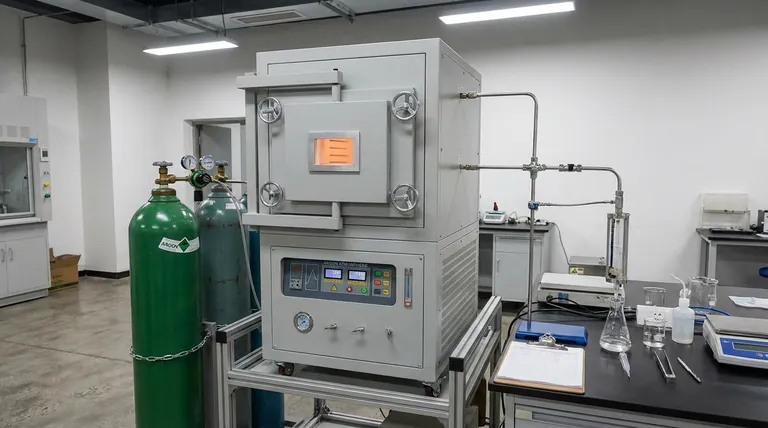
Maintaining chemical integrity is the critical reason for using an argon atmosphere during Spark Plasma Sintering (SPS). High-purity argon acts as an inert protective shield, isolating the Ti-6Al-4Zr-4Nb alloy from atmospheric gases. This prevents the material from reacting with oxygen and nitrogen during the high-temperature densification process.
The Core Insight Titanium alloys are highly reactive at elevated temperatures, making them susceptible to immediate degradation in standard air. An argon atmosphere is not merely an operational preference but a metallurgical necessity to preserve the alloy's design standards and mechanical properties.
The Critical Role of Inert Atmospheres
Preventing High-Temperature Oxidation
The primary function of the argon atmosphere is to stop the oxidation of titanium alloys.
When Ti-6Al-4Zr-4Nb is subjected to the high temperatures required for sintering, it becomes extremely reactive.
Without a protective barrier, the alloy would bond immediately with oxygen present in the environment, forming unwanted oxides.
Isolating Nitrogen Impurities
In addition to oxygen, the atmosphere contains nitrogen, which can also degrade titanium alloys during heating.
The argon environment effectively isolates the material from these airborne impurities.
By displacing the air within the chamber, argon ensures that nitrogen cannot diffuse into the alloy structure.
Preserving Chemical Composition
The success of Ti-6Al-4Zr-4Nb relies on a precise chemical balance.
Allowing the material to react with air would alter this composition, pushing the alloy outside of its design standards.
Using an inert atmosphere guarantees that the constituent elements remain in their intended ratios without external contamination.
Maintaining Mechanical Performance
The ultimate goal of the SPS process is to produce a material with superior high-temperature mechanical properties.
Contamination from oxygen or nitrogen can embrittle the alloy, significantly reducing its strength and ductility.
By preventing these reactions, argon ensures the final product retains the robust physical characteristics required for its application.
Common Pitfalls to Avoid
The Requirement for High Purity
It is not enough to simply introduce argon into the chamber; the gas must be of high purity.
Using industrial-grade argon with trace amounts of moisture or oxygen can still lead to surface oxidation.
Operators must ensure the gas source meets strict purity requirements to provide effective isolation.
Ensuring Sintering Success
To maximize the quality of your Ti-6Al-4Zr-4Nb components, you must prioritize atmospheric control alongside temperature and pressure.
- If your primary focus is Chemical Purity: Ensure your argon supply is certified high-purity to eliminate trace oxygen and nitrogen contamination.
- If your primary focus is Mechanical Strength: Verify that the inert environment is maintained throughout the entire heating and cooling cycle to prevent embrittlement.
Atmospheric control is the invisible variable that determines whether a sintered titanium alloy will fail or perform.
Summary Table:
| Feature | Impact of Argon Atmosphere | Risk Without Argon |
|---|---|---|
| Oxidation Control | Forms an inert shield against oxygen | Rapid surface and bulk oxidation |
| Nitrogen Isolation | Prevents nitrogen diffusion into the structure | Material embrittlement and degradation |
| Chemical Balance | Maintains precise alloy design ratios | Altered composition and impurities |
| Mechanical Properties | Preserves high-temperature strength/ductility | Significant loss of structural integrity |
Elevate Your Material Research with KINTEK
Precision in titanium sintering requires more than just high temperatures—it demands total atmospheric control. Backed by expert R&D and manufacturing, KINTEK offers specialized Muffle, Tube, and Vacuum systems, including advanced sintering furnaces designed to maintain the high-purity environments your alloys require. Whether you need standard or fully customizable lab high-temp furnaces, our technology ensures your Ti-6Al-4Zr-4Nb components meet the strictest mechanical standards.
Ready to achieve superior chemical integrity? Contact KINTEK today to discuss your unique sintering needs.
References
- Shilong Liang, Yoko Yamabe‐Mitarai. Microstructure Evolution and Mechanical Properties of Ti–6Al–4Zr–4Nb Alloys Fabricated by Spark Plasma Sintering (SPS). DOI: 10.1007/s11661-024-07422-8
This article is also based on technical information from Kintek Furnace Knowledge Base .
Related Products
- Spark Plasma Sintering SPS Furnace
- Chairside Dental Porcelain Zirconia Sintering Furnace with Transformer for Ceramic Restorations
- Dental Porcelain Zirconia Sintering Ceramic Vacuum Press Furnace
- Small Vacuum Heat Treat and Tungsten Wire Sintering Furnace
- 9MPa Air Pressure Vacuum Heat Treat and Sintering Furnace
People Also Ask
- Why is it necessary to maintain a high vacuum environment during the SPS of SiC? Key to High-Density Ceramics
- How does the heating mechanism of Spark Plasma Sintering (SPS) function? Enhance TiC/SiC Composite Fabrication
- What are the technical advantages of using an SPS sintering furnace? Elevate Al2O3-TiC Material Performance
- What are the steps in the discharge plasma sintering process? Master Fast, High-Density Material Consolidation
- What are the advantages of spark plasma sintering (SPS) over traditional forging? Precision Microstructural Control














