
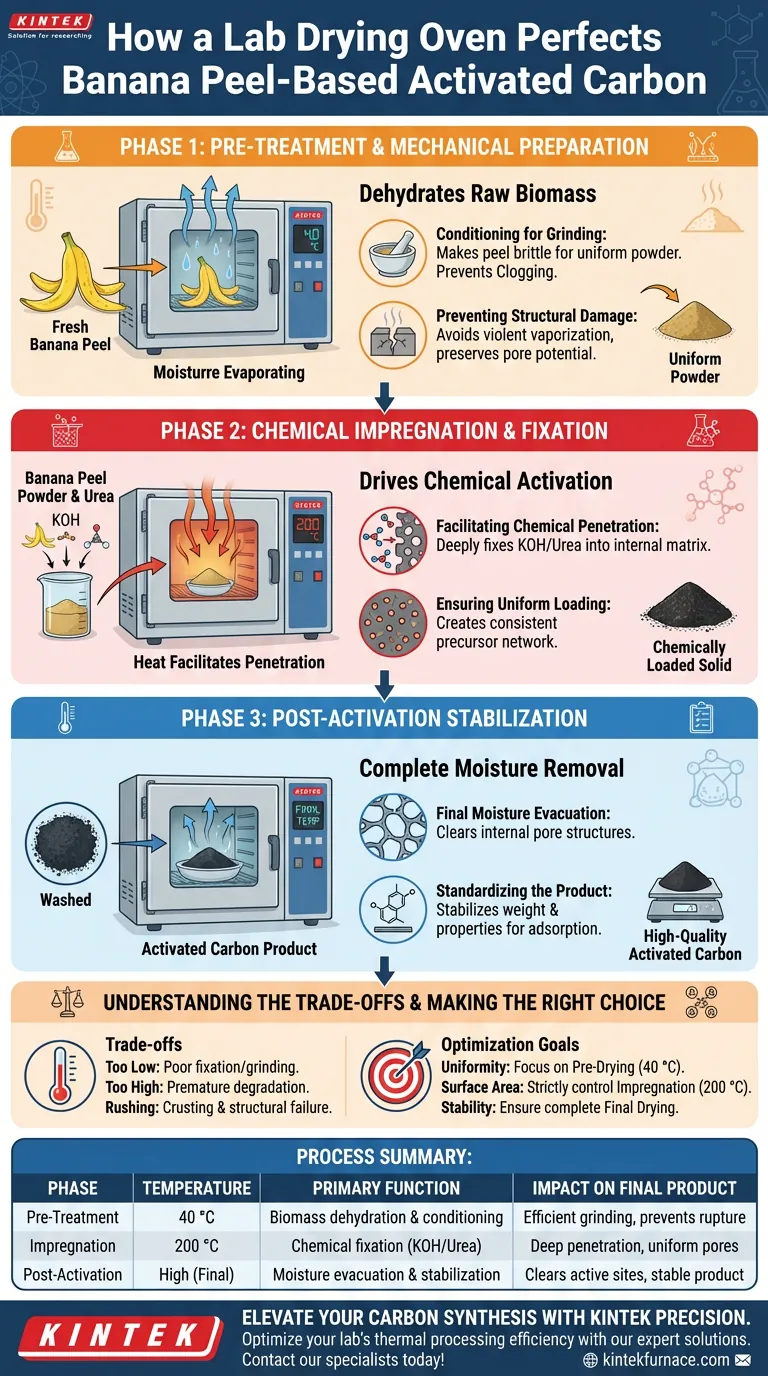
The laboratory drying oven acts as a critical process control tool across three distinct stages of converting banana peels into activated carbon. Its primary functions are to dehydrate raw biomass for mechanical processing, facilitate the deep penetration of chemical activating agents, and stabilize the final pore structure of the washed product.
The oven is not merely a dehydrator; it is a structural stabilizer. By controlling moisture levels at specific temperatures, it enables the physical fracturing of biomass, the chemical fixation of activators like KOH, and the preservation of the final carbon network.
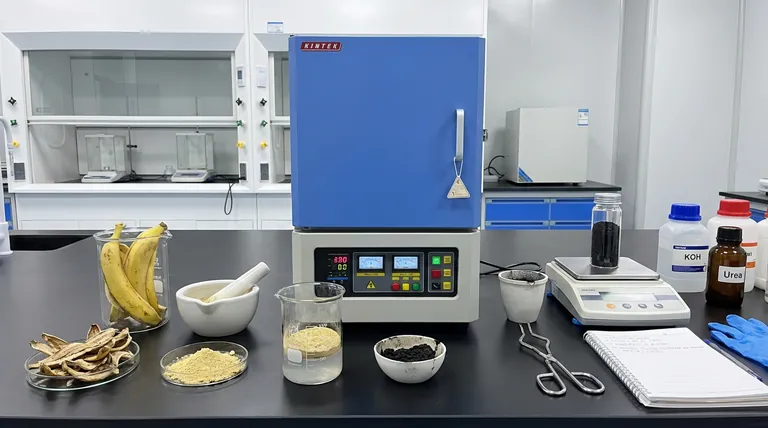
Phase 1: Pre-Treatment and Mechanical Preparation
Conditioning for Grinding
The first function of the oven is to prepare the raw banana peels for size reduction.
By drying the raw biomass at a low temperature of 40 °C, the oven removes surface moisture that makes the peels pliable or sticky.
This dehydration makes the material brittle, ensuring it can be efficiently ground into a uniform powder without clogging milling equipment.
Preventing Structural Damage
While the primary goal is grinding efficiency, this stage also serves a protective function.
Removing physically adsorbed water prevents violent vaporization during later high-temperature stages.
Without this initial drying, rapid steam expansion in a furnace could rupture the biomass, leading to a collapse of the potential pore structure.
Phase 2: Chemical Impregnation and Fixation
Facilitating Chemical Penetration
Once the banana peel powder is mixed with chemical agents—specifically potassium hydroxide (KOH) and urea—the oven drives the activation process.
This stage utilizes a significantly higher temperature of 200 °C.
This heat treatment drives the chemical solution deep into the precursor material, ensuring the agents are not just coating the surface but are fixed within the internal matrix.
Ensuring Uniform Loading
The controlled heat allows the activating agents to crystallize uniformly.
This uniformity is essential for creating a consistent network of micropores and mesopores during the final carbonization.
It transforms the mixture from a wet slurry into a chemically loaded solid ready for thermal decomposition.
Phase 3: Post-Activation Stabilization
Final Moisture Removal
After the carbonized material is washed to remove residual chemicals, the oven performs its final function.
It is used to completely dry the resulting activated carbon.
This step ensures that all moisture is evacuated from the newly formed internal pore structures.
Standardizing the Product
This final drying stage stabilizes the weight and properties of the carbon.
It ensures the material is chemically stable and ready for adsorption applications.
Leaving moisture in the pores at this stage would artificially inflate the weight and block the active sites needed for filtration.
Understanding the Trade-offs
Temperature Sensitivity
Selecting the correct temperature for each stage is a critical balancing act.
If the temperature is too low, moisture remains trapped, leading to poor grinding or incomplete chemical fixation.
If the temperature is too high (especially during pre-drying), you risk premature thermal degradation or burning of the organic components before activation even begins.
Process Time vs. Efficiency
Oven drying is often the most time-consuming step in the synthesis process.
Rushing this step by increasing heat can cause crusting, where the outside dries fast and traps moisture inside.
This trapped moisture can lead to structural failure when the material is eventually exposed to extreme heat in the carbonization furnace.
Making the Right Choice for Your Goal
To maximize the quality of your banana peel-based activated carbon, align your oven usage with your specific processing targets:
- If your primary focus is particle uniformity: Prioritize thorough pre-drying at 40 °C to maximize the brittleness and grindability of the raw peels.
- If your primary focus is surface area development: Strictly control the 200 °C impregnation stage to ensure KOH and urea are deeply fixed into the carbon precursor.
- If your primary focus is storage stability: Ensure the final drying phase is complete to prevent moisture re-adsorption and pore blockage.
Precision in drying dictates the integrity of the final carbon structure.
Summary Table:
| Process Phase | Temperature | Primary Function | Impact on Final Product |
|---|---|---|---|
| Pre-Treatment | 40 °C | Biomass dehydration & conditioning | Ensures efficient grinding and prevents structural rupture |
| Impregnation | 200 °C | Chemical fixation (KOH/Urea) | Facilitates deep penetration for uniform pore development |
| Post-Activation | High (Final) | Moisture evacuation & stabilization | Clears active sites and ensures chemical/weight stability |
Elevate Your Carbon Synthesis with KINTEK Precision
Precise thermal control is the difference between a collapsed structure and a high-surface-area adsorbent. KINTEK provides industry-leading lab solutions tailored for biomass processing and material science. Backed by expert R&D and manufacturing, we offer a comprehensive range of Muffle, Tube, Rotary, Vacuum, and CVD systems, along with specialized lab high-temp furnaces—all fully customizable to your unique research needs.
Ready to optimize your lab's thermal processing efficiency?
Contact our specialists today to find your perfect solution!
Visual Guide
References
- Joanna Sreńscek-Nazzal, Beata Michalkiewicz. Chemical Activation of Banana Peel Waste-Derived Biochar Using KOH and Urea for CO2 Capture. DOI: 10.3390/ma17040872
This article is also based on technical information from Kintek Furnace Knowledge Base .
Related Products
- Laboratory Muffle Oven Furnace with Bottom Lifting
- 1200℃ Muffle Oven Furnace for Laboratory
- High Temperature Muffle Oven Furnace for Laboratory Debinding and Pre Sintering
- 1400℃ Muffle Oven Furnace for Laboratory
- 1800℃ High Temperature Muffle Oven Furnace for Laboratory
People Also Ask
- Why is a high-temperature muffle furnace required for FeOx-MOx/TiO2? Engineering High-Performance Nanocomposites
- What function does a muffle furnace perform in Ba0.75Ca0.25TiO3 calcination? Ensure Phase Purity & Synthesis
- What is the importance of the calcination process? Master High-Purity Calcium Phosphate Nanopowder Production
- Why is a high-temperature laboratory muffle furnace essential for the alkali fusion process in zeolite synthesis?
- What are the primary functions of a high-temperature laboratory muffle furnace in the preparation of biosorbent materials?






