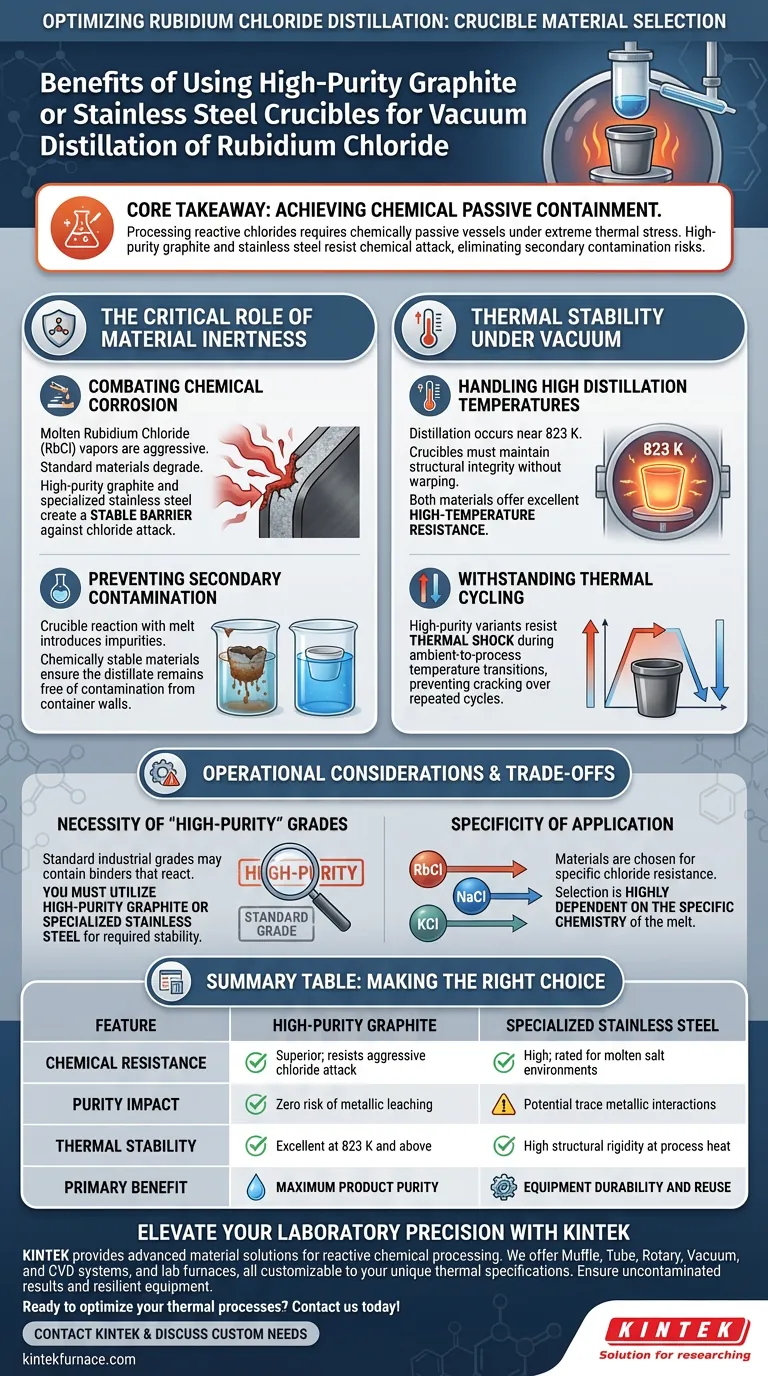
High-purity graphite and specialized stainless steel are essential for this process because they provide the necessary chemical inertness and thermal resilience to withstand the corrosive nature of molten Rubidium Chloride. At distillation temperatures around 823 K, these materials resist reacting with the salt, ensuring the crucible maintains its structural integrity while preventing impurities from leaching into the final product.
Core Takeaway Processing reactive chlorides requires a containment vessel that remains chemically passive under extreme thermal stress. High-purity graphite and stainless steel solve this by resisting chemical attack from the melt, thereby eliminating the risk of secondary contamination from the crucible itself.
The Critical Role of Material Inertness
Combating Chemical Corrosion
Rubidium Chloride becomes a highly aggressive environment when dealing with its molten state and volatile vapors.
Many standard crucible materials will degrade, pit, or dissolve when exposed to these corrosive chloride vapors.
High-purity graphite and specialized stainless steel are selected specifically because they do not react with these chlorides, creating a stable barrier between the sample and the containment vessel.
Preventing Secondary Contamination
The primary goal of vacuum distillation is purification.
If the crucible material reacts with the melt, it introduces new impurities back into the Rubidium Chloride, defeating the purpose of the process.
Using chemically stable materials ensures that the distillate remains free of "secondary contamination" derived from the container walls.
Thermal Stability Under Vacuum
Handling High Distillation Temperatures
The distillation of Rubidium Chloride generally occurs at temperatures near 823 K.
Crucibles must maintain their structural rigidity and physical form without softening or warping at this heat.
Graphite and stainless steel provide excellent high-temperature resistance, ensuring the vessel does not fail during the heating phase.
Withstanding Thermal Cycling
In addition to holding heat, the materials must withstand the transition from ambient temperature to process temperature.
High-purity variants of these materials are engineered to resist thermal shock.
This ensures the crucible does not crack or degrade over repeated distillation cycles.
Operational Considerations and Trade-offs
The Necessity of "High-Purity" Grades
It is critical to note that not all graphite or steel is suitable for this application.
Standard industrial grades may contain binders or alloys that will react with the chloride vapors.
You must utilize high-purity graphite or specialized stainless steel to achieve the chemical stability required for this specific corrosive environment.
Specificity of Application
While these materials are excellent for Rubidium Chloride, they are chosen for their specific resistance to chlorides.
Material selection is highly dependent on the specific chemistry of the melt; what works for chlorides may not work for other aggressive chemical environments.
Making the Right Choice for Your Goal
To ensure a successful distillation run, align your material selection with your specific processing needs:
- If your primary focus is maximum product purity: Prioritize high-purity graphite to eliminate any risk of metallic leaching or secondary contamination from the vessel.
- If your primary focus is equipment durability: Ensure you are using specialized stainless steel rated for high-temperature chloride resistance to prevent corrosion-induced failure.
Selecting the correct crucible material is the single most important factor in maintaining the integrity of your Rubidium Chloride purification process.
Summary Table:
| Feature | High-Purity Graphite | Specialized Stainless Steel |
|---|---|---|
| Chemical Resistance | Superior; resists aggressive chloride attack | High; rated for molten salt environments |
| Purity Impact | Zero risk of metallic leaching | Potential trace metallic interactions |
| Thermal Stability | Excellent at 823 K and above | High structural rigidity at process heat |
| Primary Benefit | Maximum product purity | Equipment durability and reuse |
Elevate Your Laboratory Precision with KINTEK
Don't let crucible degradation compromise your high-purity distillation. KINTEK provides the advanced material solutions required for reactive chemical processing. Backed by expert R&D and world-class manufacturing, we offer a comprehensive range of Muffle, Tube, Rotary, Vacuum, and CVD systems, as well as other lab high-temperature furnaces—all fully customizable to your unique thermal specifications.
Whether you are processing Rubidium Chloride or developing next-generation materials, our high-purity graphite and specialized alloy components ensure your results remain uncontaminated and your equipment remains resilient.
Ready to optimize your thermal processes? Contact us today to discuss your custom furnace and crucible needs!
Visual Guide
References
- Cui Xi, Tao Qu. A Study on the Removal of Impurity Elements Silicon and Zinc from Rubidium Chloride by Vacuum Distillation. DOI: 10.3390/ma17091960
This article is also based on technical information from Kintek Furnace Knowledge Base .
Related Products
- MPCVD Machine System Reactor Bell-jar Resonator for Lab and Diamond Growth
- Vertical Laboratory Quartz Tube Furnace Tubular Furnace
- High Temperature Muffle Oven Furnace for Laboratory Debinding and Pre Sintering
- Split Chamber CVD Tube Furnace with Vacuum Station CVD Machine
- Magnesium Extraction and Purification Condensing Tube Furnace
People Also Ask
- What are the essential components of an MPCVD reactor system? Build a Pristine Environment for High-Purity Materials
- How does pressure affect the MPCVD growth process? Master Plasma Control for Superior Film Quality
- How do carbon-containing groups contribute to diamond growth in the MPCVD method? Unlock High-Quality Diamond Synthesis
- Why is temperature control important in the MPCVD growth process? Ensure High-Quality, Reliable Diamond Film Deposition
- What are the key components of an MPCVD system? Unlock High-Purity Crystal Growth