
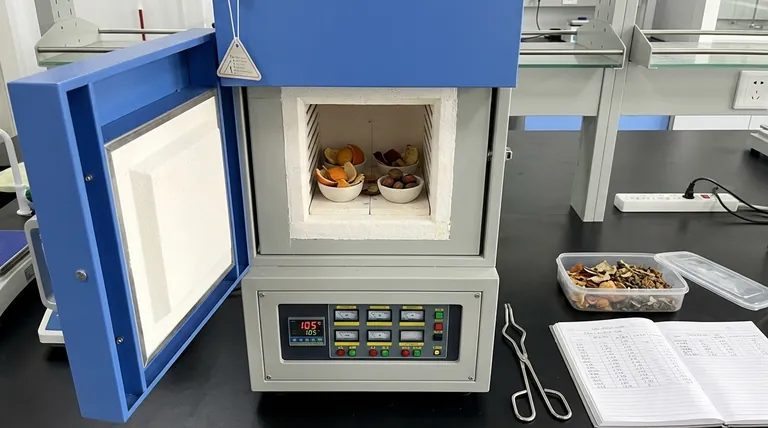
The primary function of a laboratory electric oven in food waste torrefaction is to standardize the moisture content of raw biomass materials. Specifically, it is used to subject samples—such as fruit peels and pits—to constant temperature drying at 105 °C until they reach a constant weight, effectively removing free water before the actual experimentation begins.
Accurate torrefaction analysis requires a consistent baseline. The laboratory electric oven eliminates variable moisture content, ensuring that subsequent experimental results reflect the actual thermochemical conversion rather than inconsistencies caused by water evaporation.
The Mechanics of Sample Preparation
Reaching Constant Weight
The goal of using the electric oven is not simply to heat the sample, but to achieve a state known as constant weight.
This indicates that all moisture capable of being removed at the set temperature has evaporated. This step transforms variable food waste into a stable raw material ready for testing.
The 105 °C Standard
The reference specifies an operating temperature of 105 °C for a distinct reason.
This temperature is sufficient to boil off water (which vaporizes at 100 °C) but is generally low enough to avoid triggering significant chemical decomposition or "roasting" of the biomass structure itself.
Why Pre-Drying is Critical for Accuracy
Eliminating Initial Discrepancies
Food waste is inherently inconsistent; a fruit peel may hold significantly more water than a fruit pit.
Without the electric oven to equalize these samples, it would be impossible to compare the torrefaction performance of different materials fairly. The oven creates a level playing field by removing the moisture variable.
Ensuring Experimental Validity
The ultimate goal of torrefaction is thermochemical conversion.
If samples enter this phase while still wet, a portion of the thermal energy meant for the conversion process is wasted on simple evaporation. Pre-drying ensures the data collected during torrefaction accurately represents the material's chemical changes, not its water content.
Operational Considerations and Constraints
avoiding Premature Decomposition
While the oven is essential, precise temperature control is vital.
If the oven temperature drifts significantly above 105 °C, you risk initiating mild pyrolysis (thermal degradation) prematurely. This alters the chemical composition of the sample before the actual experiment begins, compromising the data.
The Time Factor
Achieving constant weight is a slow process compared to the torrefaction event itself.
Users must account for this preparation bottleneck. Rushing this stage by increasing heat will damage the sample, while removing the sample too early leaves residual moisture that skews mass balance calculations.
Establishing a Reliable Experimental Protocol
To maximize the reliability of your torrefaction data, apply the following guidelines based on your specific objectives:
- If your primary focus is Data Precision: Verify the "constant weight" status by weighing the sample, returning it to the oven for an hour, and weighing it again to ensure no mass is lost.
- If your primary focus is Comparative Analysis: Ensure every distinct type of food waste (peels, pits, pulps) is treated at the exact same temperature (105 °C) to validate side-by-side comparisons.
By rigorously controlling moisture content during preparation, you build the foundation for reproducible and scientifically valid torrefaction data.
Summary Table:
| Step in Preparation | Purpose | Key Parameter |
|---|---|---|
| Initial Drying | Removal of free water | 105 °C |
| Constant Weight | Ensure complete moisture removal | Mass stabilization |
| Standardization | Equalize diverse biomass types | Uniform baseline |
| Data Validation | Prevent energy waste on evaporation | Thermochemical accuracy |
Optimize Your Biomass Research with KINTEK
Precision in sample preparation is the foundation of reliable torrefaction data. KINTEK provides high-performance laboratory electric ovens and high-temperature furnace systems designed for the rigors of biomass research and thermochemical conversion.
Backed by expert R&D and manufacturing, KINTEK offers Muffle, Tube, Rotary, Vacuum, and CVD systems, all fully customizable to meet your unique lab requirements. Whether you are drying fruit peels for torrefaction or performing complex pyrolysis, our equipment ensures the temperature stability and control you need to achieve valid, reproducible results.
Ready to elevate your lab's efficiency? Contact us today to discuss your specific needs with our technical specialists.
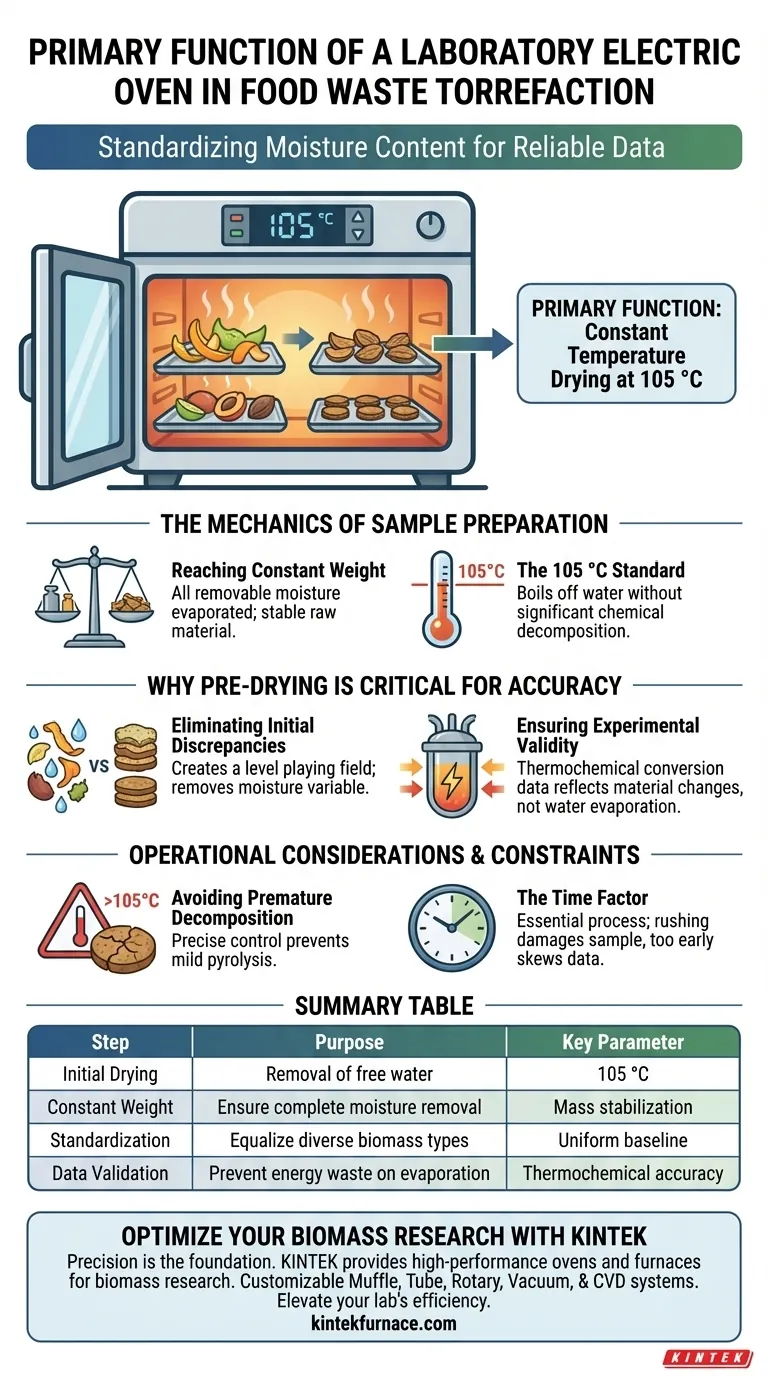
Visual Guide
References
- Andreja Škorjanc, Danijela Urbancl. Advancing Energy Recovery: Evaluating Torrefaction Temperature Effects on Food Waste Properties from Fruit and Vegetable Processing. DOI: 10.3390/pr13010208
This article is also based on technical information from Kintek Furnace Knowledge Base .
Related Products
- 1200℃ Muffle Oven Furnace for Laboratory
- 1400℃ Muffle Oven Furnace for Laboratory
- 1800℃ High Temperature Muffle Oven Furnace for Laboratory
- Laboratory Muffle Oven Furnace with Bottom Lifting
- 1700℃ High Temperature Muffle Oven Furnace for Laboratory
People Also Ask
- What is the primary function of a high-temperature laboratory muffle furnace in chemical synthesis? Achieve Precision.
- How does a high-temperature laboratory muffle furnace affect material properties? Transform Anodic Oxide Films Fast
- How is a laboratory muffle furnace used in 3D-printed PP-CF cross-linking? Achieve Thermal Stability at 150 °C
- What is the role of a laboratory high-temperature muffle furnace in iron analysis? Key to Precise Sample Mineralization
- How is a laboratory high-temperature muffle furnace used to evaluate porous Co-Al materials? Precision Thermal Analysis














