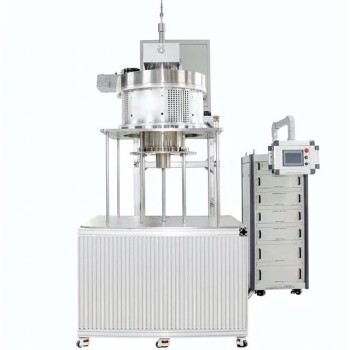
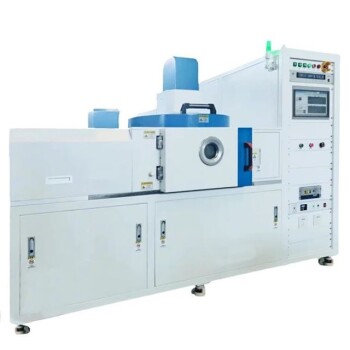
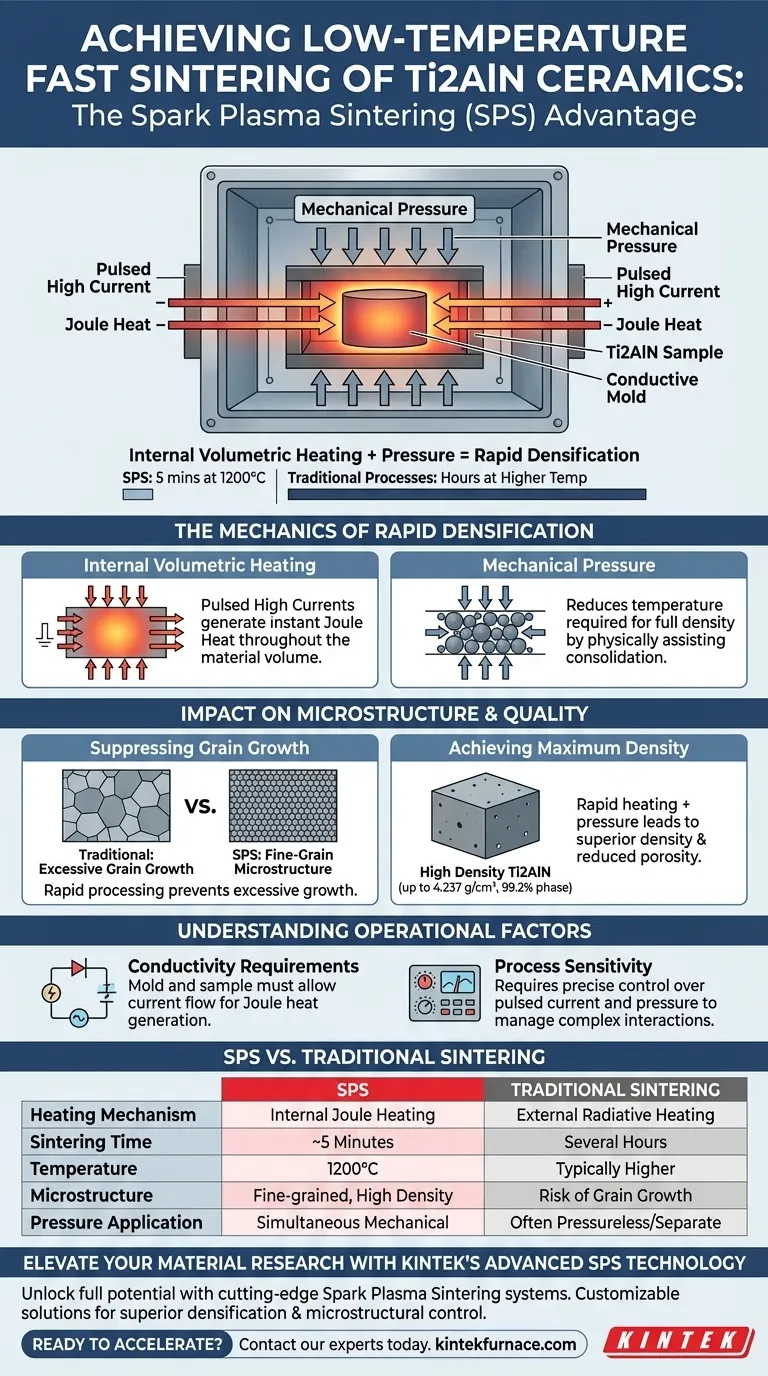
The Spark Plasma Sintering (SPS) system achieves low-temperature fast sintering by generating heat internally rather than applying it externally. By passing a pulsed high current directly through the mold and the Ti2AlN sample while simultaneously applying mechanical pressure, the system utilizes Joule heating to achieve rapid heating rates. This unique mechanism allows Ti2AlN ceramics to complete densification after holding at only 1200°C for five minutes, a threshold significantly lower and faster than traditional processes.
The core advantage of SPS lies in its shift from external radiative heating to internal volumetric heating combined with pressure. This enables the synthesis of high-density Ti2AlN ceramics with optimal phase content while drastically reducing the thermal budget required for processing.
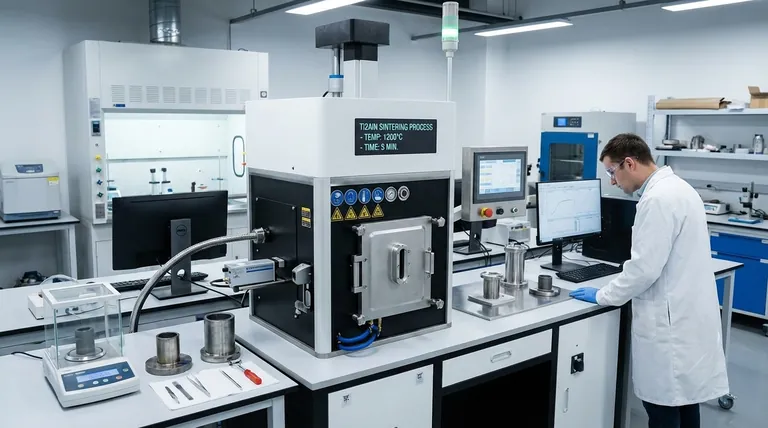
The Mechanics of Rapid Densification
Internal Volumetric Heating
Unlike conventional sintering furnaces that heat samples from the outside in, SPS utilizes pulsed high currents.
These currents pass directly through the conductive mold and the powder sample itself. This generates Joule heat instantly throughout the volume of the material, resulting in extremely fast heating rates.
The Role of Mechanical Pressure
In addition to thermal energy, SPS applies significant mechanical pressure during the heating process.
This pressure physically assists in the consolidation of particles. By mechanically forcing the material together, the system reduces the temperature required to achieve full density compared to pressureless sintering methods.
Impact on Microstructure and Quality
Suppressing Grain Growth
One of the primary challenges in ceramic processing is preventing grains from growing too large, which weakens the material.
Because SPS completes the sintering process in minutes rather than hours, there is insufficient time for excessive grain growth to occur. This results in a fine-grain microstructure with uniform distribution.
Achieving Maximum Density
The combination of rapid heating and pressure allows Ti2AlN to reach exceptional density levels.
The process achieves a high relative density (up to 4.237 g/cm³) and high phase content (99.2%). The resulting ceramic is characterized by complete grain development and a lack of obvious porosity.
Understanding the Operational Factors
Conductivity Requirements
Because the process relies on passing current through the assembly, the system is dependent on the electrical properties of the setup.
The molds and, to varying degrees, the sample materials must allow for the generation of Joule heat or plasma discharge between particles to facilitate this internal heating mechanism.
Process Sensitivity
While efficient, the rapid nature of SPS requires precise control over the pulsed current and pressure application.
The interaction between the pulsed current and the particles—potentially generating plasma discharges—creates a complex environment that must be carefully managed to ensure uniformity across the entire sample.
Making the Right Choice for Your Goal
When evaluating SPS for Ti2AlN ceramic production, consider your specific performance targets:
- If your primary focus is Process Efficiency: SPS offers a dramatic reduction in cycle time, requiring only 5 minutes at holding temperature compared to the extended hours required by traditional methods.
- If your primary focus is Material Performance: The technique provides superior microstructural integrity, yielding higher density and phase purity by minimizing grain coarsening.
SPS represents the most effective method for producing dense, high-quality Ti2AlN ceramics when speed and microstructural control are paramount.
Summary Table:
| Feature | Spark Plasma Sintering (SPS) | Traditional Sintering |
|---|---|---|
| Heating Mechanism | Internal Joule Heating (Pulsed Current) | External Radiative Heating |
| Sintering Time | ~5 Minutes (Holding) | Several Hours |
| Temperature (Ti2AlN) | 1200°C | Typically higher |
| Microstructure | Fine-grained, high density | Risk of excessive grain growth |
| Pressure Application | Simultaneous mechanical pressure | Often pressureless or separate |
Elevate Your Material Research with KINTEK’s Advanced SPS Technology
Unlock the full potential of your ceramic synthesis with KINTEK. Backed by expert R&D and precision manufacturing, we provide cutting-edge Spark Plasma Sintering (SPS) systems alongside our range of Muffle, Tube, Rotary, and Vacuum furnaces. Whether you are developing Ti2AlN ceramics or advanced composites, our customizable high-temp solutions are engineered to deliver superior densification and microstructural control.
Ready to accelerate your sintering process? Contact our technical experts today to find the perfect system for your unique laboratory needs.
Visual Guide
Related Products
- Spark Plasma Sintering SPS Furnace
- 915MHz MPCVD Diamond Machine Microwave Plasma Chemical Vapor Deposition System Reactor
- RF PECVD System Radio Frequency Plasma Enhanced Chemical Vapor Deposition
- Vacuum Heat Treat Sintering Furnace with Pressure for Vacuum Sintering
- 9MPa Air Pressure Vacuum Heat Treat and Sintering Furnace
People Also Ask
- How does the heating mechanism of Spark Plasma Sintering (SPS) function? Enhance TiC/SiC Composite Fabrication
- Why is it necessary to maintain a high vacuum environment during the SPS of SiC? Key to High-Density Ceramics
- What are the technical advantages of using an SPS sintering furnace? Elevate Al2O3-TiC Material Performance
- What are the steps in the discharge plasma sintering process? Master Fast, High-Density Material Consolidation
- What are the advantages of spark plasma sintering (SPS) over traditional forging? Precision Microstructural Control