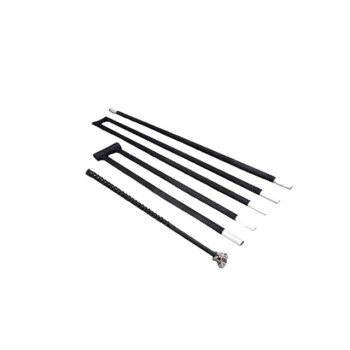
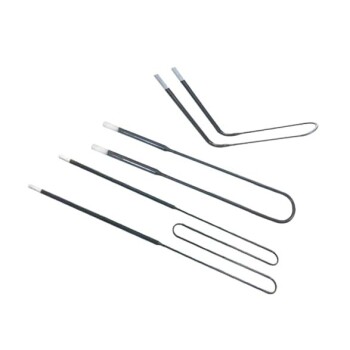
Heating elements in vacuum furnaces primarily adopt shapes like wide strips, ribbons, flat panels, or cylindrical/semi-circular forms. These configurations are strategically chosen to maximize their radiant surface area, which is crucial for highly efficient heat transfer within the vacuum environment.
Vacuum furnace heating elements are shaped to optimize radiant heat transfer. Designs such as wide strips, ribbons, and flat panels ensure a large surface area, facilitating efficient energy distribution and enabling precise temperature control across diverse material processing needs.
Optimizing Heat Transfer Through Element Shape
Why Shape Matters for Efficiency
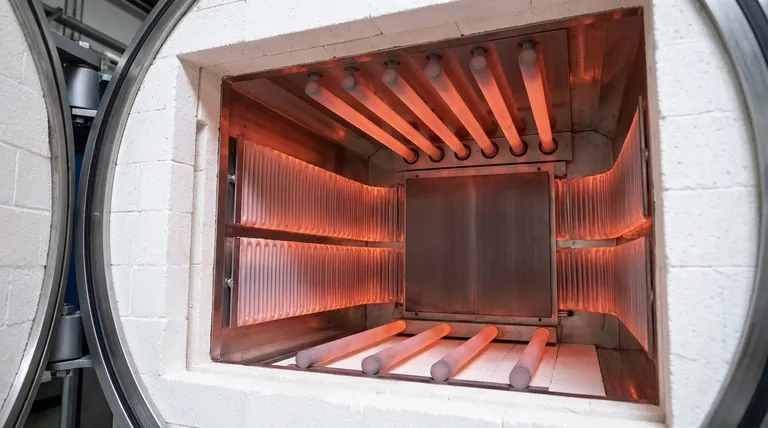
The primary function of heating elements in a vacuum furnace is to transfer heat to the workpiece. In a vacuum, convection is negligible, making radiation the dominant mode of heat transfer. Therefore, element shapes are designed to maximize the surface area available for thermal radiation.
Common Element Shapes
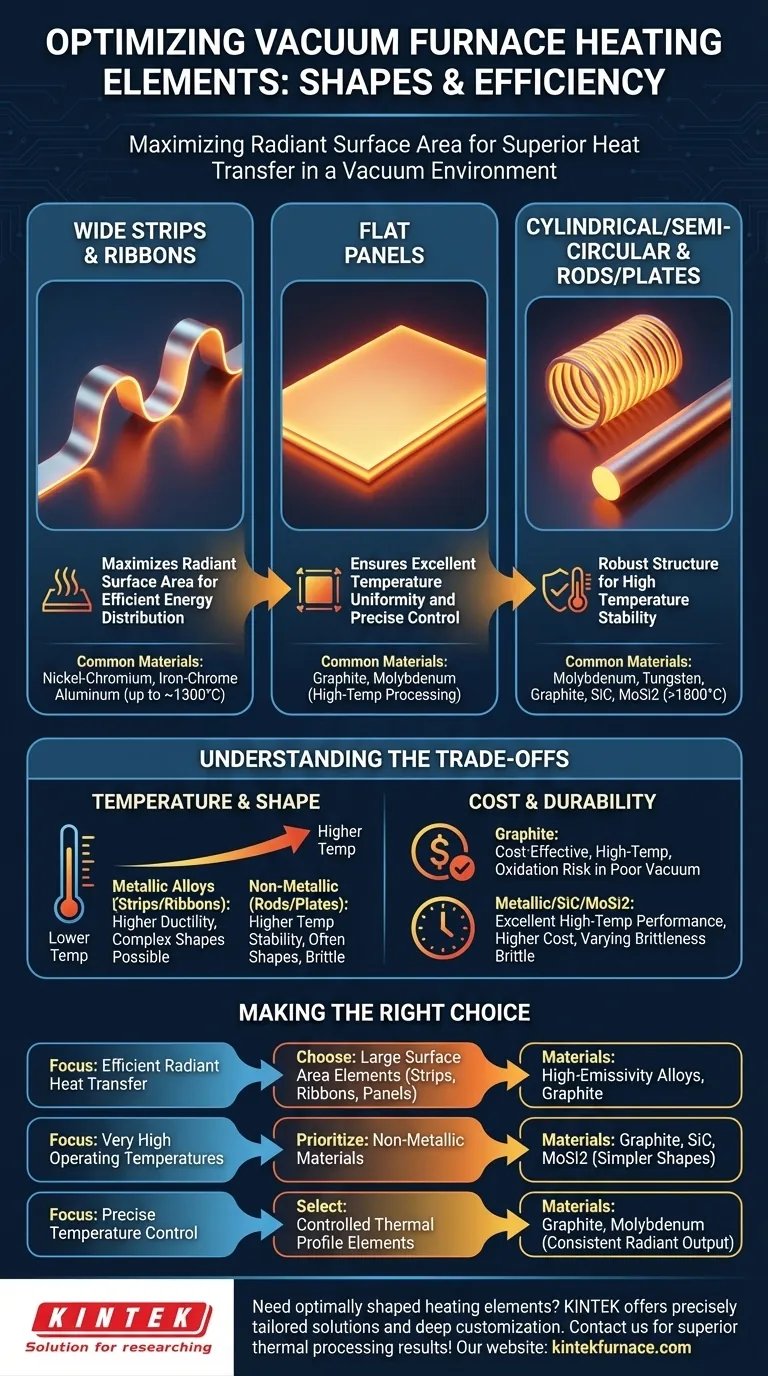
Many vacuum furnace heating elements are designed as wide strips or ribbons. This flat, broad profile significantly increases the radiant surface area compared to a simple wire. Other standard shapes, particularly in industrial settings, include flat panels, cylindrical, or semi-circular forms. These shapes also contribute to a larger radiating surface.
Maximizing Radiant Surface Area
The objective behind these shapes is to maximize both the physical and radiant surface area of the heating element. A larger radiant surface means more energy can be emitted and absorbed by the furnace chamber and the workload, leading to more efficient heating. This design principle underpins why narrow, round wires are less common as primary radiant elements.
Materials Dictating Form and Function
Metallic Alloy Elements
For operating temperatures typically up to around 1300°C (though some go higher), metallic alloys like nickel-chromium, iron-chrome aluminum, molybdenum, tungsten, or tantalum are common. These materials can be easily formed into strips, ribbons, or more complex cylindrical/semi-circular geometries, leveraging their ductility.
Non-Metallic Elements
For extremely high temperatures (up to 2200°C), non-metallic materials like graphite, silicon carbide (SiC), and molybdenum disilicide (MoSi2) are used. Graphite elements are often formed into wide strips, plates, or complex shapes to maximize surface area and capitalize on their high emissivity. SiC and MoSi2 elements are frequently found as rods or specific structural forms that offer robust performance at high heat.
Understanding the Trade-offs
Temperature Range vs. Element Type
The choice of heating element material directly influences the maximum achievable operating temperature, which in turn can influence the viable element shapes. Molybdenum and tungsten allow for higher temperatures than nickel-chromium alloys, but might be more brittle and harder to form into complex shapes beyond strips or rods.
Cost and Lifespan Considerations
Graphite elements are cost-effective for very high temperatures but can be susceptible to oxidation if the vacuum integrity is compromised. Metallic elements like molybdenum offer excellent high-temperature performance in vacuum but are generally more expensive. The shape often balances manufacturing cost with desired thermal performance and longevity.
Durability and Brittleness
Materials such as silicon carbide (SiC) and molybdenum disilicide (MoSi2) offer high-temperature stability but are inherently more brittle than metallic alloys. This can limit the complexity of shapes they can reliably maintain, often favoring robust rod or simple panel designs.
Making the Right Choice for Your Goal
If your primary focus is efficient radiant heat transfer: Choose elements with large surface areas, such as wide strips, ribbons, or flat panels made from high-emissivity materials like graphite or specific metallic alloys. If your primary focus is very high operating temperatures: Prioritize non-metallic materials like graphite, silicon carbide, or molybdenum disilicide, understanding that their shapes might be simpler (rods, plates) due to material properties. If your primary focus is precise temperature control and reproducibility (e.g., laboratory use): Select elements and furnace designs that allow for controlled thermal profiles, often using materials like graphite or molybdenum that provide consistent radiant output.
The strategic shaping of heating elements in vacuum furnaces is a critical engineering decision, ensuring optimal heat distribution and temperature uniformity for a wide array of demanding applications.
Summary Table:
| Element Shape | Common Materials | Key Advantage | Typical Use Case |
|---|---|---|---|
| Wide Strips, Ribbons | Nickel-Chromium, Iron-Chrome Aluminum | Maximizes radiant surface area | General-purpose heating (up to ~1300°C) |
| Flat Panels | Graphite, Molybdenum | Excellent temperature uniformity | High-temperature processing, lab applications |
| Cylindrical/Semi-Circular | Molybdenum, Tungsten | Robust structure for high temperatures | Industrial heating, sintering |
| Rods, Plates | Graphite, SiC, MoSi2 | High-temperature stability (>1800°C) | Extreme temperature applications |
Need a high-temperature furnace with optimally shaped heating elements for your specific application? KINTEK's advanced R&D and in-house manufacturing capabilities allow us to provide precisely tailored solutions. Whether you require Muffle, Tube, Rotary, Vacuum, or Atmosphere Furnaces, or specialized CVD/PECVD Systems, our deep customization expertise ensures your heating elements are perfectly configured for maximum efficiency, temperature uniformity, and process control. Contact our experts today to discuss your unique requirements and achieve superior thermal processing results.
Visual Guide
Related Products
- Silicon Carbide SiC Thermal Heating Elements for Electric Furnace
- Molybdenum Disilicide MoSi2 Thermal Heating Elements for Electric Furnace
- 2200 ℃ Graphite Vacuum Heat Treat Furnace
- Molybdenum Vacuum Heat Treat Furnace
- Vacuum Heat Treat Furnace with Ceramic Fiber Liner
People Also Ask
- How do the different types of silicon carbide heating elements compare in terms of applications? Find the Best Fit for Your High-Temp Needs
- What are the temperature capabilities and mounting options for silicon carbide heating elements? Unlock High-Temp Flexibility and Durability
- What are the advantages of using silicon carbide heating elements in industrial furnaces? Boost Efficiency and Durability
- How do silicon carbide heating elements enhance the heat treatment of alloys? Achieve Superior Temperature Control
- What are the unique properties of silicon carbide heating elements? Key Benefits for High-Temp Performance