Knowledge How does nano-MgO particle size influence sulfur doping in activated carbon? Optimize Doping for High-Performance Lab Materials
Author avatar

Tech Team · Kintek Furnace

Updated 1 day ago

How does nano-MgO particle size influence sulfur doping in activated carbon? Optimize Doping for High-Performance Lab Materials


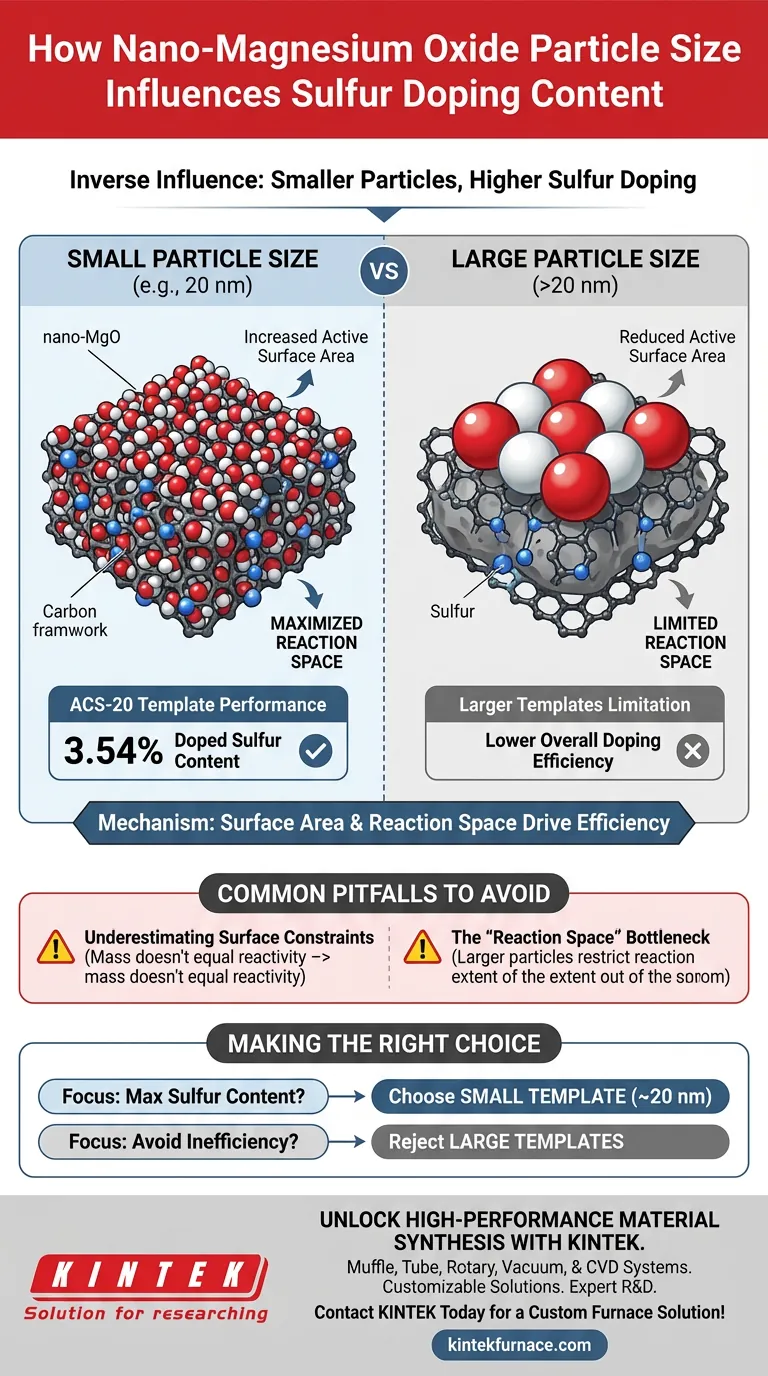
The particle size of nano-magnesium oxide exerts a direct, inverse influence on sulfur doping content. Specifically, utilizing smaller particle sizes, such as 20 nm, significantly increases the percentage of sulfur incorporated into the activated carbon. This is primarily driven by the dramatic increase in available active surface area provided by smaller particles.

The core principle is that smaller template particles maximize the "reaction space" per unit of mass. This increased surface exposure facilitates a more complete reaction between the carbon framework and the sulfur source, resulting in superior doping efficiency.

How does nano-MgO particle size influence sulfur doping in activated carbon? Optimize Doping for High-Performance Lab Materials

The Mechanism Behind Doping Efficiency

The Role of Active Surface Area

The fundamental driver of this process is the active surface area. Smaller nano-magnesium oxide particles provide a much larger surface area for the same mass compared to larger particles.

Facilitating the Reaction

This expanded surface area allows for greater interaction between materials. It ensures a more comprehensive reaction between the carbon framework and the sulfur source.

Creating Reaction Space

Smaller particles effectively increase the available reaction space. This physical characteristic removes bottlenecks that would otherwise prevent sulfur from integrating into the carbon structure.

Evidence of Impact

Performance of 20 nm Templates (ACS-20)

Empirical studies demonstrate clear advantages when using smaller templates. Specifically, sulfur-doped porous carbon prepared with a 20 nm template (ACS-20) achieves a high doped sulfur content of approximately 3.54%.

The Limitation of Larger Templates

Conversely, larger templates result in reduced doping content. The larger particle size inherently limits the active reaction space, leading to lower overall doping efficiency.

Common Pitfalls to Avoid

Underestimating Surface Constraints

A common error in synthesis is assuming that mass equals reactivity. Even if the mass of the magnesium oxide is constant, increasing the particle size reduces the functional surface area available for the reaction.

The "Reaction Space" Bottleneck

Using larger particles creates a physical constraint. This limits the extent of the reaction between the carbon and sulfur, making it chemically impossible to achieve the high doping levels seen with 20 nm particles.

Making the Right Choice for Your Goal

To optimize the synthesis of sulfur-doped activated carbon, you must select your template size based on your chemical targets.

  • If your primary focus is maximizing sulfur content: Utilize nano-magnesium oxide with a small particle size (ideally around 20 nm) to ensure maximum active surface area and reaction completeness.
  • If your primary focus is avoiding process inefficiency: Reject larger particle templates, as they inherently restrict reaction space and will fail to achieve high doping percentages.

By prioritizing the smallest viable template size, you unlock the full chemical potential of the sulfur-carbon reaction.

Summary Table:

Particle Size Sample Identifier Sulfur Doping Content Reaction Efficiency
20 nm ACS-20 3.54% High (Maximum active surface area)
Large (>20 nm) Standard Templates Low Low (Limited reaction space)

Unlock High-Performance Material Synthesis with KINTEK

Precise material engineering requires equipment that can handle demanding chemical processes. KINTEK provides industry-leading Muffle, Tube, Rotary, Vacuum, and CVD systems, all customizable to meet your specific research and synthesis needs.

Backed by expert R&D and world-class manufacturing, our lab high-temperature furnaces ensure the uniform heating and stability necessary for optimizing activated carbon doping and other advanced material applications.

Ready to elevate your research efficiency? Contact KINTEK today for a custom furnace solution!

Visual Guide
How does nano-MgO particle size influence sulfur doping in activated carbon? Optimize Doping for High-Performance Lab Materials Visual Guide

References

  1. Yaoping Guo, Rui Fang. Sulfur-doped activated carbon for the efficient degradation of tetracycline with persulfate: Insight into the effect of pore structure on catalytic performance. DOI: 10.1039/d3ra08958d

This article is also based on technical information from Kintek Furnace Knowledge Base .

Related Products

People Also Ask

Related Products

Magnesium Extraction and Purification Condensing Tube Furnace

Magnesium Extraction and Purification Condensing Tube Furnace

Magnesium purification tube furnace for high-purity metal production. Achieve ≤10Pa vacuum, dual-zone heating. Ideal for aerospace, electronics, and lab research.

Vacuum Dental Porcelain Sintering Furnace for Dental Laboratories

Vacuum Dental Porcelain Sintering Furnace for Dental Laboratories

KinTek Vacuum Porcelain Furnace: Precision dental lab equipment for high-quality ceramic restorations. Advanced firing control & user-friendly operation.

Chairside Dental Porcelain Zirconia Sintering Furnace with Transformer for Ceramic Restorations

Chairside Dental Porcelain Zirconia Sintering Furnace with Transformer for Ceramic Restorations

Dental Porcelain Speedy Sintering Furnace: Fast 9-minute zirconia sintering, 1530°C precision, SiC heaters for dental labs. Boost productivity today!

915MHz MPCVD Diamond Machine Microwave Plasma Chemical Vapor Deposition System Reactor

915MHz MPCVD Diamond Machine Microwave Plasma Chemical Vapor Deposition System Reactor

KINTEK MPCVD Diamond Machine: High-quality diamond synthesis with advanced MPCVD technology. Faster growth, superior purity, customizable options. Boost production now!

1700℃ High Temperature Laboratory Tube Furnace with Quartz or Alumina Tube

1700℃ High Temperature Laboratory Tube Furnace with Quartz or Alumina Tube

KINTEK's Tube Furnace with Alumina Tube: Precision heating up to 1700°C for material synthesis, CVD, and sintering. Compact, customizable, and vacuum-ready. Explore now!

1400℃ Muffle Oven Furnace for Laboratory

1400℃ Muffle Oven Furnace for Laboratory

KT-14M Muffle Furnace: Precision 1400°C heating with SiC elements, PID control, and energy-efficient design. Ideal for labs.

High Temperature Muffle Oven Furnace for Laboratory Debinding and Pre Sintering

High Temperature Muffle Oven Furnace for Laboratory Debinding and Pre Sintering

KT-MD Debinding & Pre-Sintering Furnace for ceramics - precise temperature control, energy-efficient design, customizable sizes. Boost your lab efficiency today!

1800℃ High Temperature Muffle Oven Furnace for Laboratory

1800℃ High Temperature Muffle Oven Furnace for Laboratory

KINTEK Muffle Furnaces: Precision 1800°C heating for labs. Energy-efficient, customizable, with PID control. Ideal for sintering, annealing, and research.

Multi Heating Zones CVD Tube Furnace Machine for Chemical Vapor Deposition Equipment

Multi Heating Zones CVD Tube Furnace Machine for Chemical Vapor Deposition Equipment

KINTEK's Multi-Zone CVD Tube Furnaces offer precision temperature control for advanced thin film deposition. Ideal for research and production, customizable for your lab needs.

1400℃ High Temperature Laboratory Tube Furnace with Quartz and Alumina Tube

1400℃ High Temperature Laboratory Tube Furnace with Quartz and Alumina Tube

KINTEK's Tube Furnace with Alumina Tube: Precision high-temperature processing up to 2000°C for labs. Ideal for material synthesis, CVD, and sintering. Customizable options available.

Molybdenum Disilicide MoSi2 Thermal Heating Elements for Electric Furnace

Molybdenum Disilicide MoSi2 Thermal Heating Elements for Electric Furnace

High-performance MoSi2 heating elements for labs, reaching 1800°C with superior oxidation resistance. Customizable, durable, and reliable for high-temperature applications.

High Pressure Laboratory Vacuum Tube Furnace Quartz Tubular Furnace

High Pressure Laboratory Vacuum Tube Furnace Quartz Tubular Furnace

KINTEK High Pressure Tube Furnace: Precision heating up to 1100°C with 15Mpa pressure control. Ideal for sintering, crystal growth, and lab research. Customizable solutions available.

1700℃ Controlled Inert Nitrogen Atmosphere Furnace

1700℃ Controlled Inert Nitrogen Atmosphere Furnace

KT-17A Controlled Atmosphere Furnace: Precise 1700°C heating with vacuum & gas control. Ideal for sintering, research & material processing. Explore now!

1200℃ Split Tube Furnace Laboratory Quartz Tube Furnace with Quartz Tube

1200℃ Split Tube Furnace Laboratory Quartz Tube Furnace with Quartz Tube

Discover KINTEK's 1200℃ Split Tube Furnace with quartz tube for precise high-temperature lab applications. Customizable, durable, and efficient. Get yours now!

600T Vacuum Induction Hot Press Vacuum Heat Treat and Sintering Furnace

600T Vacuum Induction Hot Press Vacuum Heat Treat and Sintering Furnace

600T Vacuum Induction Hot Press Furnace for precise sintering. Advanced 600T pressure, 2200°C heating, vacuum/atmosphere control. Ideal for research & production.

Vacuum Heat Treat Sintering Furnace Molybdenum Wire Vacuum Sintering Furnace

Vacuum Heat Treat Sintering Furnace Molybdenum Wire Vacuum Sintering Furnace

KINTEK's Vacuum Molybdenum Wire Sintering Furnace excels in high-temperature, high-vacuum processes for sintering, annealing, and material research. Achieve precise 1700°C heating with uniform results. Custom solutions available.

Ultra High Vacuum CF Flange Stainless Steel Sapphire Glass Observation Sight Window

Ultra High Vacuum CF Flange Stainless Steel Sapphire Glass Observation Sight Window

CF sapphire viewing window for ultra-high vacuum systems. Durable, clear, and precise for semiconductor and aerospace applications. Explore specs now!

Spark Plasma Sintering SPS Furnace

Spark Plasma Sintering SPS Furnace

Discover KINTEK's advanced Spark Plasma Sintering (SPS) Furnace for rapid, precise material processing. Customizable solutions for research and production.

Silicon Carbide SiC Thermal Heating Elements for Electric Furnace

Silicon Carbide SiC Thermal Heating Elements for Electric Furnace

High-performance SiC heating elements for labs, offering 600-1600°C precision, energy efficiency, and long lifespan. Customizable solutions available.

Ultra High Vacuum Observation Window Stainless Steel Flange Sapphire Glass Sight Glass for KF

Ultra High Vacuum Observation Window Stainless Steel Flange Sapphire Glass Sight Glass for KF

KF flange observation window with sapphire glass for ultra-high vacuum. Durable 304 stainless steel, 350℃ max temperature. Ideal for semiconductor and aerospace.


Leave Your Message
