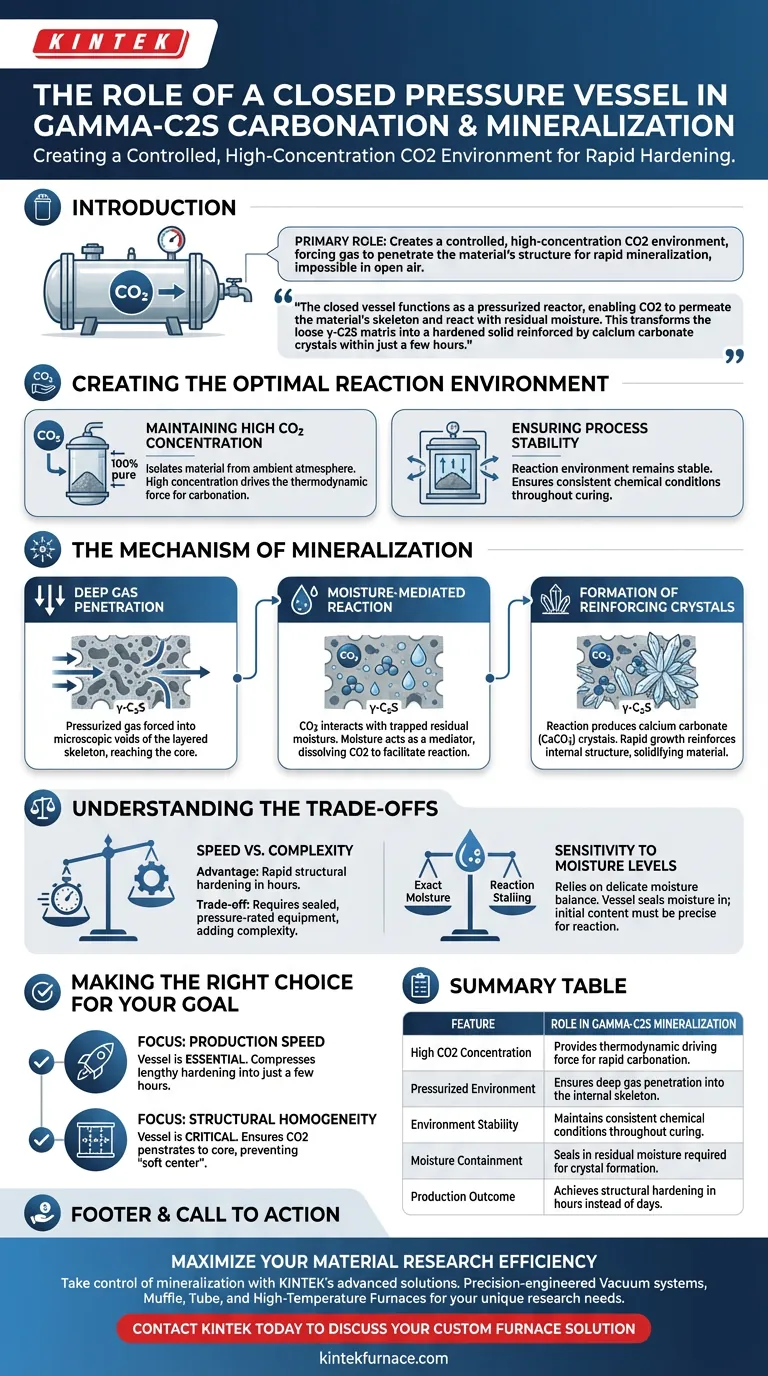
The primary role of a closed pressure vessel in this process is to create a controlled, high-concentration carbon dioxide environment that drives the rapid mineralization of gamma-dicalcium silicate ($\gamma-C_2S$). By maintaining specific atmospheric conditions, the vessel forces CO2 gas to penetrate deep into the material's internal structure, facilitating a chemical reaction that would be inefficient or impossible in open air.
The closed vessel functions as a pressurized reactor, enabling CO2 to permeate the material's skeleton and react with residual moisture. This transforms the loose $\gamma-C_2S$ matrix into a hardened solid reinforced by calcium carbonate crystals within just a few hours.
Creating the Optimal Reaction Environment
To understand the necessity of the vessel, one must look at the requirements for maximizing the reaction rate of $\gamma-C_2S$.
Maintaining High CO2 Concentration
The vessel isolates the material from the ambient atmosphere. This allows for the maintenance of a pure, high-concentration CO2 environment.
A high concentration of CO2 is the thermodynamic driving force required to initiate the carbonation process effectively.
Ensuring Process Stability
Within the closed system, the reaction environment remains stable and unaffected by external variables.
This stability ensures that the chemical conditions required for mineralization are consistent throughout the entire duration of the curing process.
The Mechanism of Mineralization
The vessel is not just a container; it is an active participant in facilitating the physical transport of reactants.
Deep Gas Penetration
The pressurized nature of the vessel forces CO2 gas into the microscopic voids of the material’s layered skeleton.
Without this driven penetration, the reaction might be limited to the exterior surface, leaving the core of the material unreacted and weak.
Moisture-Mediated Reaction
Once the gas penetrates the voids, it interacts with the residual moisture trapped within the $\gamma-C_2S$ matrix.
The reference highlights that moisture acts as a mediator; it dissolves the CO2 and facilitates its reaction with the calcium silicate.
Formation of Reinforcing Crystals
The reaction between the dissolved CO2 and the $\gamma-C_2S$ produces calcium carbonate (CaCO3) crystals.
These crystals grow rapidly, acting as a binder that reinforces the internal structure and solidifies the material.
Understanding the Trade-offs
While the closed pressure vessel enables rapid production, it introduces specific operational considerations.
Speed vs. Complexity
The primary advantage is speed; the vessel allows for structural stabilization and hardening within a few hours.
However, this necessitates the use of sealed, pressure-rated equipment, which adds complexity compared to traditional ambient air curing methods.
Sensitivity to Moisture Levels
Because the reaction is mediated by residual moisture, the internal environment of the vessel relies on a delicate balance.
The vessel seals moisture in, meaning the initial moisture content of the material must be precise to ensure the reaction proceeds without stalling.
Making the Right Choice for Your Goal
When evaluating the use of a closed pressure vessel for $\gamma-C_2S$ carbonation, consider your specific production targets.
- If your primary focus is Production Speed: The vessel is essential, as it compresses a lengthy hardening process into a cycle of just a few hours.
- If your primary focus is Structural Homogeneity: The vessel is critical for ensuring CO2 penetrates to the core of the material, preventing a "soft center" in the final product.
The closed pressure vessel acts as the catalyst for efficiency, turning a chemical potential into a rapid, industrial-grade manufacturing capability.
Summary Table:
| Feature | Role in Gamma-C2S Mineralization |
|---|---|
| High CO2 Concentration | Provides the thermodynamic driving force for rapid carbonation. |
| Pressurized Environment | Ensures deep gas penetration into the material's internal skeleton. |
| Environment Stability | Maintains consistent chemical conditions throughout the curing cycle. |
| Moisture Containment | Seals in residual moisture required to mediate crystal formation. |
| Production Outcome | Achieves structural hardening in hours instead of days. |
Maximize Your Material Research Efficiency
Take control of your mineralization processes with KINTEK’s advanced laboratory solutions. Backed by expert R&D and manufacturing, KINTEK offers precision-engineered Vacuum systems, Muffle, Tube, and High-Temperature Furnaces, all customizable to meet your unique carbonation and mineralization research needs.
Whether you are scaling up gamma-C2S production or optimizing atmospheric reaction environments, our technical team provides the specialized tools you need for consistent, industrial-grade results.
Ready to elevate your lab's performance? Contact KINTEK today to discuss your custom furnace solution!
Visual Guide
References
- Energy‐Efficient Fabrication of Biomimetic Materials for Sustainable Infrastructure Applications. DOI: 10.1002/advs.202503854
This article is also based on technical information from Kintek Furnace Knowledge Base .
Related Products
- Multi Heating Zones CVD Tube Furnace Machine for Chemical Vapor Deposition Equipment
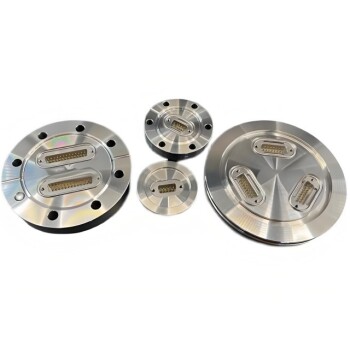
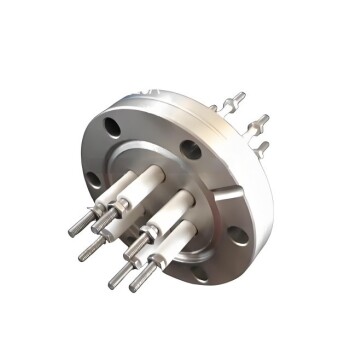
- Ultra-High Vacuum Flange Aviation Plug Glass Sintered Airtight Circular Connector for KF ISO CF
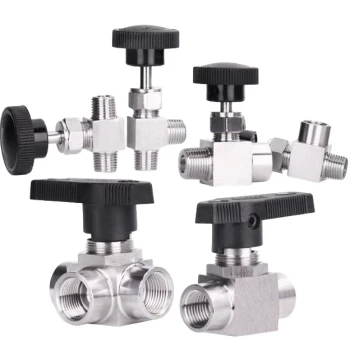
- 304 316 Stainless Steel High Vacuum Ball Stop Valve for Vacuum Systems
- Stainless Steel Quick Release Vacuum Chain Three Section Clamp
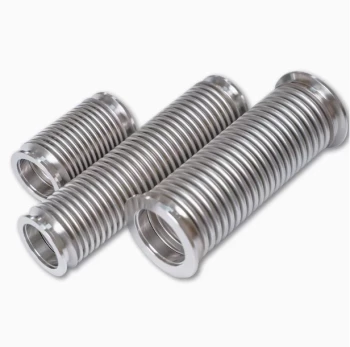
- High Performance Vacuum Bellows for Efficient Connection and Stable Vacuum in Systems
People Also Ask
- What is the function of a multi-zone tube furnace in CVD synthesis? Master 2D In2Se3 Nanosheet Precision
- What role do multi zone tube furnaces play in new energy research? Unlock Precise Thermal Control for Innovation
- What temperature-related capabilities make multi zone tube furnaces valuable for research? Unlock Precision Thermal Control
- Why are multi zone tube furnaces particularly useful for nanomaterial research? Unlock Precise Thermal Control for Advanced Synthesis
- What environmental protection applications utilize multi zone tube furnaces? Unlock Precision in Waste Treatment and Green Tech