
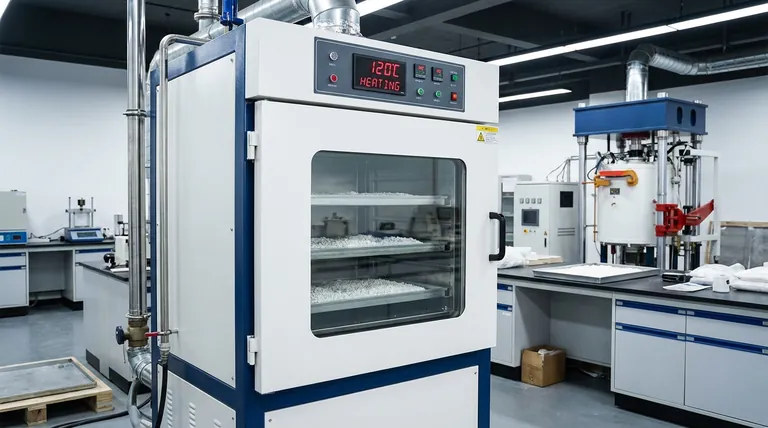
The industrial blast drying oven acts as a critical stabilization stage in the processing of calcium-based energy storage materials. It employs controlled hot air circulation to systematically remove moisture from the precursor suspension following wet mixing, ensuring the material is chemically and physically prepared for subsequent high-temperature treatments.
By maintaining a precise thermal environment, this equipment bridges the gap between wet synthesis and calcination, eliminating moisture that leads to structural failure while locking in essential chemical properties.
The Mechanism of Moisture Removal
Controlled Hot Air Circulation
The oven operates by circulating hot air around the material. This ensures consistent heat distribution across the precursor suspension.
Targeting Adsorbed Water
The primary function at this stage is the removal of physically adsorbed water. This is the moisture clinging to the surface of particles after the wet mixing process.
Ensuring Structural Integrity
The Importance of 120°C
To achieve optimal drying, the oven maintains a constant temperature of 120 degrees Celsius. This temperature is sufficient to drive off water without inducing premature chemical reactions.
Preventing Sample Bursting
This process is a safeguard against rapid vaporization. If significant moisture remains during the subsequent high-temperature processing, it will turn to steam instantly, causing the sample to burst.
Controlled Evaporation
By using an oven for an extended period, the water is removed gradually. This prevents the mechanical stress associated with thermal shock in later stages.
Enhancing Material Performance
Fixing Spatial Distribution
Beyond simple drying, this step plays a role in the material's chemical structure. It helps to initially fix the spatial distribution of components within the mixture.
Stabilizing Doped Components
For calcium-based materials that utilize doping (adding impurities to improve performance), this drying phase ensures these doped components remain evenly distributed rather than migrating with evaporating fluids.
Operational Constraints and Trade-offs
Process Time vs. Throughput
This method requires maintaining the material at temperature for an extended period. While this ensures safety and quality, it creates a bottleneck compared to faster, more aggressive drying methods.
Energy Consumption
Running a blast drying oven for long durations consumes significant energy. However, this cost is generally outweighed by the reduction in wasted batches due to sample bursting or poor component distribution.
Optimizing Material Synthesis
To maximize the effectiveness of your processing workflow, consider the following strategic priorities:
- If your primary focus is Safety and Yield: Ensure the drying phase is completed fully at 120°C to eliminate the risk of sample bursting during calcination.
- If your primary focus is Material Performance: Utilize the controlled drying phase to lock in the spatial distribution of doped components for a more uniform final product.
Properly utilizing the blast drying stage transforms a volatile precursor into a stable foundation for high-performance energy storage.
Summary Table:
| Feature | Function in Calcium Material Processing |
|---|---|
| Temperature Setting | Constant 120°C to remove adsorbed water without premature reaction |
| Air Circulation | Ensures uniform heat distribution across precursor suspensions |
| Structural Safety | Prevents rapid vaporization and sample bursting during calcination |
| Chemical Stability | Fixes spatial distribution and prevents migration of doped components |
| Process Impact | Eliminates moisture-induced structural failure and improves final yield |
Elevate Your Material Research with KINTEK
Don't let moisture compromise your high-performance energy storage materials. KINTEK provides precision thermal solutions backed by expert R&D and manufacturing. Our extensive range of Muffle, Tube, Rotary, Vacuum, and CVD systems—along with specialized industrial drying ovens—are fully customizable to meet your unique laboratory and production requirements.
Ensure structural integrity and uniform component distribution in your next project.
Contact KINTEK today for a customized quote
References
- Dehao Kong, Zhihui Wang. Enhancement of Thermochemical Energy Storage by Alkali Metal Chloride Salts-Doped Ca-Based Sorbents: A Combined DFT and Experimental Study. DOI: 10.3390/molecules29246058
This article is also based on technical information from Kintek Furnace Knowledge Base .
Related Products
- Electric Rotary Kiln Pyrolysis Furnace Plant Machine Small Rotary Kiln Calciner
- High Temperature Muffle Oven Furnace for Laboratory Debinding and Pre Sintering
- Electric Rotary Kiln Continuous Working Small Rotary Furnace Kiln for Pyrolysis Plant Heating
- Electric Rotary Kiln Small Rotary Furnace for Activated Carbon Regeneration
- Vacuum Heat Treat Sintering and Brazing Furnace
People Also Ask
- What are the advantages of electric rotary kilns compared to fuel-fired ones? Boost Precision and Efficiency in Your Process
- What advantages do electric rotary kilns offer over fuel-based kilns? Boost Efficiency and Purity in Your Process
- What materials can be processed in an electric rotary kiln? Versatile Solutions for Advanced Materials
- What is the significance of the refractory lining in a rotary kiln electric furnace? Unlock Efficiency and Longevity
- What are the main applications of a rotary kiln electric furnace? Achieve Uniform Heat Treatment for Powders



















