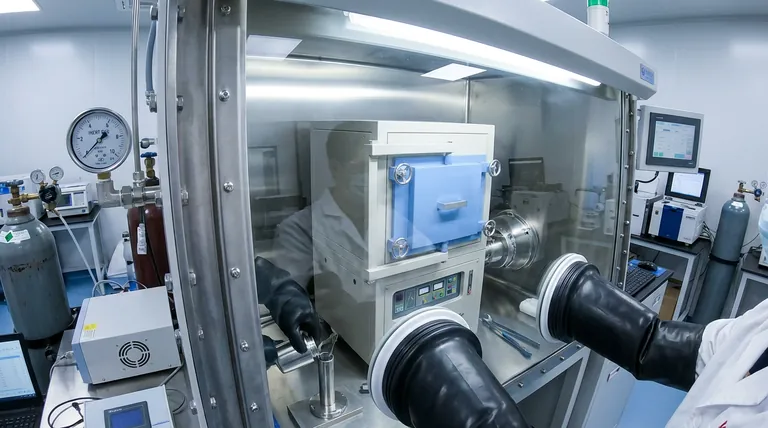
The filling of a sodium heat pipe must be conducted in a glovebox because metallic sodium is an extremely reactive alkali metal that poses immediate safety and performance risks when exposed to standard atmosphere. By utilizing an inert gas environment, you effectively isolate the sodium from oxygen and moisture, preventing violent chemical reactions and ensuring the working fluid remains pure.
Core Takeaway The glovebox environment serves two critical functions: it eliminates the risk of violent combustion caused by atmospheric moisture and prevents the formation of oxide impurities that would compromise the heat pipe's long-term chemical stability.
The Chemical Necessity of Isolation
Reactivity with Oxygen
Metallic sodium has a high affinity for oxygen. Upon contact with air, it oxidizes rapidly, degrading the quality of the metal instantly.
Reactivity with Moisture
The most significant danger lies in sodium's reaction with water vapor present in the atmosphere. This reaction is violent and exothermic, posing a severe physical hazard to the operator and the equipment.
The Role of Inert Gas
Flling the glovebox with an inert gas creates a barrier between the sodium and the environment. This effectively neutralizes the threat of oxidation and hydration during the delicate filling process.
Impact on Heat Pipe Performance
Preserving Purity
For a sodium heat pipe to function correctly, the working medium must be chemically pure. Even trace amounts of oxidation can introduce impurities into the system.
Ensuring Long-Term Stability
The primary reference highlights that chemical stability is essential for the device's operational life. Conducting the filling process in a protected environment ensures that the sodium retains its original properties, preventing degradation over years of use.
The Risks of Inadequate Protection
Safety Hazards
Attempting to handle metallic sodium outside of a controlled, inert environment is a major safety violation. The resulting reaction with ambient moisture can lead to fires or small-scale explosions.
Irreversible Contamination
If the sodium is exposed to air even briefly, oxides form that cannot be easily removed. These contaminants can clog the heat pipe's internal structures or alter the thermal properties of the working fluid, rendering the device inefficient or useless.
Ensuring Process Integrity
If your primary focus is Safety:
Ensure the glovebox maintains a positive pressure of inert gas to prevent any atmospheric leakage that could trigger a violent reaction.
If your primary focus is Device Longevity:
Prioritize the purity of the inert gas source to guarantee zero oxidation, as this directly correlates to the chemical stability of the heat pipe over time.
Strict adherence to this isolation protocol is the only way to guarantee both operator safety and the thermal reliability of the final product.
Summary Table:
| Factor | Atmospheric Risk | Glovebox Benefit |
|---|---|---|
| Chemical Reaction | Violent, exothermic reaction with moisture | Stable, non-reactive environment |
| Medium Purity | Rapid oxidation and contamination | Preserves 100% sodium purity |
| Operator Safety | High risk of fire or explosion | Safe, isolated handling process |
| Device Life | Reduced stability and efficiency | Guaranteed long-term thermal performance |
Secure Your High-Temperature Research with KINTEK
Handling reactive materials like sodium requires precision and safety. Backed by expert R&D and manufacturing, KINTEK offers high-performance Muffle, Tube, Rotary, Vacuum, and CVD systems—all customizable for your unique laboratory needs. Whether you are developing advanced heat pipes or conducting complex thermal experiments, our equipment provides the stability and control your project demands.
Ready to elevate your thermal processing capabilities? Contact KINTEK today to discuss your custom furnace solution!
References
- Shuaijie Sha, Junjie Wang. Experimental and numerical simulation study of sodium heat pipe with large aspect ratio. DOI: 10.2298/tsci231030059s
This article is also based on technical information from Kintek Furnace Knowledge Base .
Related Products
- Multi Zone Laboratory Quartz Tube Furnace Tubular Furnace
- High Purity Quartz Tube and Quartz Boat for Laboratory Furnaces
- Vertical Laboratory Quartz Tube Furnace Tubular Furnace
- Multi Heating Zones CVD Tube Furnace Machine for Chemical Vapor Deposition Equipment
- 1700℃ High Temperature Laboratory Tube Furnace with Alumina Tube
People Also Ask
- What environmental protection applications utilize multi zone tube furnaces? Unlock Precision in Waste Treatment and Green Tech
- Why are multi zone tube furnaces particularly useful for nanomaterial research? Unlock Precise Thermal Control for Advanced Synthesis
- What role do multi zone tube furnaces play in new energy research? Unlock Precise Thermal Control for Innovation
- What temperature-related capabilities make multi zone tube furnaces valuable for research? Unlock Precision Thermal Control
- What are the main applications of multi zone tube furnaces in university laboratories? Unlock Precision in Material Science and Energy Research