
Programmable temperature control is strictly required because curing composite materials is a complex chemical process, not merely a drying application. To achieve high-performance mechanical properties, the material must undergo a specific multi-stage thermal cycle—such as holding at 60 °C followed by 80 °C—rather than simply sitting at a static temperature. Programmability automates these precise ramps and dwell times, ensuring full cross-linking of the resin system while preventing the structural defects caused by uncontrolled heating.
Achieving high-performance composites is not about reaching a single temperature, but about controlling the entire thermal journey. Programmable ovens execute exact heating ramps and dwell times to optimize reaction kinetics, minimizing residual stress and maximizing the material's structural integrity.
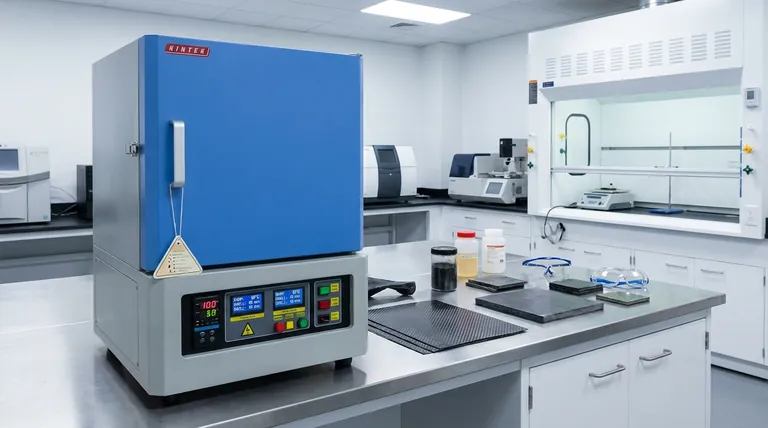
The Critical Role of Staged Heating
Achieving Full Cross-Linking
Composite materials, particularly those using epoxy resin systems, require "staged heating" to cure properly. A programmable oven allows you to set specific profiles, such as holding the material at 60 °C for a set duration before ramping up to 80 °C.
This stepwise approach ensures the chemical bonds between the resin and hardener are fully formed. Without this precise control, the polymer network may remain incomplete, compromising the final strength of the product.
Optimizing Glass Transition Temperature ($T_g$)
The thermal history of the material directly dictates its final properties, specifically the glass transition temperature ($T_g$). By adhering to a programmed cycle, you allow the material to reach its optimal $T_g$, which defines the temperature range in which the composite can safely operate.
Controlling Reaction Kinetics
Chemical reactions in resins occur at specific rates that change with temperature. Programmable equipment allows you to synchronize the temperature with the ideal reaction kinetics of the epoxy. This ensures the molecular network forms uniformly throughout the composite matrix.
Managing Structural Integrity
Regulating Heating Rates
Beyond just holding a temperature, the speed at which you reach that temperature is critical. Programmable ovens control the heating rate (e.g., 1 °C/min or 5 °C/min) to prevent thermal shock.
Eliminating Internal Stresses
Rapid or uneven heating creates thermal gradients, where the outside of the part cures faster than the inside. This differential curing generates internal residual stresses. By controlling the ramp rate, the oven ensures the entire part warms and cures evenly, relieving these internal tensions.
Preventing Physical Defects
A stable, programmed thermal field minimizes the risk of warping and micro-cracks. In complex materials like epoxy-polyimide composites or recycled carbon fiber, this stability results in a dense, void-free product with superior flexural strength and modulus.
Understanding the Trade-offs
Complexity vs. Consistency
While programmable ovens offer superior control, they introduce complexity in process validation. A programmable oven is only as effective as the cycle programmed into it; an incorrect ramp rate or insufficient dwell time can ruin a batch just as easily as a manual error.
Investment vs. Application
Programmable units typically carry a higher cost than standard static ovens. For simple drying tasks, this feature is unnecessary. However, for structural composites where mechanical failure is not an option, the inability to control the thermal profile is a liability that outweighs the initial equipment savings.
Making the Right Choice for Your Goal
To determine if programmable control is necessary for your specific application, consider the complexity of your resin system:
- If your primary focus is simple drying or non-critical bonding: A constant temperature oven may suffice, as long as the material does not require staged chemical activation.
- If your primary focus is high-performance or structural composites: A programmable oven is mandatory to execute the specific ramp and dwell cycles required to eliminate internal stress and achieve maximum mechanical strength.
Precision in the curing process is the difference between a material that survives stress and one that fails.
Summary Table:
| Feature | Constant Temperature Oven | Programmable Electric Oven |
|---|---|---|
| Best Use Case | Simple drying & non-critical bonding | Structural composite curing & staged heating |
| Heating Control | Static/Single set point | Multi-stage ramps and dwell times |
| Chemical Impact | Basic evaporation/heating | Optimized reaction kinetics & cross-linking |
| Structural Result | Risk of internal stress/warping | Uniform cure with minimized residual stress |
| Consistency | Manual adjustment required | Automated, repeatable thermal cycles |
Elevate Your Materials Research with KINTEK Precision
Don't let uncontrolled thermal cycles compromise your composite's structural integrity. KINTEK provides industry-leading laboratory high-temperature solutions, including Muffle, Tube, Rotary, Vacuum, and CVD systems, all engineered for the precise programmable control your R&D demands.
Backed by expert manufacturing, our systems are fully customizable to meet your unique curing profiles and material requirements. Ensure full cross-linking and optimal mechanical properties in every batch.
Ready to optimize your thermal processing? Contact KINTEK today to discuss your custom furnace needs!
References
- Rita C. M. Sales-Contini, F.J.G. Silva. Mechanical Strength and Surface Analysis of a Composite Made from Recycled Carbon Fibre Obtained via the Pyrolysis Process for Reuse in the Manufacture of New Composites. DOI: 10.3390/ma17020423
This article is also based on technical information from Kintek Furnace Knowledge Base .
Related Products
- 1200℃ Muffle Oven Furnace for Laboratory
- 1400℃ Muffle Oven Furnace for Laboratory
- 1800℃ High Temperature Muffle Oven Furnace for Laboratory
- Laboratory Muffle Oven Furnace with Bottom Lifting
- 1700℃ High Temperature Muffle Oven Furnace for Laboratory
People Also Ask
- How does a high-temperature laboratory muffle furnace affect material properties? Transform Anodic Oxide Films Fast
- What is the primary function of a high-temperature laboratory muffle furnace in chemical synthesis? Achieve Precision.
- How is a laboratory muffle furnace used in 3D-printed PP-CF cross-linking? Achieve Thermal Stability at 150 °C
- What functions does a laboratory muffle furnace perform for AISI 1025 steel post-processing? Precision Thermal Control
- What is the role of a laboratory high-temperature muffle furnace in iron analysis? Key to Precise Sample Mineralization














