
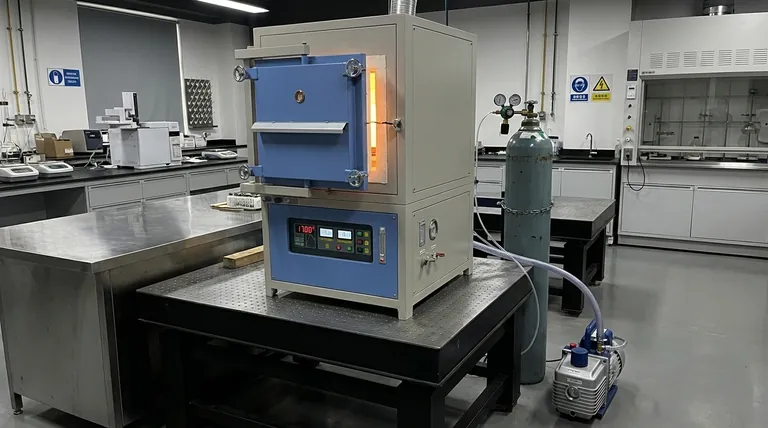
Under vacuum conditions, the pressure inside an atmosphere box furnace shifts dramatically from ambient atmospheric pressure to a significantly lower range. While a standard furnace operates near 1013 hPa, a vacuum-capable furnace can reduce this pressure to a rough vacuum of -0.1 MPa (gauge pressure) or achieve a high vacuum level as low as 10⁻³ hPa (absolute pressure), depending on the system's capabilities.
Shifting an atmosphere furnace to vacuum is not just about changing a pressure value; it transforms the chamber into a highly controlled environment, fundamentally altering its function from a simple heater to a sophisticated tool for material purification and advanced synthesis.
The Spectrum of Pressure: From Atmosphere to Vacuum
Understanding the different pressure regimes is key to utilizing an atmosphere box furnace effectively. The operational pressure directly dictates the types of processes you can perform.
Standard Atmospheric Operation
Under normal conditions, a box furnace operates at or near local atmospheric pressure. This typically falls within a range of 700 hPa to 1060 hPa. This pressure is suitable for general heat treatment, annealing, and sintering processes where interaction with air is not a concern or is intended.
The Shift to Low (Rough) Vacuum
The first step into vacuum processing involves removing the bulk of the air from the chamber. This is often referred to as a "rough" or "low" vacuum.
Many systems are rated to achieve -0.1 MPa, which is a gauge pressure measurement. This simply means the internal pressure is one atmosphere lower than the pressure outside, bringing it close to a zero-pressure state. This level is effective for preventing most oxidation during heating.
Achieving High and Ultra-High Vacuum
For more sensitive applications, a high or ultra-high vacuum is required. These systems use multi-stage pumps to reach pressures measured in absolute terms, such as 1 Pa or even 10⁻³ hPa.
Achieving these deep vacuum levels is essential for removing residual and trapped gases, enabling processes that are impossible in the presence of even trace amounts of atmosphere.
Why Vacuum is a Critical Tool in Material Processing
Creating a vacuum is not an end in itself; it is a means to create a specific, highly controlled processing environment.
Preventing Oxidation and Contamination
The primary reason to use a vacuum is to remove reactive gases, especially oxygen. At high temperatures, many materials will readily oxidize, which can ruin the sample. A vacuum environment effectively eliminates this risk.
Degassing and Material Purification
Many materials contain trapped gases within their structure. Heating a material under vacuum helps these gases escape from the bulk material, a process known as degassing. This is a critical step for purifying metals and creating components for use in high-vacuum systems.
Enabling Advanced Processes
A vacuum is a prerequisite for sophisticated techniques like Chemical Vapor Deposition (CVD). In CVD, a precursor gas is introduced into the chamber to deposit a thin film onto a substrate. A high vacuum ensures the chamber is clean before the process begins and that the precursor gases can travel to the substrate without unwanted collisions or reactions.
Understanding the Technical Trade-offs
Reaching and maintaining a vacuum introduces specific engineering challenges and costs that are not present in standard atmospheric furnaces.
The Role of Vacuum Pumps
Achieving a low vacuum (-0.1 MPa) can be done with a single mechanical pump. However, reaching high vacuum (10⁻³ hPa) requires a multi-stage pumping system, typically combining a roughing pump with a high-vacuum pump (like a turbomolecular or diffusion pump). This adds significant complexity and cost.
Furnace Sealing and Integrity
A furnace chamber must be hermetically sealed to hold a deep vacuum. This requires high-quality gaskets, precision-machined door flanges, and leak-free feedthroughs for power and sensors. Any leak, no matter how small, will prevent the system from reaching its target pressure.
Pressure Measurement: Absolute vs. Gauge
It is critical to distinguish between gauge and absolute pressure. Gauge pressure (e.g., -0.1 MPa) measures pressure relative to the outside atmosphere. Absolute pressure (e.g., 10⁻³ hPa) measures pressure relative to a perfect vacuum. High-end scientific processes almost always refer to absolute pressure for precision.
Making the Right Choice for Your Goal
Select the vacuum level based on the specific outcome you need to achieve for your material.
- If your primary focus is simple heat treatment without oxidation: A low vacuum system capable of reaching -0.1 MPa (gauge) is often sufficient and cost-effective.
- If your primary focus is material purification or degassing: You will require a high vacuum system to effectively remove trapped gases from the bulk material.
- If your primary focus is advanced deposition (CVD) or sensitive material synthesis: An ultra-high vacuum system (10⁻³ hPa or lower) with multi-stage pumping is essential for purity and process control.
Ultimately, choosing the right pressure range is about creating the ideal environment to achieve your desired material properties.
Summary Table:
| Pressure Condition | Typical Range | Key Applications |
|---|---|---|
| Standard Atmospheric | 700–1060 hPa | General heat treatment, annealing, sintering |
| Low (Rough) Vacuum | -0.1 MPa (gauge) | Oxidation prevention, basic material protection |
| High/Ultra-High Vacuum | 1 Pa to 10⁻³ hPa (absolute) | Material purification, degassing, CVD processes |
Unlock the full potential of your material processing with KINTEK's advanced furnace solutions! Leveraging exceptional R&D and in-house manufacturing, we provide diverse laboratories with high-temperature furnaces like Muffle, Tube, Rotary, Vacuum & Atmosphere Furnaces, and CVD/PECVD Systems. Our strong deep customization capability ensures we precisely meet your unique experimental requirements, whether for oxidation prevention, degassing, or advanced synthesis. Contact us today to discuss how our tailored solutions can enhance your lab's efficiency and results!
Visual Guide

Related Products
- Mesh Belt Controlled Atmosphere Furnace Inert Nitrogen Atmosphere Furnace
- 1200℃ Controlled Inert Nitrogen Atmosphere Furnace
- 1400℃ Controlled Inert Nitrogen Atmosphere Furnace
- 1700℃ Controlled Inert Nitrogen Atmosphere Furnace
- Controlled Inert Nitrogen Hydrogen Atmosphere Furnace
People Also Ask
- How is a controlled atmosphere furnace used in material research? Achieve Precise Material Synthesis and Heat Treatment
- What are the two main purposes of controlled atmosphere conditions in furnaces? Protect or Transform Materials for Peak Performance
- What types of furnaces have controlled atmosphere furnaces largely replaced? Boost Metallurgical Precision & Safety
- How does a controlled atmosphere furnace improve product quality and consistency? Master Precise Heat Treatment for Superior Results
- What types of gases can a controlled atmosphere furnace handle? Master Inert and Reactive Gases for Your Lab

















