
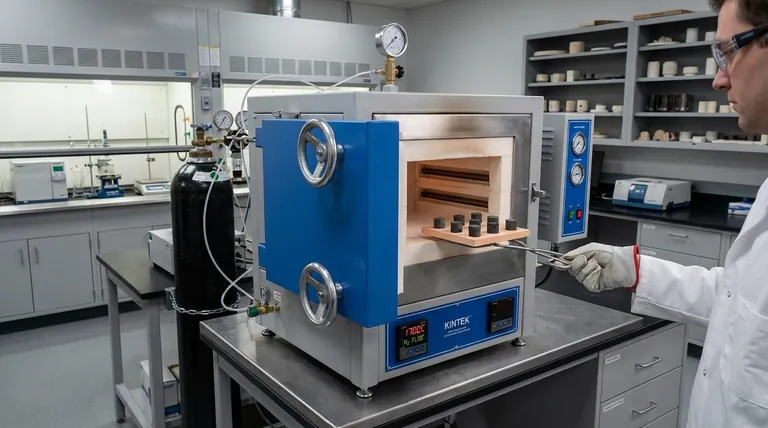
A high-temperature atmosphere sintering furnace serves as the fundamental vessel for engineering the microstructure of advanced nuclear fuel. It provides the precise thermodynamic environment—specifically temperatures around 1700°C and a reducing atmosphere—necessary to transform raw powders into dense, safety-compliant ceramics. This process enables manganese atoms to integrate into the uranium dioxide lattice, driving the densification and grain growth required for high-performance fuel.
The furnace acts as a catalyst for atomic substitution and grain boundary migration. By maintaining extreme heat and a controlled atmosphere over a prolonged period, it converts loose particles into a unified, densified ceramic with the specific grain size required for safe nuclear operation.
The Mechanics of Material Densification
To convert raw fuel materials into usable ceramics, the furnace must overcome significant energy barriers.
Generating Extreme Thermodynamics
The furnace provides the extreme thermal energy required for densification, typically operating at 1700°C. This specific temperature threshold is critical to activate the thermodynamic mechanisms that bind fuel particles together.
The Role of the Reducing Environment
Heat alone is insufficient; the chemical atmosphere is equally vital. The furnace maintains a reducing environment which chemically facilitates the interaction between the dopant and the host material. This atmosphere prevents oxidation and prepares the atomic structure for modification.
Engineering the Microstructure
The deep value of the sintering furnace lies in its ability to manipulate the fuel at an atomic level.
Enabling Atomic Substitution
Within the furnace's controlled environment, manganese atoms are able to diffuse into the uranium dioxide structure. These dopant atoms do not merely sit on the surface; they substitute positions within the lattice itself.
Driving Grain Boundary Migration
The thermal energy supplied by the furnace promotes grain boundary migration. This movement causes the microscopic grains within the material to grow and coalesce.
Achieving Target Densification
Through these combined mechanisms, the fuel particles densify into a solid ceramic. This results in a final product that possesses the specific grain sizes necessary to meet rigorous nuclear safety standards.
Process Constraints and Critical Dependencies
While the furnace enables high-performance fuel production, the process relies on strict adherence to operational variables.
The Requirement of Time
The transformation is not instantaneous; it requires prolonged sintering at a constant temperature. Shortening this duration compromises the extent of grain growth and prevents full densification.
Sensitivity to Atmospheric Conditions
The success of manganese doping is strictly bound to the reducing atmosphere. Deviating from this specific environmental condition inhibits the diffusion of manganese atoms into the lattice, resulting in sub-standard fuel.
Optimizing Sintering for Fuel Performance
The sintering furnace is the defining tool for finalizing the physical properties of the fuel pellet.
- If your primary focus is Material Density: Ensure the furnace maintains a steady 1700°C to maximize the thermodynamic energy available for particle fusion.
- If your primary focus is Doping Efficiency: Strictly control the reducing atmosphere to allow manganese atoms to successfully substitute within the uranium dioxide lattice.
Mastering the time, temperature, and atmosphere of the sintering process is the only path to producing advanced nuclear fuel that is both dense and operationally safe.
Summary Table:
| Process Parameter | Role in Fuel Development | Impact on Material |
|---|---|---|
| Temperature (1700°C) | Provides thermal energy | Activates densification and particle fusion |
| Reducing Atmosphere | Controls chemical environment | Facilitates Mn-doping and prevents oxidation |
| Sintering Time | Duration of thermal exposure | Determines grain size and final density |
| Lattice Substitution | Atomic-level manipulation | Integrates manganese into uranium dioxide structure |
Elevate Your Nuclear Research with KINTEK Precision
Ready to achieve superior material densification and precise grain control? KINTEK provides state-of-the-art Muffle, Tube, Rotary, Vacuum, and CVD systems tailored for the most demanding high-temperature applications.
Backed by expert R&D and world-class manufacturing, our lab furnaces are fully customizable to meet the unique thermodynamic and atmospheric requirements of your research. Whether you are developing advanced nuclear fuels or high-performance ceramics, KINTEK offers the reliability and precision you need to succeed.
Contact KINTEK today to discuss your custom furnace solution
References
- H. R. W. Smith, Claire L. Corkhill. Fabrication, defect chemistry and microstructure of Mn-doped UO2. DOI: 10.1038/s41598-023-50676-2
This article is also based on technical information from Kintek Furnace Knowledge Base .
Related Products
- High Temperature Muffle Oven Furnace for Laboratory Debinding and Pre Sintering
- 1700℃ Controlled Inert Nitrogen Atmosphere Furnace
- Molybdenum Vacuum Heat Treat Furnace
- Vacuum Heat Treat Sintering Furnace Molybdenum Wire Vacuum Sintering Furnace
- 2200 ℃ Tungsten Vacuum Heat Treat and Sintering Furnace
People Also Ask
- What thermal phenomena occur during polymer binder burnout in ceramic green bodies? Lab Furnace Guide
- What role does a high-temperature muffle furnace play in STFO synthesis? Achieve Pure Perovskite Results
- Why is controlled heat treatment in a muffle furnace necessary for calcined clay? Achieve Optimal Pozzolanic Activity
- How does a high-temperature muffle furnace facilitate the formation of LaNbxAl1−xO3+δ perovskite structures? Key Roles
- What role does a high-temperature muffle furnace play in the multi-stage synthesis of Li0.5MnFe1.5O4? Key to Pure Spinel



















