
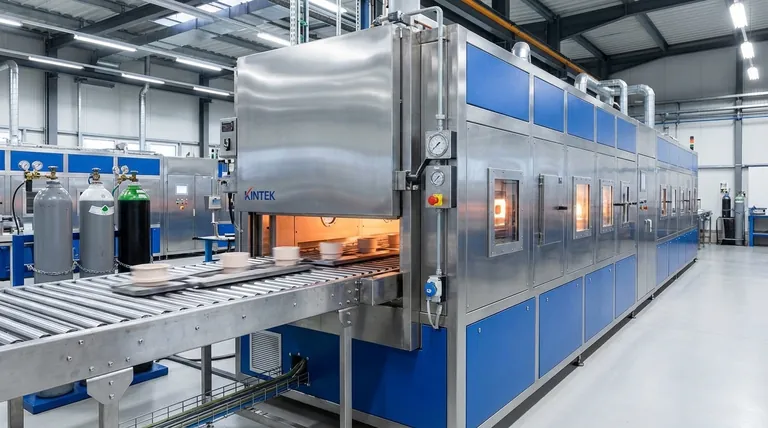
At its core, a continuous controlled atmosphere furnace operates by moving materials through a heated, sealed chamber in a constant stream while precisely managing the gas environment inside. Unlike a simple oven, it combines the efficiency of a production line with the environmental precision necessary for advanced material processing. This design ensures that every part is subjected to the exact same thermal and atmospheric conditions, enabling high-volume, repeatable manufacturing.
The critical takeaway is that a continuous controlled atmosphere furnace is not just a heating device; it is an integrated production system. It solves the challenge of scaling up sensitive thermal processes by marrying the throughput of continuous motion with the meticulous environmental control of a sealed laboratory chamber.
Deconstructing the Operation
To understand how this furnace achieves its results, we must look at its three core operational pillars: continuous material transport, a sealed heating environment, and active atmosphere management.
The Principle of Continuous Flow
The "continuous" aspect is what sets this furnace apart for high-volume applications. Materials are constantly fed into the furnace, moved through the heating zones, and discharged at the other end.
This is typically achieved using a conveyor belt, a "pusher" mechanism, or a walking beam system. The key challenge is to introduce and remove work without compromising the internal atmosphere, often solved with multi-stage entry and exit vestibules or nitrogen "curtains."
The Sealed Heating Chamber
The heating chamber is the heart of the furnace. It is a tightly sealed enclosure designed to withstand extreme temperatures and prevent external air from contaminating the process.
This chamber is constructed from specialized refractory metals or ceramics and features high-grade insulation. This construction not only contains the heat for energy efficiency but also provides the sealed environment necessary for atmosphere control.
The Atmosphere Control System
This system is what makes the furnace a "controlled atmosphere" device. It allows you to replace the ambient air with a specific gas or mixture of gases to achieve a desired chemical interaction—or lack thereof—with the material being processed.
Common atmospheres include inert gases like nitrogen or argon to prevent oxidation, or reactive gases to induce specific surface treatments. The system actively monitors and purges the chamber to maintain these precise atmospheric conditions throughout the process.
Key Advantages of a Continuous System
The integration of these systems delivers significant benefits for specific industrial and laboratory processes.
High-Volume Throughput
The primary advantage is production efficiency. By eliminating the need to load, heat, cool, and unload individual batches, a continuous furnace dramatically increases throughput and reduces labor costs.
Unmatched Process Consistency
Because every part follows the exact same path through the exact same thermal and atmospheric profile, part-to-part and batch-to-batch variation is minimized. This is critical for applications like brazing and sintering where consistency is paramount.
Enhanced Energy Efficiency
While a large furnace requires significant energy, the continuous operation is more efficient than the constant heating and cooling cycles of a batch furnace. Heat is maintained at a steady state, reducing overall energy consumption per part produced.
Understanding the Trade-offs
No single technology is a universal solution. Understanding the limitations of a continuous controlled atmosphere furnace is crucial for making an informed decision.
Atmosphere Purity vs. Throughput
The entry and exit points required for continuous operation are a potential source of contamination. While designs mitigate this, they cannot achieve the perfect hermetic seal of a batch furnace, making them less suitable for processes requiring the absolute highest purity or deep vacuum conditions.
Flexibility and Process Changes
These furnaces are optimized for a specific, consistent process. Changing the temperature profile or atmosphere is a significant undertaking. They lack the flexibility of smaller batch furnaces, which are better suited for research, development, or producing a wide variety of small-run parts.
Upfront Cost and Complexity
A continuous furnace is a complex, integrated system. The initial investment in equipment, installation, and control systems is substantially higher than for a standard batch furnace.
Making the Right Choice for Your Process
Selecting the correct furnace technology depends entirely on your primary goal.
- If your primary focus is high-volume manufacturing with repeatable quality: A continuous controlled atmosphere furnace is the ideal solution for processes like industrial heat treatment or brazing.
- If your primary focus is material research or producing diverse, small-run parts: A more flexible and less costly batch-style controlled atmosphere furnace will better serve your needs.
- If your primary focus is achieving an ultra-pure environment without any oxidation: A dedicated batch vacuum furnace is the superior technology, as it eliminates the atmospheric challenges inherent in a continuous system.
Ultimately, choosing the right thermal processing equipment is about aligning the tool's core strengths with your specific operational requirements.
Summary Table:
| Aspect | Description |
|---|---|
| Operation | Moves materials continuously through a sealed, heated chamber with precise gas control for uniform processing. |
| Key Components | Continuous transport (e.g., conveyor), sealed heating chamber, active atmosphere management system. |
| Advantages | High throughput, unmatched consistency, enhanced energy efficiency. |
| Limitations | Lower atmosphere purity vs. batch furnaces, less flexibility, higher upfront cost. |
| Ideal For | High-volume manufacturing with repeatable quality, such as industrial heat treatment. |
Ready to enhance your lab's efficiency with precision high-temperature solutions? Leveraging exceptional R&D and in-house manufacturing, KINTEK provides diverse laboratories with advanced furnaces like Muffle, Tube, Rotary, Vacuum & Atmosphere, and CVD/PECVD Systems. Our strong deep customization capability ensures we meet your unique experimental needs. Contact us today to discuss how our continuous controlled atmosphere furnaces can drive your high-volume processes forward!
Visual Guide

Related Products
- 1700℃ Controlled Inert Nitrogen Atmosphere Furnace
- 1200℃ Controlled Inert Nitrogen Atmosphere Furnace
- 1400℃ Controlled Inert Nitrogen Atmosphere Furnace
- Mesh Belt Controlled Atmosphere Furnace Inert Nitrogen Atmosphere Furnace
- Controlled Inert Nitrogen Hydrogen Atmosphere Furnace
People Also Ask
- How do controlled-atmosphere furnaces support polymer pyrolysis? Master SiC & Si3N4 Ceramic Conversion
- How does real-time dilatometric analysis in a controlled-atmosphere furnace optimize PZT ceramic sintering?
- Why is thorough binder burnout necessary before sintering advanced ceramics? Ensure Peak Density & Zero Defects
- Why is controlled-atmosphere heating required for functional ceramics and sensors? Master Defect Engineering
- How do controlled-atmosphere furnaces verify ceramic powder sinterability? Get True Empirical Densification Data



















