Cordierite (MgO-SiO2-Al2O3) is selected as the primary support material for hydroxylammonium nitrate (HAN) decomposition catalysts due to its exceptional capacity to withstand extreme thermal environments while maintaining structural integrity. Its unique properties allow it to endure instantaneous temperature spikes up to 1200°C without failure, ensuring reliable operation in satellite thrusters.
The selection of cordierite is driven by a critical engineering balance: it combines high mechanical strength and thermal shock resistance with a geometry that maximizes catalytic efficiency. This allows for the rapid, uniform decomposition of liquid propellants while minimizing flow resistance.
Thermal Durability in Extreme Environments
Surviving Thermal Shock
The decomposition of HAN-based propellants generates intense heat almost instantly. Thermal shock resistance is the most critical attribute for a catalyst support in this context.
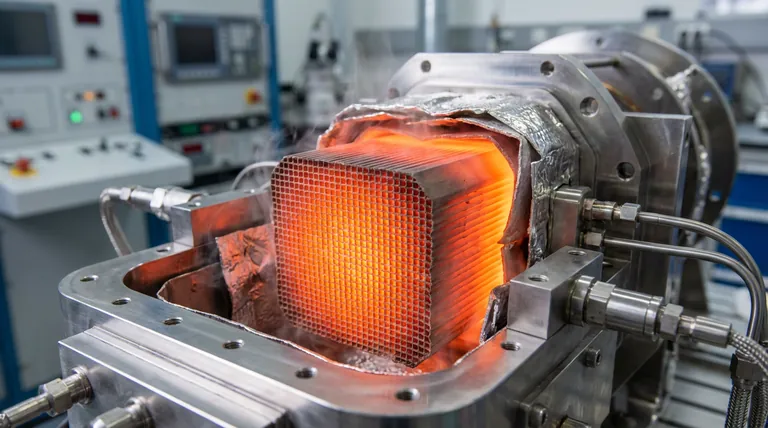
Cordierite is specifically engineered to withstand rapid temperature changes. It can survive instantaneous exposure to temperatures as high as 1200°C without cracking or structural degradation.
Preventing Structural Failure
In the harsh environment of a satellite thruster, material failure is not an option.
Cordierite offers high mechanical strength, ensuring the honeycomb structure remains intact under the physical stresses of propulsion. This durability prevents the catalyst bed from collapsing during operation.
Optimizing Propellant Decomposition
Maximizing Surface Area
Efficient catalysis requires maximum contact between the liquid propellant and the active catalytic material.
The multi-channel honeycomb structure of cordierite supports provides a massive geometric surface area. This ensures the HAN propellant has uniform contact with the catalyst, leading to complete and efficient decomposition.
Reducing Flow Resistance
While high surface area is necessary for reaction efficiency, it must not impede the flow of the propellant.
Cordierite honeycombs are characterized by low back-pressure. This property allows the decomposed gases to exit the thruster efficiently, maximizing the propulsion system's overall performance.
Understanding the Trade-offs
The Thermal Ceiling
While cordierite is robust, it is not invincible. The material is rated for instantaneous temperatures up to 1200°C.
If a propulsion system requires operating temperatures significantly exceeding this threshold, cordierite may face structural failure. Engineers must ensure the combustion profile of the HAN blend stays within this thermal envelope.
Balancing Area and Pressure
The honeycomb design is a compromise between surface area and flow dynamics.
Increasing the channel density improves reaction efficiency but can potentially increase back-pressure. Cordierite is selected because it occupies the "sweet spot" where catalytic contact is maximized without choking the flow.
Making the Right Choice for Your Project
When designing catalyst beds for liquid propulsion, understanding your specific operational constraints is vital.
- If your primary focus is Reliability: Ensure your maximum theoretical combustion temperature does not exceed the 1200°C thermal shock limit of cordierite.
- If your primary focus is Efficiency: Leverage the multi-channel honeycomb geometry to maximize propellant-to-catalyst contact for uniform decomposition.
- If your primary focus is System Performance: rely on the low back-pressure characteristics of cordierite to maintain optimal thrust levels without flow restriction.
Cordierite remains the industry standard because it reliably bridges the gap between thermal survival and aerodynamic efficiency.
Summary Table:
| Key Feature | Performance Benefit |
|---|---|
| Material Composition | MgO-SiO2-Al2O3 (Cordierite) |
| Thermal Resistance | Withstands instantaneous spikes up to 1200°C |
| Geometry | Multi-channel honeycomb for high surface area |
| Flow Dynamics | Low back-pressure for maximum propulsion efficiency |
| Mechanical Status | High strength to prevent structural failure under stress |
Elevate Your Aerospace Research with KINTEK
Precision engineering is the backbone of reliable propulsion. Backed by expert R&D and manufacturing, KINTEK offers a wide range of laboratory high-temperature solutions, including Muffle, Tube, Rotary, Vacuum, and CVD systems. Whether you are testing HAN-based propellants or developing advanced catalyst supports, our systems are fully customizable to meet your unique thermal and structural needs.
Don't let material failure compromise your mission. Contact KINTEK today to discover how our high-temperature expertise can bring your project to life.
References
- Dalsan Yoo, Jong‐Ki Jeon. Synthesis of Hydroxylammonium Nitrate and Its Decomposition over Metal Oxide/Honeycomb Catalysts. DOI: 10.3390/catal14020116
This article is also based on technical information from Kintek Furnace Knowledge Base .
Related Products
- High Temperature Muffle Oven Furnace for Laboratory Debinding and Pre Sintering
- Multi Heating Zones CVD Tube Furnace Machine for Chemical Vapor Deposition Equipment
- Controlled Inert Nitrogen Hydrogen Atmosphere Furnace
- Electric Rotary Kiln Small Rotary Furnace for Activated Carbon Regeneration
- Multi Zone Laboratory Quartz Tube Furnace Tubular Furnace
People Also Ask
- What thermal phenomena occur during polymer binder burnout in ceramic green bodies? Lab Furnace Guide
- Why is controlled heat treatment in a muffle furnace necessary for calcined clay? Achieve Optimal Pozzolanic Activity
- What role does a high-temperature muffle furnace play in STFO synthesis? Achieve Pure Perovskite Results
- How does a high-temperature muffle furnace facilitate the formation of LaNbxAl1−xO3+δ perovskite structures? Key Roles
- What role does a high-temperature muffle furnace play in the multi-stage synthesis of Li0.5MnFe1.5O4? Key to Pure Spinel