
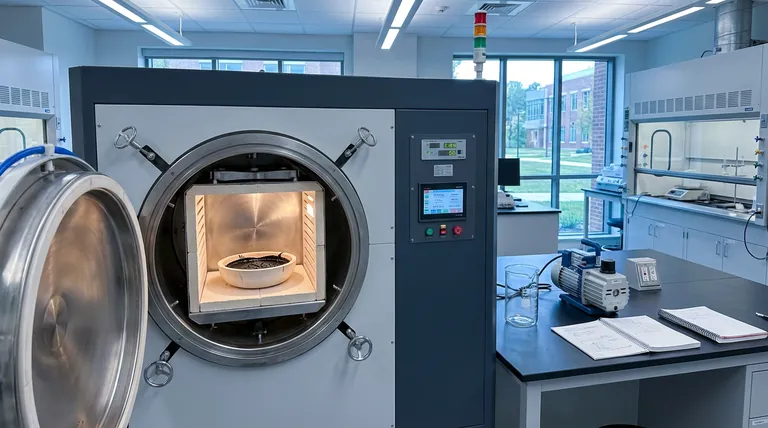
The primary reason for utilizing a vacuum oven is to facilitate the efficient removal of solvents from the sodium iron phosphate (NaFePO4) gel precursor at significantly reduced temperatures. This process protects the material from oxidation and compositional segregation, which commonly occur when iron-based precursors are exposed to high heat in an aerobic environment. Additionally, the vacuum ensures uniform solvent evaporation, preventing structural cracks and yielding a stable xerogel for the subsequent calcination phase.
Core Insight: The vacuum oven is not merely a drying tool; it is a preservation environment. By lowering the boiling point of the solvent, it allows you to lock in the chemical homogeneity and physical structure of the precursor without subjecting it to the destructive thermal stress and oxidative potential of standard air drying.
Protecting Chemical Composition
Lowering the Thermal Threshold
The central advantage of a vacuum oven is its ability to depress the boiling point of solvents. This allows for rapid drying at temperatures that are safe for the precursor.
By keeping the temperature low, you minimize the kinetic energy available for unwanted side reactions. This is particularly critical for sodium iron phosphate, as high temperatures can alter the intended stoichiometry.
Preventing Oxidation
Iron-based compounds are inherently susceptible to oxidation when heated in the presence of oxygen. A standard oven acts as an oxidizing environment, potentially converting Fe(II) to Fe(III) prematurely.
The vacuum environment removes ambient air, creating an inert atmosphere. This preserves the valence state of the iron and ensures the precursor remains chemically pure.
Avoiding Compositional Segregation
Extended exposure to heat can cause constituent elements within a gel to separate or migrate. This leads to a non-homogeneous material.
Vacuum drying accelerates the solvent removal process, locking the elements in place. This maintains the uniform distribution of sodium, iron, and phosphate ions achieved during the sol-gel mixing phase.
Ensuring Structural Stability
Promoting Uniform Evaporation
In a standard oven, drying often occurs from the outside in, creating a "skin" that traps moisture and leads to pressure buildup. This differential drying causes stress within the material.
A vacuum environment promotes evaporation from within the bulk of the material simultaneously. This uniformity is essential for maintaining the integrity of the gel structure.
Preventing Cracks in the Green Body
The "green body" (the unfired ceramic precursor) is fragile. Uneven drying forces can cause macro- and micro-cracking, which ruins the mechanical stability of the final product.
By removing solvents gently and uniformly, vacuum drying mitigates these capillary stresses. The result is a crack-free, stable xerogel sample that is ready to withstand the rigors of calcination.
Understanding the Trade-offs
Process Control Sensitivity
While vacuum drying prevents oxidation, it introduces the risk of "bumping" or violent boiling if the pressure is reduced too quickly. This can physically scatter the powder or damage the pore structure.
Equipment Complexity
Unlike simple convection drying, vacuum drying requires precise maintenance of seals and pumps. Any leak in the system introduces oxygen, negating the primary chemical benefit of the process.
Making the Right Choice for Your Goal
To maximize the quality of your NaFePO4 precursor, align your drying parameters with your specific material constraints.
- If your primary focus is Chemical Purity: Prioritize the lowest possible temperature setting that still allows evaporation, relying on deep vacuum to drive the process and strictly preventing oxidation.
- If your primary focus is Structural Morphology: Modulate the vacuum pressure to ensure a slow, steady evaporation rate, avoiding rapid pressure drops that could collapse the gel's pore structure.
Ultimately, the vacuum oven serves as a critical stabilization step, ensuring that the intricate chemistry you engineered in the liquid phase is faithfully preserved in the solid phase.
Summary Table:
| Feature | Vacuum Drying Benefit | Impact on NaFePO4 Precursor |
|---|---|---|
| Temperature | Lowered boiling point | Minimizes thermal stress and side reactions |
| Atmosphere | Oxygen-free environment | Prevents Fe(II) to Fe(III) oxidation |
| Drying Uniformity | Internal & surface evaporation | Eliminates structural cracks and skinning |
| Homogeneity | Faster solvent removal | Prevents compositional segregation |
| Final State | Stable xerogel | Ensures ideal stoichiometry for calcination |
Optimize Your Advanced Material Synthesis with KINTEK
Precise control over the drying environment is essential for high-performance battery materials like NaFePO4. KINTEK provides industry-leading vacuum, tube, and muffle furnace systems designed to meet the rigorous demands of laboratory research and pilot production.
Our Value to You:
- Expert R&D & Manufacturing: Solutions engineered for superior thermal uniformity and vacuum integrity.
- Customizable Systems: Tailored configurations for CVD, rotary, and high-temp processes to match your unique precursors.
- Quality Assurance: Reliable equipment that prevents oxidation and locks in chemical homogeneity.
Elevate your lab’s efficiency and material purity today. Contact KINTEK for a specialized consultation!
References
- Krishna Dagadkhair, Paresh H. Salame. Electronic Transport Properties of Carbon‐Encapsulated Maricite NaFePO<sub>4</sub> as Cathode Material for Sodium‐Ion Batteries. DOI: 10.1002/adsu.202500188
This article is also based on technical information from Kintek Furnace Knowledge Base .
Related Products
- Vacuum Heat Treat Sintering and Brazing Furnace
- Vacuum Heat Treat Sintering Furnace Molybdenum Wire Vacuum Sintering Furnace
- Dental Porcelain Zirconia Sintering Ceramic Vacuum Press Furnace
- Vacuum Hot Press Furnace Machine for Lamination and Heating
- Vacuum Hot Press Furnace Machine Heated Vacuum Press
People Also Ask
- What are the benefits of using vacuum heat treating furnaces for metal alloys? Achieve Superior Metal Properties and Performance
- How does vacuum heat treating affect the grain structure of metal alloys? Achieve Precise Microstructure Control
- What is one of the most important uses of vacuum heat treating furnaces in aerospace? Achieve Superior Strength in Aircraft Alloys
- What is the temperature of a vacuum furnace brazing? Optimize Your Joint Strength and Cleanliness
- What are the steps involved in a typical vacuum brazing treatment? Master the Process for Strong, Clean Joints



















