
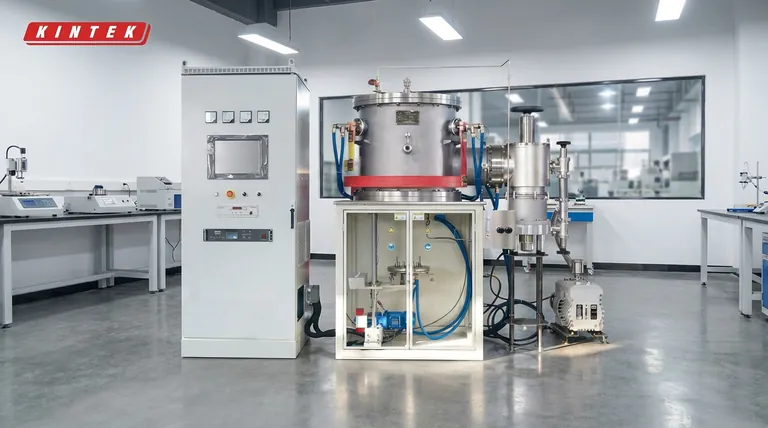
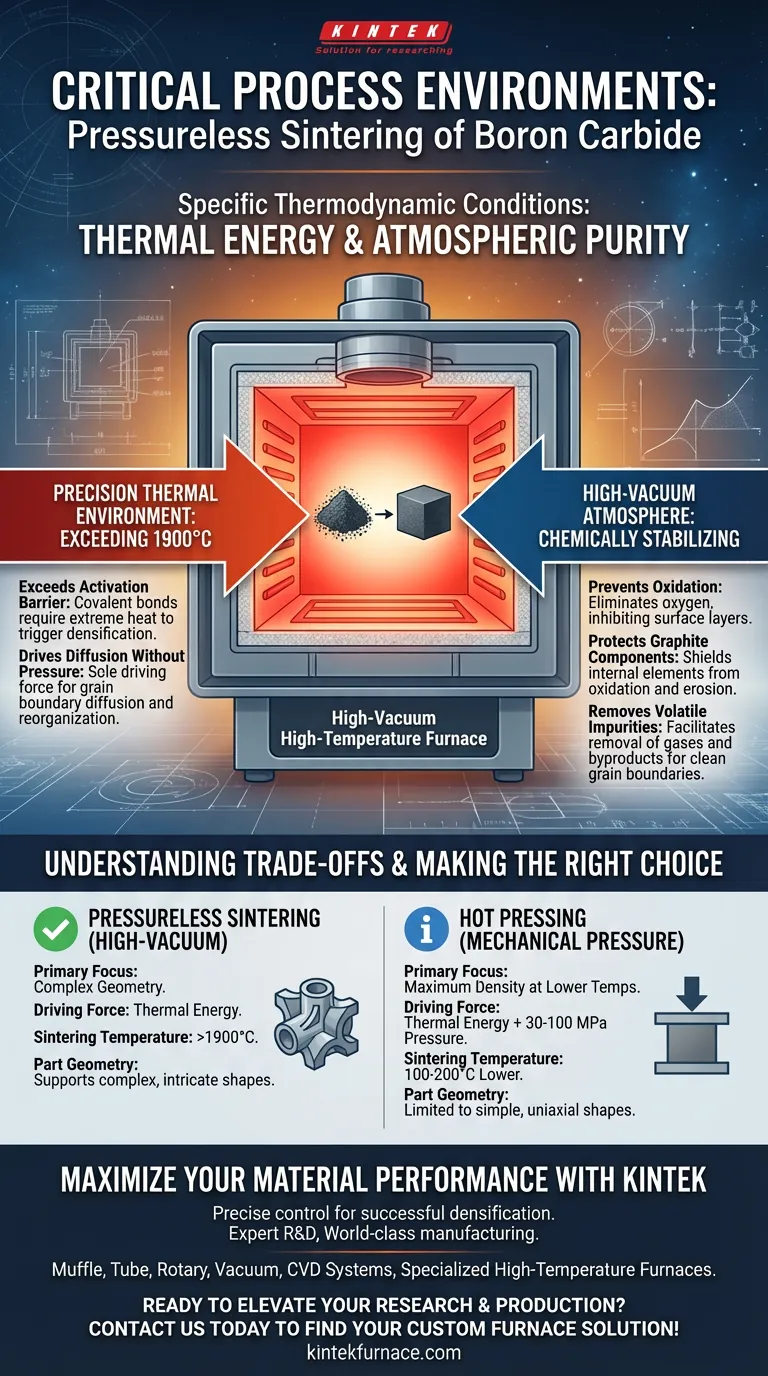
A high-vacuum high-temperature furnace creates the specific thermodynamic conditions necessary to sinter boron carbide without external mechanical force. Specifically, it generates a precise thermal environment exceeding 1900 degrees Celsius while simultaneously maintaining a high-vacuum atmosphere to chemically stabilize the material.
The core function of this equipment is to replace mechanical pressure with thermal energy and atmospheric purity. By eliminating oxygen and removing volatiles, the furnace allows grain boundary diffusion to drive densification entirely through heat, ensuring the integrity of both the boron carbide and the furnace's graphite components.
The Role of the Thermal Environment
Exceeding the Activation Barrier
Boron carbide is a covalent material with extremely strong chemical bonds, making it resistant to sintering.
To trigger densification, the furnace must provide precise temperature control exceeding 1900°C.
Driving Diffusion Without Pressure
In a pressureless process, there is no mechanical force (such as a ram) to physically close pores.
Consequently, the furnace uses this extreme thermal energy as the sole driving force to activate grain boundary diffusion and grain reorganization.
The Critical Function of High Vacuum
Prevention of Oxidation
The most immediate threat to boron carbide sintering is oxygen. At high temperatures, boron carbide oxidizes rapidly, creating surface layers that inhibit bonding.
The high-vacuum environment eliminates oxygen from the chamber, preventing the degradation of the boron carbide powder.
Protection of Graphite Components
These furnaces often utilize graphite heating elements or insulation to achieve temperatures above 1900°C.
The vacuum environment is equally critical for protecting these internal graphite components from oxidation and erosion.
Removal of Volatile Impurities
During the sintering process, materials often release gases or volatile byproducts.
The vacuum actively facilitates the removal of these volatile substances, cleaning the grain boundaries to enable liquid-phase or solid-phase densification.
Understanding the Trade-offs
Higher Temperature Requirements
It is important to recognize that relying solely on a vacuum furnace changes the energy requirements compared to other methods.
While pressureless sintering is effective, it typically requires higher temperatures than vacuum hot pressing, which uses external pressure (30-100 MPa) to lower the necessary densification temperature by 100-200°C.
Sensitivity to Surface Activity
Because there is no external pressure to force particles together, the process is highly sensitive to particle surface chemistry.
If the vacuum level is insufficient to maintain surface activity, densification will stall, whereas a pressurized system might overcome slight surface impurities through brute force.
Making the Right Choice for Your Goal
To select the correct processing path, you must weigh geometric complexity against densification ease.
- If your primary focus is complex geometry: Rely on the high-vacuum high-temperature furnace, as pressureless sintering allows for net-shape manufacturing of intricate parts that cannot be uniaxially pressed.
- If your primary focus is maximum density at lower temperatures: Consider hot pressing, where mechanical pressure acts as an additional driving force to eliminate internal pores and lower thermal requirements.
Success in pressureless sintering ultimately depends on the furnace's ability to maintain a pristine, oxygen-free vacuum while delivering the extreme thermal energy required to fuse covalent bonds.
Summary Table:
| Feature | Pressureless Sintering (High-Vacuum) | Hot Pressing (Mechanical Pressure) |
|---|---|---|
| Sintering Temperature | Exceeds 1900°C | 100-200°C lower than pressureless |
| Driving Force | Thermal energy & grain boundary diffusion | Thermal energy + 30-100 MPa pressure |
| Atmosphere | High Vacuum (eliminates oxygen) | Vacuum or Inert Gas |
| Part Geometry | Supports complex, intricate shapes | Limited to simple, uniaxial shapes |
| Graphite Protection | Essential vacuum shielding | Integrated pressure/vacuum systems |
Maximize Your Material Performance with KINTEK
Precise control over high-vacuum and high-temperature environments is the difference between successful densification and material failure. Backed by expert R&D and world-class manufacturing, KINTEK offers a comprehensive range of Muffle, Tube, Rotary, Vacuum, and CVD systems, as well as specialized high-temperature furnaces. Whether you need to sinter complex boron carbide geometries or require customized high-pressure solutions, our laboratory equipment is built for reliability and precision.
Ready to elevate your research and production? Contact us today to find your custom furnace solution!
Visual Guide
References
- O. A. Reutova, В. А. Светличный. Self‐Dispersing of (CuO<sub>x</sub>)<sub>n</sub> Species on Dark TiO<sub>2</sub> Surface as a Key to High‐Performance HER Photocatalysts. DOI: 10.1002/cctc.202500594
This article is also based on technical information from Kintek Furnace Knowledge Base .
Related Products
- 2200 ℃ Tungsten Vacuum Heat Treat and Sintering Furnace
- 2200 ℃ Graphite Vacuum Heat Treat Furnace
- Molybdenum Vacuum Heat Treat Furnace
- Vacuum Heat Treat Sintering Furnace Molybdenum Wire Vacuum Sintering Furnace
- High Temperature Muffle Oven Furnace for Laboratory Debinding and Pre Sintering
People Also Ask
- How does a tungsten-heated vacuum sintering furnace prepare (TbxY1-x)2O3 ceramics? Achieve 99%+ Density & Purity
- How do compaction pressure and vacuum sintering optimize porous ceramics? Maximize Density & Toughness
- What wear-resistance enhancements are achieved by powder coating? The Role of Vacuum Sintering Furnaces
- What role does a high-temperature vacuum sintering furnace play in the densification of WC-10(Ni, Ni/Co) alloys?
- What core role does a high-temperature vacuum sintering furnace play in Sm:YAG ceramics? Mastering Optical Clarity



















