
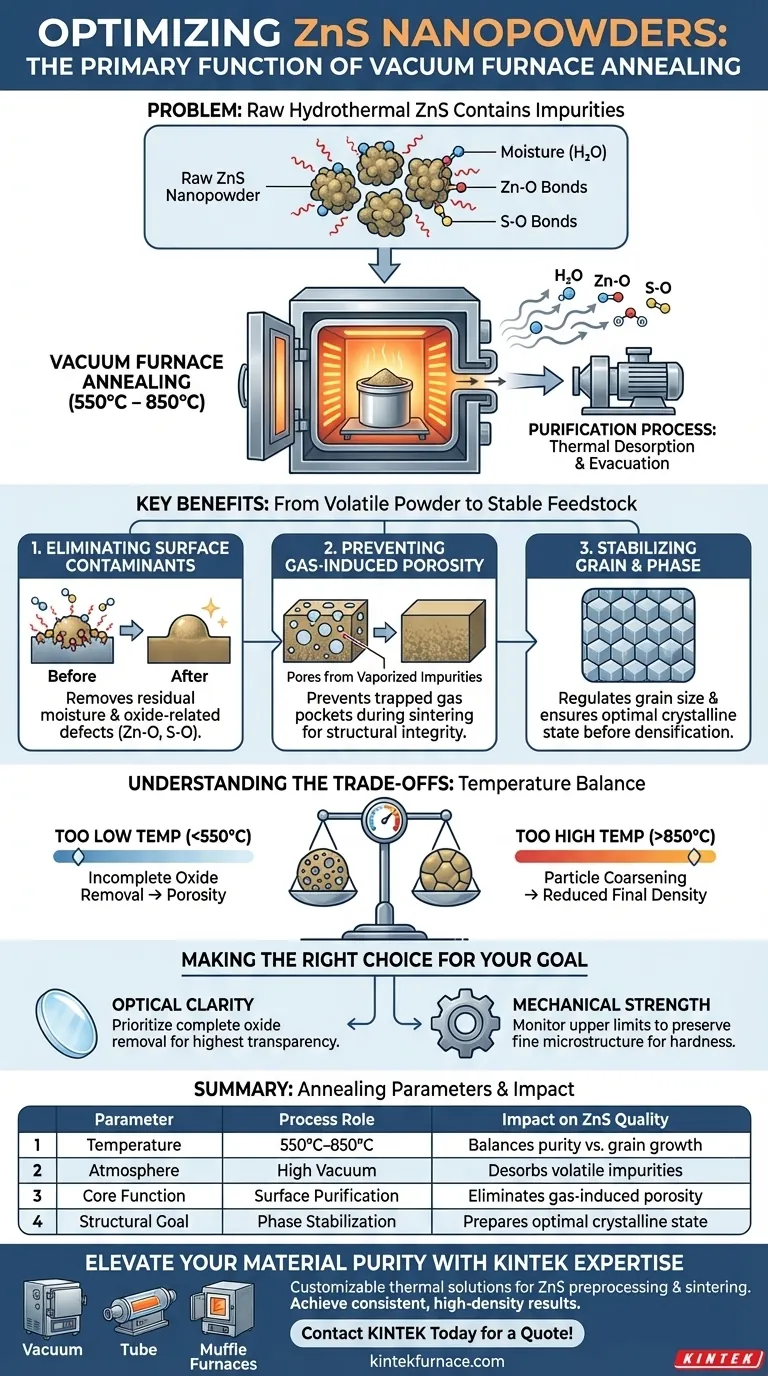
The primary function of vacuum furnace annealing is to purify the surface of Zinc Sulfide (ZnS) nanopowders by eliminating residual moisture and oxide-related defects. Typically performed between 550°C and 850°C, this preprocessing step is critical for removing contaminants like Zn-O and S-O bonds that naturally occur during hydrothermal synthesis.
By purging volatile impurities and oxides before the material is compacted, vacuum annealing prevents gas-induced porosity and ensures the final ceramic achieves structural integrity. It serves as a crucial bridge between raw powder synthesis and high-density sintering.
The Role of Annealing in Defect Reduction
Eliminating Surface Contaminants
ZnS nanopowders synthesized via hydrothermal methods often retain significant surface impurities. These include residual moisture and specific oxide bonds, such as Zn-O and S-O.
Vacuum annealing targets these defects thermally. By exposing the powder to heat in a vacuum, these volatile components are desorbed and evacuated from the material.
Preventing Gas-Induced Porosity
If left untreated, surface oxides and moisture become a major liability during later processing stages. When the powder is subjected to the high temperatures of sintering or hot pressing, these impurities vaporize.
This vaporization creates trapped gas pockets within the material. By annealing beforehand, you remove the source of these gases, preventing the formation of pores that would weaken the final ceramic.
Stabilizing Grain and Phase
Beyond cleaning, annealing acts as a control mechanism for the material's physical structure. It helps regulate grain size before the powder undergoes final densification.
The process also assists in managing phase transformation. This ensures the powder is in the optimal crystalline state for subsequent processing steps.
Understanding the Trade-offs
Temperature Balance and Particle Growth
While annealing is necessary for purity, the processing temperature must be carefully calibrated (typically 550°C–850°C).
If the temperature is too low, the removal of oxide defects will be incomplete, leading to porosity later.
If the temperature is too high, the particles may begin to coarsen or sinter prematurely. Excessive grain growth at this stage can reduce the driving force for densification in the final sintering step, limiting the final density.
Making the Right Choice for Your Goal
To optimize the quality of your ZnS ceramics, align your annealing parameters with your specific performance requirements:
- If your primary focus is optical clarity: Prioritize complete oxide removal to eliminate scattering centers and gas pores, ensuring the highest possible transparency.
- If your primary focus is mechanical strength: Monitor the upper temperature limits carefully to prevent excessive grain growth, preserving the fine microstructure needed for hardness.
Correctly executed vacuum annealing transforms a volatile raw powder into a stable feedstock ready for high-performance fabrication.
Summary Table:
| Parameter | Process Role | Impact on ZnS Quality |
|---|---|---|
| Temperature Range | 550°C – 850°C | Balances purity vs. grain growth control |
| Atmosphere | High Vacuum | Desorbs volatile impurities like Zn-O and S-O bonds |
| Core Function | Surface Purification | Eliminates gas-induced porosity in final ceramics |
| Structural Goal | Phase Stabilization | Prepares optimal crystalline state for sintering |
Elevate Your Material Purity with KINTEK Expertise
Don't let surface defects compromise your advanced ceramic production. KINTEK provides state-of-the-art thermal solutions, including specialized Vacuum, Tube, and Muffle furnaces designed for the rigorous demands of ZnS preprocessing and sintering.
Backed by expert R&D and precision manufacturing, our systems are fully customizable to help you achieve the perfect balance of grain control and oxide removal. Whether you are focused on optical clarity or mechanical strength, our high-temp lab furnaces ensure consistent, high-density results.
Ready to optimize your lab's efficiency? Contact KINTEK today to discuss your unique project requirements and request a quote!
Visual Guide
Related Products
- Vacuum Heat Treat Sintering Furnace with Pressure for Vacuum Sintering
- Molybdenum Vacuum Heat Treat Furnace
- Vacuum Heat Treat Sintering and Brazing Furnace
- Vacuum Induction Melting Furnace
- Vacuum Heat Treat Sintering Furnace Molybdenum Wire Vacuum Sintering Furnace
People Also Ask
- What is one of the most important uses of vacuum heat treating furnaces in aerospace? Achieve Superior Strength in Aircraft Alloys
- How does vacuum heat treating affect the grain structure of metal alloys? Achieve Precise Microstructure Control
- What are the benefits of using vacuum heat treating furnaces for metal alloys? Achieve Superior Metal Properties and Performance
- What is the purpose of setting a mid-temperature dwell stage? Eliminate Defects in Vacuum Sintering
- What are the key components of a vacuum sintering furnace? Essential Parts for Precision Material Processing



















