
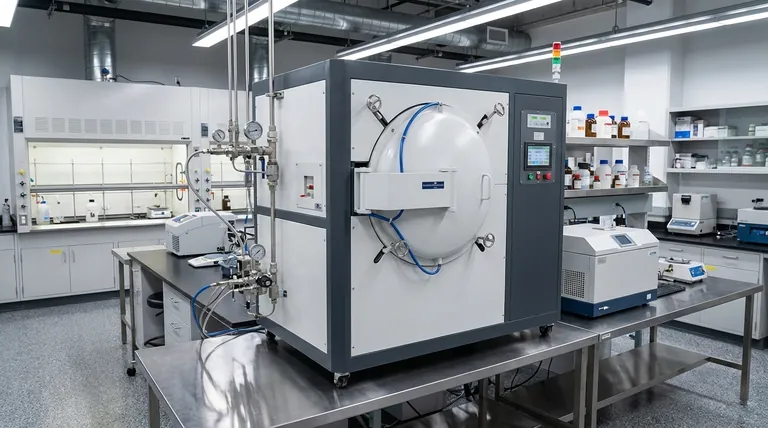
A vacuum oven is a critical requirement for the "deep drying" phase of carbon nanosphere (CNS) production, specifically following the centrifugal washing process. It functions by creating a low-pressure environment that significantly lowers the boiling point of residual solvents—such as moisture and ethanol—allowing them to be removed completely without subjecting the material to damaging heat.
Core Takeaway Standard thermal drying often degrades nanomaterials through oxidation and clumping. A vacuum oven solves this by enabling low-temperature solvent extraction, which is the only way to ensure the structural integrity, chemical stability, and proper dispersion of the final carbon nanosphere powder.
The Mechanics of Deep Drying
Lowering the Boiling Point
The primary mechanism at work is the relationship between pressure and vaporization. By reducing the atmospheric pressure within the chamber, the vacuum oven lowers the temperature at which solvents boil.
This allows for the rapid evaporation of ethanol and water without requiring the high thermal energy needed in a standard oven.
Extracting Internal Moisture
Carbon nanospheres often trap solvents within their porous structures, not just on the surface. Standard drying methods frequently fail to reach this trapped liquid.
The vacuum environment facilitates "deep drying," effectively pulling moisture and ethanol from both the interior and the surface of the particles. This ensures the final product is completely dry, rather than just superficially dry.
Critical Quality Protections
Preventing Oxidation
Carbon nanospheres are highly sensitive to their environment during processing. Exposing them to high temperatures in the presence of air (oxygen) often leads to oxidation.
Oxidation alters the chemical composition of the CNSs, degrading their intended properties. The vacuum oven mitigates this by removing air from the chamber, allowing the material to dry in an oxygen-deprived environment.
Preserving Dispersion and Activity
The utility of nanoparticles depends heavily on their surface area and dispersion. If particles clump together, their effectiveness drops.
Vacuum drying prevents agglomeration (clumping). By avoiding the uneven heating patterns characteristic of standard convection ovens, the vacuum process ensures the final powder remains loose, dispersed, and chemically active.
Common Pitfalls to Avoid
The Danger of High-Temperature Air
A common error in material processing is attempting to accelerate drying by simply increasing the temperature in a standard air oven.
According to the process requirements, this results in the oxidation of the carbon nanospheres. You effectively sacrifice the chemical purity of the material for the sake of drying speed.
The Risk of Uneven Heating
Using non-vacuum heating methods often results in thermal gradients—hot spots and cool spots within the material batch.
This uneven heating is a primary cause of particle agglomeration. Once nanospheres agglomerate during the drying phase, it is extremely difficult to re-disperse them, rendering the powder less active for its intended application.
Ensuring Process Integrity
To maximize the quality of your carbon nanospheres, align your equipment choices with your specific quality goals:
- If your primary focus is Chemical Purity: Rely on the vacuum oven to eliminate oxygen exposure, preventing surface oxidation that occurs in high-temperature air.
- If your primary focus is Particle Performance: Use the vacuum environment to ensure uniform, low-temperature drying that prevents agglomeration and maintains high dispersibility.
The vacuum oven is not merely a drying tool; it is a preservation instrument essential for maintaining the high-performance characteristics of nanotechnology.
Summary Table:
| Feature | Vacuum Oven Drying | Standard Air Oven Drying |
|---|---|---|
| Mechanism | Low-pressure vaporization | High-temperature convection |
| Oxidation Risk | Near zero (Oxygen-deprived) | High (Heat + Air exposure) |
| Particle Integrity | Prevents agglomeration | High risk of clumping |
| Moisture Removal | Deep extraction from pores | Surface-level only |
| Resulting Quality | High purity & dispersibility | Chemically degraded & active loss |
Elevate Your Nanomaterial Integrity with KINTEK
Precision in the drying phase is non-negotiable for high-performance carbon nanospheres. KINTEK provides industry-leading vacuum systems designed to prevent oxidation and ensure perfect particle dispersion. Backed by expert R&D and manufacturing, KINTEK offers a full suite of Muffle, Tube, Rotary, Vacuum, and CVD systems, all fully customizable to meet your unique lab requirements.
Ready to optimize your CNS production flow? Contact us today to find the perfect vacuum solution and secure the chemical purity your research demands.
Visual Guide

References
- Kaihe Lv, Jinsheng Sun. Microwave-Assisted Synthesis of Carbon Nanospheres and Their Application as Plugging Agents for Oil-Based Drilling Fluids. DOI: 10.3390/molecules30030463
This article is also based on technical information from Kintek Furnace Knowledge Base .
Related Products
- Vacuum Heat Treat Sintering and Brazing Furnace
- Vacuum Heat Treat Sintering Furnace Molybdenum Wire Vacuum Sintering Furnace
- Dental Porcelain Zirconia Sintering Ceramic Vacuum Press Furnace
- Vacuum Hot Press Furnace Machine for Lamination and Heating
- Vacuum Hot Press Furnace Machine Heated Vacuum Press
People Also Ask
- What is one of the most important uses of vacuum heat treating furnaces in aerospace? Achieve Superior Strength in Aircraft Alloys
- How does vacuum heat treating affect the grain structure of metal alloys? Achieve Precise Microstructure Control
- What are the benefits of using vacuum heat treating furnaces for metal alloys? Achieve Superior Metal Properties and Performance
- What is the temperature of a vacuum furnace brazing? Optimize Your Joint Strength and Cleanliness
- What are the steps involved in a typical vacuum brazing treatment? Master the Process for Strong, Clean Joints



















