
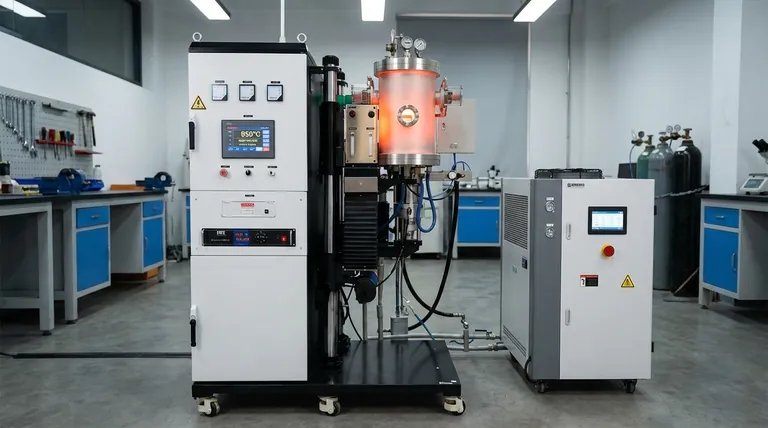
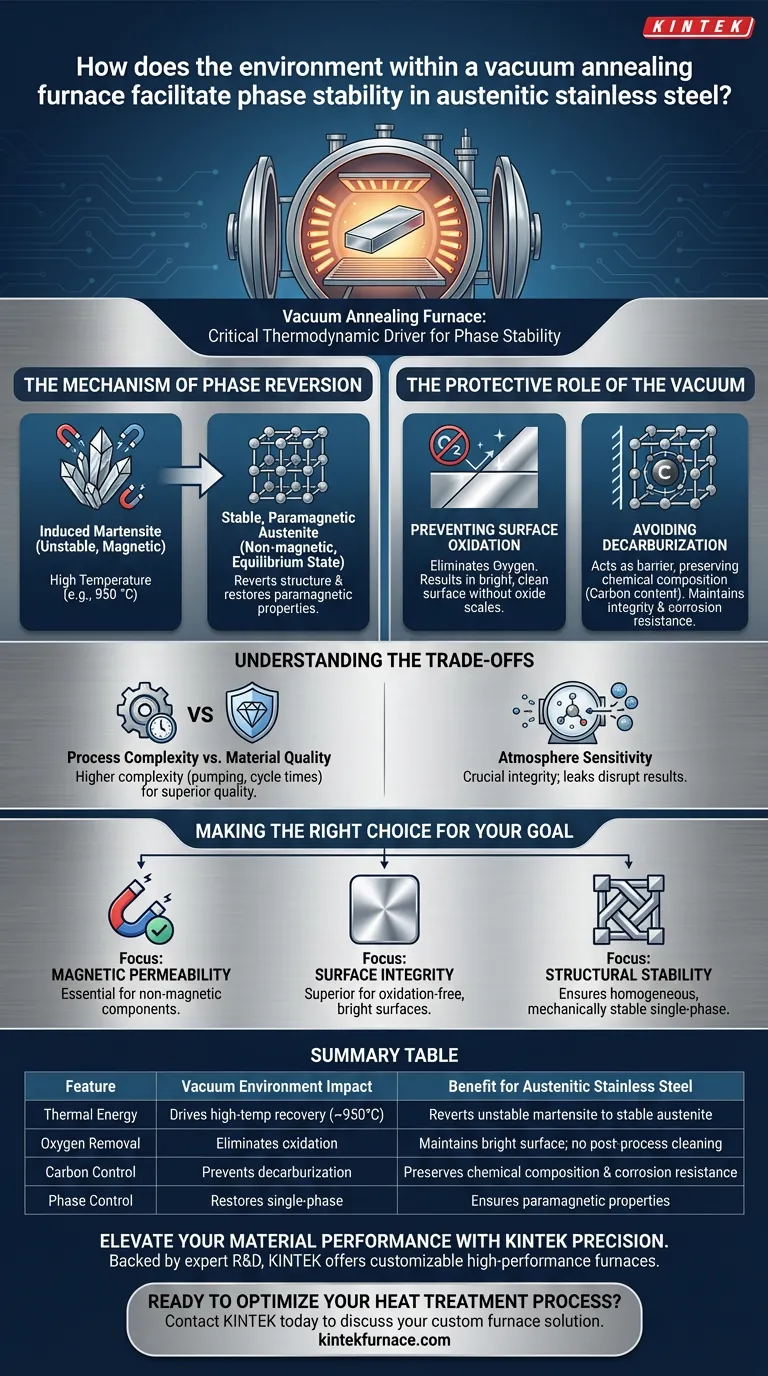
The environment within a vacuum annealing furnace acts as a critical thermodynamic driver that facilitates phase stability by combining high thermal energy with a strictly controlled atmosphere. By heating the material to approximately 950 °C in a high-vacuum setting, the furnace provides the necessary energy to revert unstable, induced martensite structures back into a stable, paramagnetic austenite phase.
Core Takeaway: The vacuum environment is not merely a passive container; it is an active protective measure that prevents surface oxidation and decarburization. This allows the steel to undergo necessary high-temperature structural recovery without suffering the chemical degradation that would occur in an open atmosphere.
The Mechanism of Phase Reversion
Reverting Induced Martensite
Processing austenitic stainless steel often induces a martensitic structure, which is generally unstable and magnetic.
The vacuum annealing furnace utilizes high temperatures (e.g., 950 °C) to energetically drive the microstructure back to its equilibrium state.
This thermal input forces the atomic lattice to rearrange, converting the induced martensite back into a stable, single-phase austenite structure.
Restoring Paramagnetic Properties
A key indicator of phase stability in austenitic stainless steel is its magnetic response.
Induced martensite is magnetic, which can be detrimental depending on the application.
The vacuum annealing process ensures the material returns to a fully paramagnetic (non-magnetic) state, confirming the successful recovery of the austenite phase.
The Protective Role of the Vacuum
Preventing Surface Oxidation
High-temperature heat treatment in air inevitably leads to the formation of oxide scales on the metal surface.
The vacuum environment eliminates oxygen from the processing chamber.
This ensures the steel remains bright and clean throughout the phase transformation, removing the need for post-process cleaning or grinding to remove oxides.
Avoiding Decarburization
At high temperatures, carbon can diffuse out of the steel if the atmosphere is not controlled, leading to decarburization.
Decarburization alters the chemical composition of the surface layer, potentially weakening the material and reducing corrosion resistance.
The vacuum environment acts as a barrier, preserving the precise chemical composition of the alloy—specifically its carbon content—to maintain phase stability and material integrity.
Understanding the Trade-offs
Process Complexity vs. Material Quality
While vacuum annealing delivers superior phase stability and surface finish, it introduces higher operational complexity compared to standard atmospheric annealing.
The equipment requires robust pumping systems to maintain high vacuum levels, and the cycle times may be longer due to the need for pump-down and controlled cooling.
Atmosphere Sensitivity
The process relies entirely on the integrity of the vacuum.
Even minor leaks or insufficient vacuum levels can introduce gaseous impurities.
As seen in similar metallurgical processes, the presence of uncontrolled gases can disrupt densification or fail to remove oxide films, compromising the final mechanical properties.
Making the Right Choice for Your Goal
To determine if vacuum annealing is the correct solution for your austenitic stainless steel project, consider your primary performance metrics:
- If your primary focus is Magnetic Permeability: Vacuum annealing is essential to fully revert induced martensite to paramagnetic austenite, ensuring the component is non-magnetic.
- If your primary focus is Surface Integrity: The vacuum process is superior for preventing oxidation and decarburization, yielding a clean, "bright" surface that requires minimal post-processing.
- If your primary focus is Structural Stability: This method provides the thermodynamic drive necessary to ensure a homogeneous, single-phase structure that is mechanically stable.
Vacuum annealing transforms the furnace from a simple heater into a precision tool for microstructural engineering.
Summary Table:
| Feature | Vacuum Environment Impact | Benefit for Austenitic Stainless Steel |
|---|---|---|
| Thermal Energy | Drives high-temp structural recovery (~950°C) | Reverts unstable induced martensite to stable austenite |
| Oxygen Removal | Eliminates oxidation and scale formation | Maintains bright surface finish; no post-process cleaning |
| Carbon Control | Prevents surface decarburization | Preserves chemical composition and corrosion resistance |
| Phase Control | Restores single-phase microstructure | Ensures paramagnetic (non-magnetic) properties |
Elevate Your Material Performance with KINTEK Precision
Don't compromise on the phase stability and surface integrity of your austenitic stainless steel. Backed by expert R&D and manufacturing, KINTEK offers high-performance Muffle, Tube, Rotary, Vacuum, and CVD systems, all customizable for your unique research or production needs. Whether you require precise magnetic permeability control or oxidation-free results, our lab high-temp furnaces provide the thermodynamic accuracy your project demands.
Ready to optimize your heat treatment process? Contact KINTEK today to discuss your custom furnace solution.
Visual Guide
References
- Microstructure and magnetism of austenitic steels in relation to chemical composition, severe plastic deformation, and solution annealing. DOI: 10.1038/s41598-025-86028-5
This article is also based on technical information from Kintek Furnace Knowledge Base .
Related Products
- Vacuum Heat Treat Sintering and Brazing Furnace
- Small Vacuum Heat Treat and Tungsten Wire Sintering Furnace
- Vacuum Sealed Continuous Working Rotary Tube Furnace Rotating Tube Furnace
- Vacuum Heat Treat Sintering Furnace Molybdenum Wire Vacuum Sintering Furnace
- Vacuum Heat Treat Sintering Furnace with Pressure for Vacuum Sintering
People Also Ask
- What are the benefits of using vacuum heat treating furnaces for metal alloys? Achieve Superior Metal Properties and Performance
- What is one of the most important uses of vacuum heat treating furnaces in aerospace? Achieve Superior Strength in Aircraft Alloys
- How does vacuum heat treating affect the grain structure of metal alloys? Achieve Precise Microstructure Control
- What is the temperature of a vacuum furnace brazing? Optimize Your Joint Strength and Cleanliness
- What are the steps involved in a typical vacuum brazing treatment? Master the Process for Strong, Clean Joints



















