
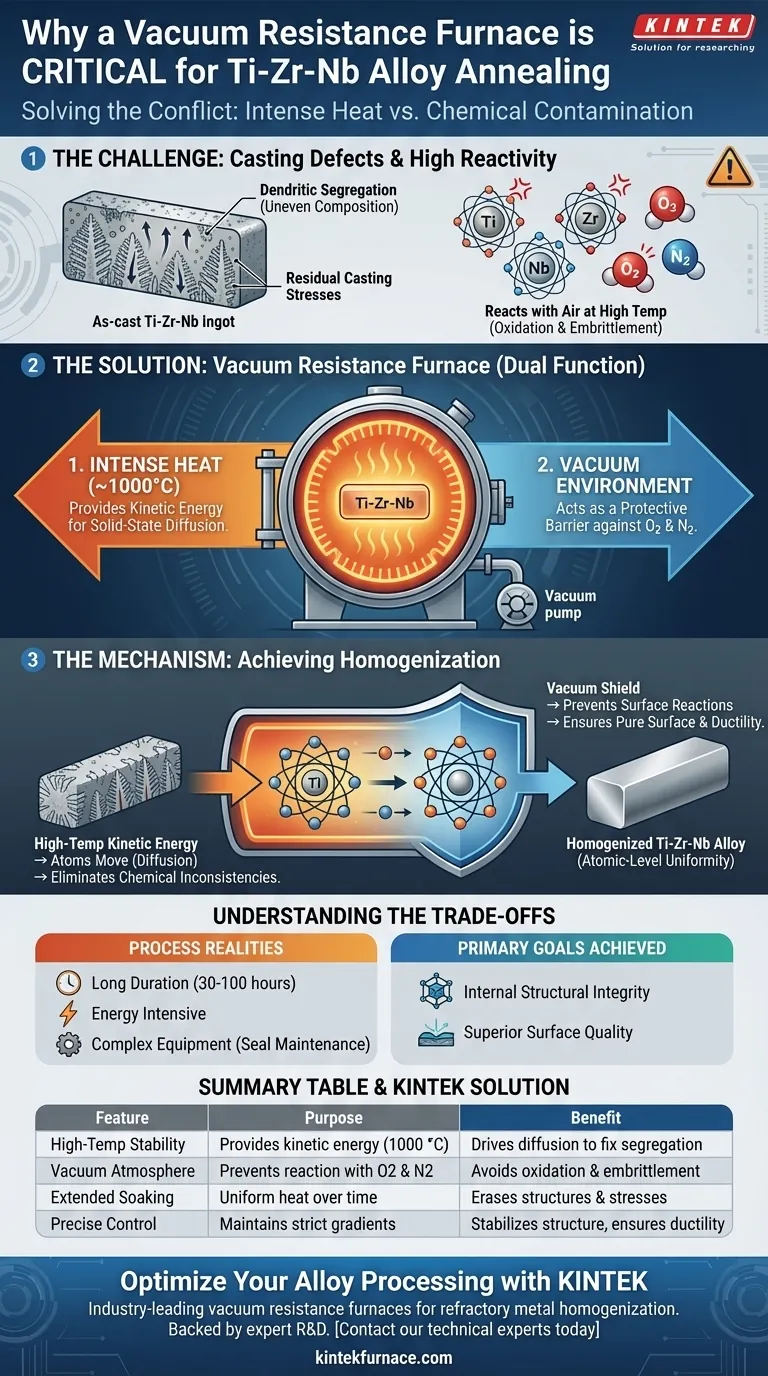
A vacuum resistance furnace is critical for the high-temperature homogenization annealing of Ti-Zr-Nb alloy ingots because it solves two conflicting requirements: applying intense heat while preventing chemical contamination. This equipment provides a stable thermal environment (around 1000 °C) to drive solid-state diffusion and eliminate chemical unevenness, while simultaneously maintaining a vacuum to prevent the highly reactive alloy surface from oxidizing or becoming brittle.
The core function of this furnace is to repair the internal structural defects caused by casting without introducing new surface defects. It uses high-temperature kinetic energy to smooth out chemical segregation, relying on a vacuum to shield the reactive metals from the damaging effects of air.
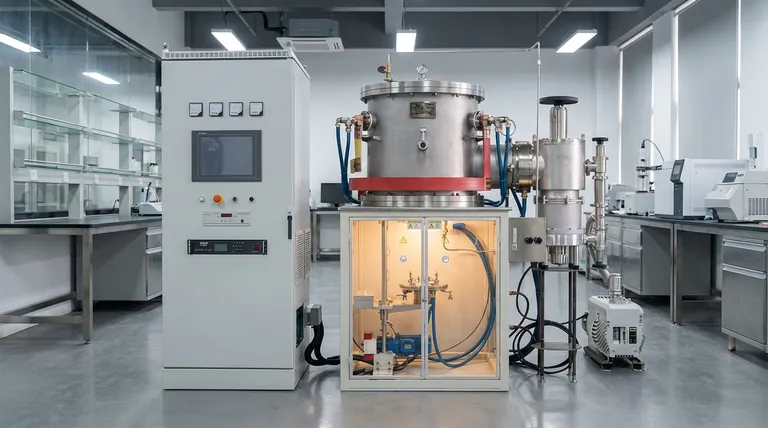
The Challenge of Casting Ti-Zr-Nb Alloys
The Formation of Dendritic Segregation
During the initial melting and solidification process, alloys do not freeze uniformly. This results in dendritic segregation, where the chemical composition varies significantly between the center of a grain and its boundary.
Residual Casting Stresses
The rapid cooling associated with casting often locks in significant internal mechanical stresses. Without treatment, these residual stresses can lead to deformation or failure during subsequent processing steps.
How the Vacuum Resistance Furnace Solves the Problem
Facilitating Solid-State Diffusion
To eliminate segregation, atoms within the alloy must physically move to achieve a uniform distribution. The furnace provides the precise, constant high temperature (e.g., 1000 °C) needed to give atoms sufficient kinetic energy to diffuse through the solid state.
Eliminating Chemical Inconsistencies
By maintaining this high temperature over a long duration, the furnace ensures the internal chemical composition becomes consistent. This process effectively erases the non-equilibrium structures formed during melting, stabilizing the alloy's phase structure.
Preventing Environmental Reaction
Titanium, zirconium, and niobium are highly reactive refractory metals. If heated to 1000 °C in a standard atmosphere, they would react instantly with oxygen and nitrogen, causing severe oxidation and embrittlement.
Shielding the Surface
The vacuum environment acts as a protective barrier. It allows the alloy to undergo the necessary long-duration heat treatment without reacting with air, ensuring the surface remains pure and the material retains its mechanical integrity.
Understanding the Trade-offs
Process Duration and Energy
Achieving full homogenization is not instant; it often requires extended "soaking" times (potentially 30 to 100 hours) to allow sufficient diffusion. This makes the process energy-intensive and time-consuming compared to simple stress-relief treatments.
Equipment Complexity
Vacuum resistance furnaces are significantly more complex than standard atmospheric furnaces. They require rigorous maintenance of vacuum seals and pumps to ensure the oxygen-free environment is never compromised during the heat cycle.
Making the Right Choice for Your Goal
To determine if your process requires this specific equipment, consider your primary objectives:
- If your primary focus is internal structural integrity: The furnace is required to drive the diffusion necessary to eliminate dendritic segregation and residual casting stresses.
- If your primary focus is surface quality: The vacuum capability is non-negotiable to prevent the oxidation and embrittlement inherent to heating Ti-Zr-Nb alloys in air.
By strictly controlling both temperature and atmosphere, you ensure the alloy achieves atomic-level uniformity while preserving its ductility for future use.
Summary Table:
| Feature | Purpose in Ti-Zr-Nb Annealing | Benefit to Alloy Performance |
|---|---|---|
| High-Temp Stability | Provides kinetic energy (1000 °C) | Drives solid-state diffusion to fix segregation |
| Vacuum Atmosphere | Prevents reaction with O2 and N2 | Avoids surface oxidation and material embrittlement |
| Extended Soaking | Uniform heat over 30-100 hours | Erases dendritic structures and internal stresses |
| Precise Control | Maintains strict thermal gradients | Stabilizes phase structure and ensures ductility |
Optimize Your Alloy Processing with KINTEK
Don't compromise the integrity of your Ti-Zr-Nb alloys with sub-par heating environments. KINTEK provides industry-leading vacuum resistance furnaces designed to handle the rigorous demands of refractory metal homogenization.
Backed by expert R&D and manufacturing, we offer a comprehensive range of Muffle, Tube, Rotary, Vacuum, and CVD systems. Whether you need standard lab equipment or a fully customized solution for unique high-temperature applications, KINTEK ensures your materials achieve atomic-level uniformity without chemical contamination.
Ready to enhance your material properties? Contact our technical experts today to find the perfect furnace for your laboratory.
Visual Guide
References
- K. V. Sergienko, A. G. Kolmakov. Physical and Mechanical Properties of Ti-Zr-Nb Alloys for Medical Use. DOI: 10.3390/met14111311
This article is also based on technical information from Kintek Furnace Knowledge Base .
Related Products
- Vacuum Heat Treat Sintering Furnace with Pressure for Vacuum Sintering
- Small Vacuum Heat Treat and Tungsten Wire Sintering Furnace
- Molybdenum Vacuum Heat Treat Furnace
- High Pressure Laboratory Vacuum Tube Furnace
- Vacuum Heat Treat Sintering Furnace Molybdenum Wire Vacuum Sintering Furnace
People Also Ask
- What are the benefits of using vacuum heat treating furnaces for metal alloys? Achieve Superior Metal Properties and Performance
- How does vacuum heat treating affect the grain structure of metal alloys? Achieve Precise Microstructure Control
- What is one of the most important uses of vacuum heat treating furnaces in aerospace? Achieve Superior Strength in Aircraft Alloys
- What is the purpose of setting a mid-temperature dwell stage? Eliminate Defects in Vacuum Sintering
- What are the key components of a vacuum sintering furnace? Essential Parts for Precision Material Processing



















