
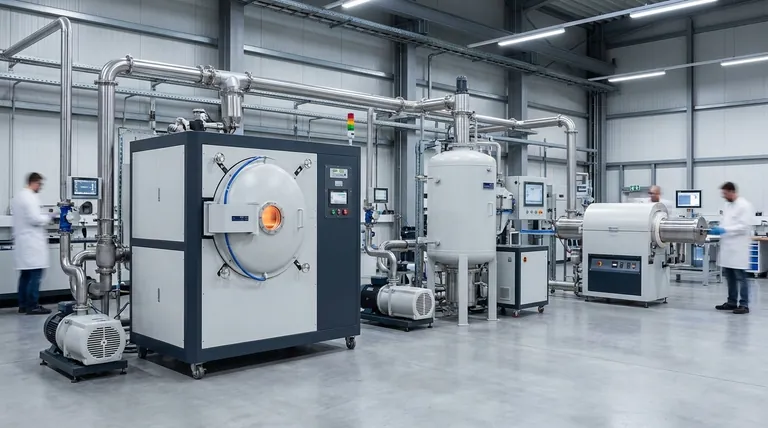
At a fundamental level, vacuum furnaces are categorized by the specific thermal process they are designed to perform. The most common types include vacuum brazing furnaces for joining materials, various heat treatment furnaces (for hardening, annealing, and tempering), and vacuum sintering furnaces for densifying powdered materials. Each is engineered to achieve a precise outcome in a contamination-free, high-temperature environment.
The specific "type" of a vacuum furnace is defined by the job it does. While all use a vacuum to prevent oxidation and ensure purity, the design of the heating, cooling, and control systems is optimized for a particular process, whether that is joining, hardening, or forming materials.
The Core Principle: Why Use a Vacuum?
Before exploring the different types, it's crucial to understand why a vacuum environment is so powerful for thermal processing. A vacuum is not the process itself; it is the ideal condition in which to conduct the process.
Preventing Oxidation and Contamination
The primary role of the vacuum is to remove atmospheric gases, especially oxygen and water vapor. This prevents the formation of oxides on the material's surface, ensuring components emerge from the furnace bright and clean.
Achieving Material Purity
Heating materials can release trapped gases or create volatile by-products. The vacuum actively removes these substances during the cycle, resulting in a final product with higher purity and improved structural integrity.
Ensuring Precise Temperature Control
In a vacuum, heat transfer occurs primarily through radiation. This allows for extremely uniform temperature distribution across the parts and precise, computer-controlled heating and cooling cycles, which is critical for repeatability.
Classifying Furnaces by Thermal Process
The differences between furnace types are driven by the specific requirements of the application.
For Joining Materials: Vacuum Brazing Furnaces
These furnaces are designed to join two or more components using a filler metal that has a lower melting point. The vacuum ensures an impeccably clean surface, allowing the braze alloy to flow freely and create an exceptionally strong, void-free joint.
For Hardening and Strengthening: Heat Treatment Furnaces
This broad category includes several types that alter the mechanical properties of metals.
- A Vacuum Hardening Furnace heats a metal to a critical temperature and then cools it rapidly (quenches it) to increase its hardness and strength.
- Vacuum Quenching Furnaces are specialized for the rapid cooling step. They can use either inert gas (gas quenching) or oil (oil quenching) as the cooling medium.
- Vacuum Tempering and Annealing Furnaces use slower, more controlled heating and cooling cycles to reduce brittleness, relieve internal stresses, and improve a material's ductility.
- A Vacuum Carburizing Furnace is a highly specialized type that introduces a carbon-rich gas into the chamber to harden the surface of steel components.
For Material Densification: Sintering and Hot Press Furnaces
Vacuum Sintering Furnaces are used to transform compacted powders into a solid, dense mass by heating them to a temperature below the material's melting point. This is fundamental to powder metallurgy and ceramics.
A Vacuum Hot Press Furnace is a variation that simultaneously applies high temperature and mechanical pressure. This combination accelerates densification and helps produce materials with superior properties.
Understanding the Design Trade-offs
Beyond the process, a critical design choice is how the vacuum chamber relates to the heat source. This leads to two main architectural designs: cold wall and hot wall.
Cold Wall Furnaces: The Industry Standard
In a cold wall design, the heating elements are located inside a water-cooled vacuum chamber. This is the most common and versatile configuration.
It allows for very high temperatures (up to 3,000°C), rapid heating and cooling cycles, and minimal contamination, as the cool chamber walls do not release gases.
Hot Wall Furnaces: For Specific Applications
In a hot wall design, the entire vacuum chamber (often a retort or tube) is placed inside a larger, conventional furnace. The chamber wall itself becomes hot.
These furnaces are typically limited to lower temperatures and have slower cycles. However, they can offer exceptional temperature uniformity and are sometimes preferred for processes sensitive to the outgassing that can come from the internal insulation of a cold wall furnace.
Quench Method: Gas vs. Oil
For hardening processes, the choice of quenching medium is a key trade-off. Gas quenching is cleaner, minimizes part distortion, and is better for the environment. Oil quenching is a more aggressive method that can achieve higher hardness in certain low-alloy steels but can cause more distortion and requires post-process cleaning.
Selecting the Right Furnace for Your Application
Choosing the correct furnace begins with clearly defining your process goal.
- If your primary focus is joining components with high purity: A vacuum brazing furnace is the designated tool for creating strong, clean bonds.
- If your primary focus is modifying the mechanical properties of metals: You need a heat treatment furnace, with the specific type (hardening, annealing) dictated by your desired hardness and ductility.
- If your primary focus is creating dense parts from powdered materials: A vacuum sintering furnace is required, potentially a hot press furnace if pressure is also needed.
- If your primary focus is process speed and high-temperature capability: A cold wall design is the dominant and most flexible choice for the vast majority of applications.
Understanding that the process dictates the furnace design is the key to navigating your heat treatment requirements.
Summary Table:
| Furnace Type | Primary Process | Key Features |
|---|---|---|
| Vacuum Brazing Furnace | Joining materials | Strong, void-free joints; contamination-free |
| Heat Treatment Furnace | Hardening, annealing, tempering | Precise temperature control; improved material properties |
| Vacuum Sintering Furnace | Densifying powdered materials | High purity; uniform densification |
| Vacuum Hot Press Furnace | Sintering with pressure | Accelerated densification; superior material properties |
| Cold Wall Furnace | High-temperature processes | Up to 3,000°C; rapid cycles; minimal contamination |
| Hot Wall Furnace | Low-temperature, uniform heating | Excellent temperature uniformity; reduced outgassing |
Ready to elevate your thermal processing with precision and purity? At KINTEK, we leverage exceptional R&D and in-house manufacturing to provide advanced high-temperature furnace solutions tailored for laboratories in materials science, metallurgy, and ceramics. Our product line includes Muffle, Tube, Rotary Furnaces, Vacuum & Atmosphere Furnaces, and CVD/PECVD Systems, all backed by strong deep customization capabilities to meet your unique experimental needs. Whether you require vacuum brazing, heat treatment, or sintering, we deliver reliable, contamination-free results. Contact us today to discuss how our furnaces can optimize your processes and drive innovation in your lab!
Visual Guide

Related Products
- Vacuum Hot Press Furnace Machine Heated Vacuum Press Tube Furnace
- Vacuum Hot Press Furnace Machine Heated Vacuum Press
- 600T Vacuum Induction Hot Press Vacuum Heat Treat and Sintering Furnace
- 2200 ℃ Tungsten Vacuum Heat Treat and Sintering Furnace
- Vacuum Heat Treat Sintering Furnace with Pressure for Vacuum Sintering
People Also Ask
- Why use Vacuum Hot Press (VHP) for ZnS Ceramics? Achieve Superior IR Transparency and Mechanical Strength
- What safety features are incorporated in vacuum hot press furnaces? Ensure Operator and Equipment Protection
- What are the benefits of the vacuum environment system in a vacuum hot press furnace? Unlock High-Density Sintering
- What control features does a vacuum hot press furnace offer? Precision Control for Advanced Materials Processing
- How does a vacuum hot press furnace promote densification in the manufacturing of graphite flake/copper composites? Achieve Superior Composite Materials



















