
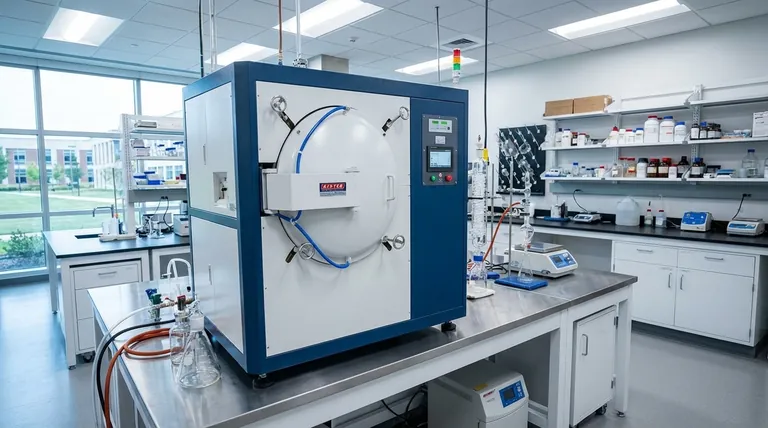
A vacuum oven is a critical preparatory tool used to remove anhydrous ethanol solvents from the precursor mixture before it undergoes high-temperature pyrolysis. By maintaining a stable temperature of 60 °C in a vacuum environment, it ensures the raw materials remain in a loose, dry physical state rather than becoming a dense, unusable mass.
Core Takeaway: The vacuum oven lowers the boiling point of residual solvents, allowing for effective drying at low temperatures. This prevents the precursor from clumping (agglomeration) or reacting with oxygen (oxidation), ensuring the material retains the specific physical structure and chemical purity required for successful nitrogen and sulfur co-doping.
Preserving Material Integrity
The primary function of the vacuum oven extends beyond simple drying; it is about conditioning the precursor to survive the harsh conditions of pyrolysis.
Prevention of Agglomeration
When precursors dry under standard atmospheric conditions, surface tension and higher temperatures often force particles to cluster together.
Agglomeration reduces the available surface area of the material. By drying under vacuum, the solvent evaporates rapidly without forcing the particles into dense clumps.
This ensures the precursor remains a "loose" powder. A loose powder structure allows for uniform heat distribution and gas flow during the subsequent pyrolysis stage.
Avoiding Oxidation
Oxygen exposure during the drying phase can chemically alter the precursor before the synthesis even begins.
Residual solvents combined with atmospheric oxygen can lead to unwanted oxidation. This degrades the chemical composition of the nitrogen and sulfur dopants.
The vacuum environment eliminates air exposure. This preserves the chemical identity of the precursor, ensuring the final carbon material has the correct elemental doping ratios.
The Mechanics of Low-Temperature Drying
To understand why a standard oven cannot replace a vacuum oven in this process, one must look at the relationship between pressure and temperature.
Lowering the Solvent Boiling Point
The vacuum oven operates by significantly reducing the pressure inside the chamber.
According to thermodynamic principles, lowering pressure lowers the boiling point of liquids. This allows solvents like ethanol to boil off vigorously at much lower temperatures than usual.
The Importance of 60 °C
The synthesis protocol specifies a target temperature of 60 °C.
In a standard oven, 60 °C might not be hot enough to remove all solvents efficiently. Raising the temperature to force evaporation could degrade the delicate polymer or precursor structure.
Under vacuum, 60 °C is sufficient for rapid, deep drying. This "gentle" approach removes the solvent without subjecting the precursor to thermal stress that could collapse its pore structure.
Understanding the Trade-offs
While vacuum drying is superior for material quality, it introduces specific challenges that must be managed to ensure consistency.
Equipment Maintenance and Leaks
A vacuum oven relies entirely on the integrity of its seals and the performance of the pump.
Even a minor leak can introduce oxygen into the chamber. This negates the anti-oxidation benefits and can lead to inconsistent doping levels across different batches.
Throughput Limitations
Vacuum drying is a batch process that often requires specific loading configurations to ensure all solvent is trapped.
Overloading the oven can inhibit the vacuum's efficiency. This may result in residual solvent remaining in the center of the sample mass, leading to structural defects during pyrolysis.
Optimizing Your Synthesis Protocol
To achieve high-performance nitrogen and sulfur co-doped carbon, align your drying strategy with your specific material goals.
- If your primary focus is Maximizing Surface Area: Ensure the precursor is spread thinly in the vacuum oven to prevent particle contact and minimize agglomeration.
- If your primary focus is Chemical Purity: Verify your vacuum seal integrity meticulously to ensure absolute exclusion of oxygen during the 60 °C cycle.
By treating the vacuum drying stage with the same rigor as the pyrolysis itself, you ensure the foundational structure of your material is sound.
Summary Table:
| Feature | Vacuum Drying (60 °C) | Standard Atmospheric Drying |
|---|---|---|
| Boiling Point | Significantly lowered for rapid evaporation | Higher, requiring more heat |
| Material State | Remains loose, high surface area powder | Risk of clumping and agglomeration |
| Chemical Purity | High (Oxygen-free environment) | Risk of oxidation and dopant degradation |
| Thermal Stress | Minimal due to low-temperature processing | High if temperature is raised to force drying |
Elevate Your Materials Research with Precision Thermal Solutions
Maximize the surface area and chemical purity of your carbon materials with KINTEK’s high-performance vacuum systems. Backed by expert R&D and manufacturing, KINTEK offers a comprehensive range of customizable Muffle, Tube, Rotary, Vacuum, and CVD systems designed to meet the rigorous demands of lab high-temperature synthesis.
Don't let clumping or oxidation compromise your research. Contact KINTEK today to find the perfect customizable furnace for your unique needs!
References
- Jiahui Li, Shaobo Tu. Pseudocapacitive Heteroatom‐Doped Carbon Cathode for Aluminum‐Ion Batteries with Ultrahigh Reversible Stability. DOI: 10.1002/eem2.12733
This article is also based on technical information from Kintek Furnace Knowledge Base .
Related Products
- Vacuum Heat Treat Sintering and Brazing Furnace
- Vacuum Heat Treat Sintering Furnace Molybdenum Wire Vacuum Sintering Furnace
- Dental Porcelain Zirconia Sintering Ceramic Vacuum Press Furnace
- Vacuum Hot Press Furnace Machine for Lamination and Heating
- Vacuum Hot Press Furnace Machine Heated Vacuum Press
People Also Ask
- What are the benefits of using vacuum heat treating furnaces for metal alloys? Achieve Superior Metal Properties and Performance
- How does vacuum heat treating affect the grain structure of metal alloys? Achieve Precise Microstructure Control
- What is one of the most important uses of vacuum heat treating furnaces in aerospace? Achieve Superior Strength in Aircraft Alloys
- What is the temperature of a vacuum furnace brazing? Optimize Your Joint Strength and Cleanliness
- What are the steps involved in a typical vacuum brazing treatment? Master the Process for Strong, Clean Joints



















