
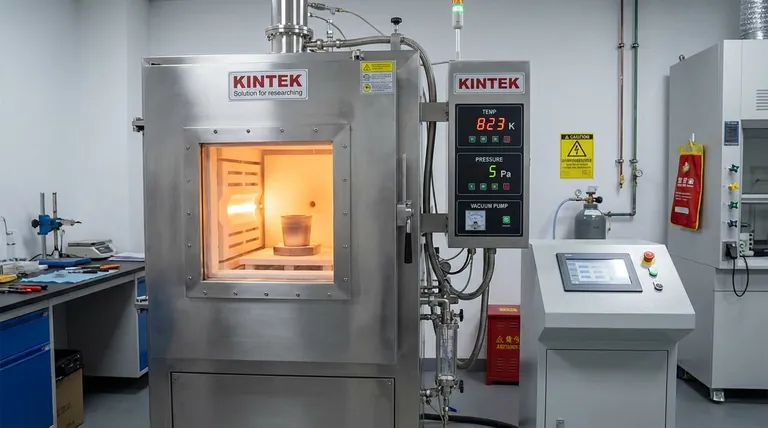
A vertical vacuum furnace serves as the critical separation vessel in the purification of Rubidium Chloride by creating a strictly controlled high-temperature, low-pressure environment. Its primary function is to induce the physical separation of impurities through selective volatilization and thermal decomposition, effectively removing contaminants while preserving the target compound.
Core Takeaway The vertical vacuum furnace utilizes the difference in volatility between Rubidium Chloride and its impurities. By maintaining a vacuum at specific temperatures, it forces zinc and silicon contaminants into a gaseous state for removal, leaving behind purified, solid Rubidium Chloride.
The Mechanism of Purification
Selective Volatilization of Impurities
The furnace operates on the principle that different compounds transition to gas at different temperatures.
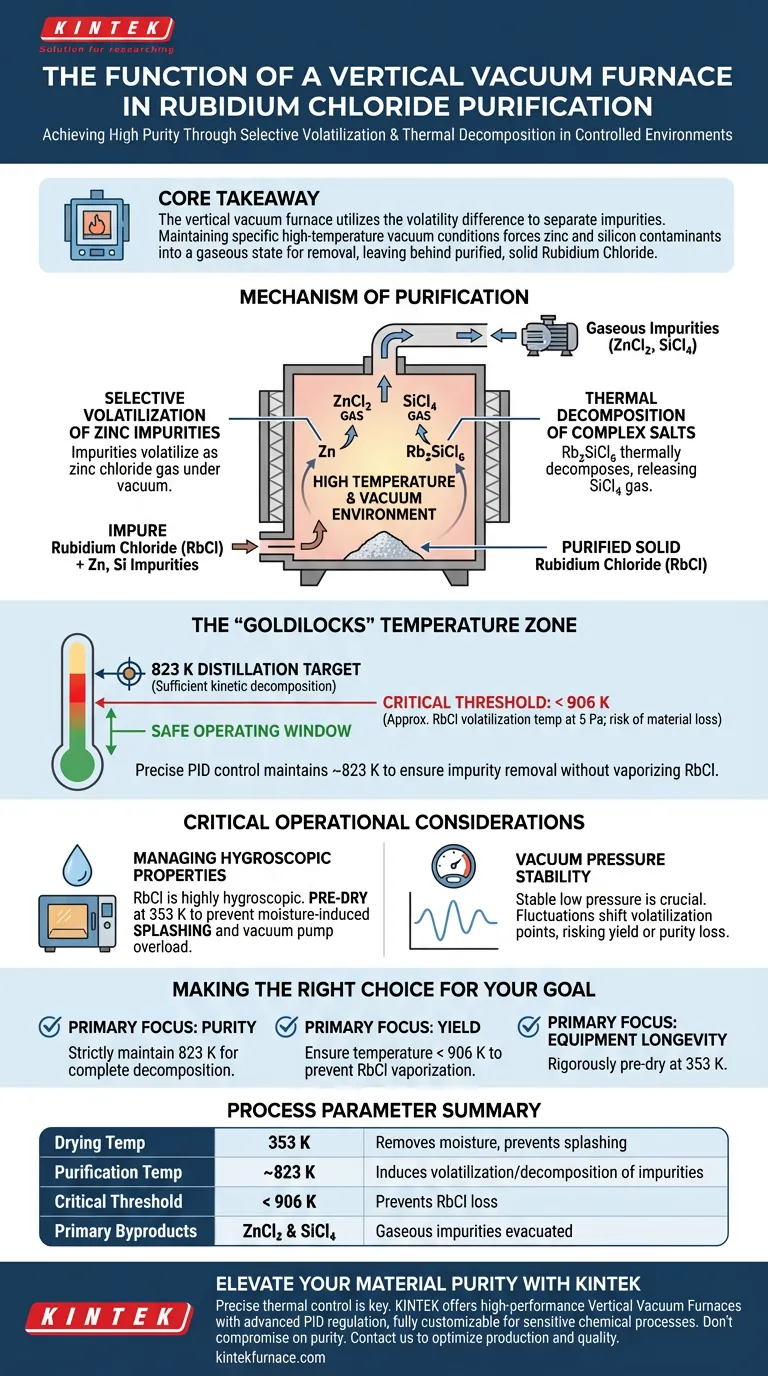
The primary goal is the removal of zinc impurities. Under the furnace's vacuum conditions, these impurities volatilize as zinc chloride gas, separating them from the solid Rubidium Chloride batch.
Thermal Decomposition of Complex Salts
Beyond simple volatilization, the furnace facilitates chemical decomposition.
Rubidium Chloride often contains complex double salts, specifically Rb2SiCl6. The high-temperature environment causes these salts to thermally decompose, releasing gaseous silicon tetrachloride (SiCl4).
Once in a gaseous state, both the zinc and silicon byproducts are evacuated from the chamber by the vacuum system, isolating the purified Rubidium Chloride.
The "Goldilocks" Temperature Zone
The effectiveness of the furnace relies entirely on precise temperature regulation, typically managed by PID control systems.
The process targets a distillation temperature of approximately 823 K.
This temperature is sufficient to drive the kinetic decomposition of impurities but remains safely below 906 K, which is the approximate volatilization temperature of Rubidium Chloride at 5 Pa.
By staying in this window, the system achieves high impurity removal rates without vaporizing the Rubidium Chloride, preventing raw material loss.
Critical Operational Considerations
Managing Hygroscopic Properties
Rubidium Chloride is highly hygroscopic, meaning it readily absorbs moisture from the air.
Before high-temperature processing, the material must be thoroughly dried (often at 353 K). Failure to remove absorbed water or residual liquids like silicon tetrachloride can lead to splashing inside the furnace.
Sudden water vaporization in a vacuum causes rapid expansion, which can physically displace the raw material and place an excessive load on the vacuum pump system.
Vacuum Pressure Stability
The relationship between temperature and pressure is non-linear.
The furnace must maintain a stable low-pressure environment (vacuum). If the pressure fluctuates significantly, the volatilization point of the Rubidium Chloride shifts, potentially risking yield loss or incomplete purification.
Making the Right Choice for Your Goal
To maximize the efficiency of a vertical vacuum furnace in this application, focus on the balance between thermal energy and vacuum pressure.
- If your primary focus is Purity: Maintain the temperature strictly at 823 K to ensure complete decomposition of Rb2SiCl6 without contaminating the final product with unrefined vapors.
- If your primary focus is Yield: Ensure the temperature never exceeds the 906 K threshold to prevent the Rubidium Chloride itself from vaporizing and exiting the system.
- If your primary focus is Equipment Longevity: rigorously pre-dry materials at 353 K to prevent moisture-induced splashing and vacuum pump overload.
Success in this process is defined by the rigorous control of thermal thresholds to separate phases without losing the product.
Summary Table:
| Process Parameter | Target Value/Setting | Function in Purification |
|---|---|---|
| Drying Temp | 353 K | Removes moisture to prevent splashing and pump overload |
| Purification Temp | ~823 K | Induces volatilization of Zn and decomposition of Rb2SiCl6 |
| Critical Threshold | < 906 K | Prevents loss of Rubidium Chloride through vaporization |
| Primary Byproducts | ZnCl2 & SiCl4 | Gaseous impurities removed via continuous vacuum system |
Elevate Your Material Purity with KINTEK
Precise thermal control is the difference between high-yield purification and material loss. Backed by expert R&D and world-class manufacturing, KINTEK offers high-performance Vertical Vacuum Furnaces, Muffle, Tube, and CVD systems tailored for sensitive chemical processes like Rubidium Chloride purification.
Our systems feature advanced PID regulation and stable vacuum environments, all fully customizable to meet your lab's unique technical requirements. Don't compromise on purity. Contact our technical specialists today to discover how KINTEK’s high-temperature solutions can optimize your production efficiency and material quality.
Visual Guide
References
- Cui Xi, Tao Qu. A Study on the Removal of Impurity Elements Silicon and Zinc from Rubidium Chloride by Vacuum Distillation. DOI: 10.3390/ma17091960
This article is also based on technical information from Kintek Furnace Knowledge Base .
Related Products
- Custom Made Versatile CVD Tube Furnace Chemical Vapor Deposition CVD Equipment Machine
- Vertical Laboratory Quartz Tube Furnace Tubular Furnace
- Vacuum Hot Press Furnace Machine Heated Vacuum Press
- 600T Vacuum Induction Hot Press Vacuum Heat Treat and Sintering Furnace
- Vacuum Induction Melting Furnace
People Also Ask
- Why are CVD tube furnace sintering systems indispensable for 2D material research and production? Unlock Atomic-Scale Precision
- What is a CVD tube furnace and what is its primary function? Discover Precision Thin-Film Deposition
- Which industries and research fields benefit from CVD tube furnace sintering systems for 2D materials? Unlock Next-Gen Tech Innovations
- How does CVD tube furnace sintering enhance graphene growth? Achieve Superior Crystallinity and High Electron Mobility
- How might AI and machine learning enhance CVD tube furnace processes? Boost Quality, Speed, and Safety



















