
Strict humidity control is non-negotiable in aluminum solution heat treatment because water vapor chemically attacks the metal at high temperatures. This reaction introduces atomic hydrogen into the alloy, which accumulates internally and causes the metal to physically deform, creating permanent defects known as blisters.
The presence of moisture triggers a chain reaction that injects hydrogen into the alloy structure, causing internal pressure buildup at oxide sites and resulting in irreversible surface blistering and hydrogen embrittlement.
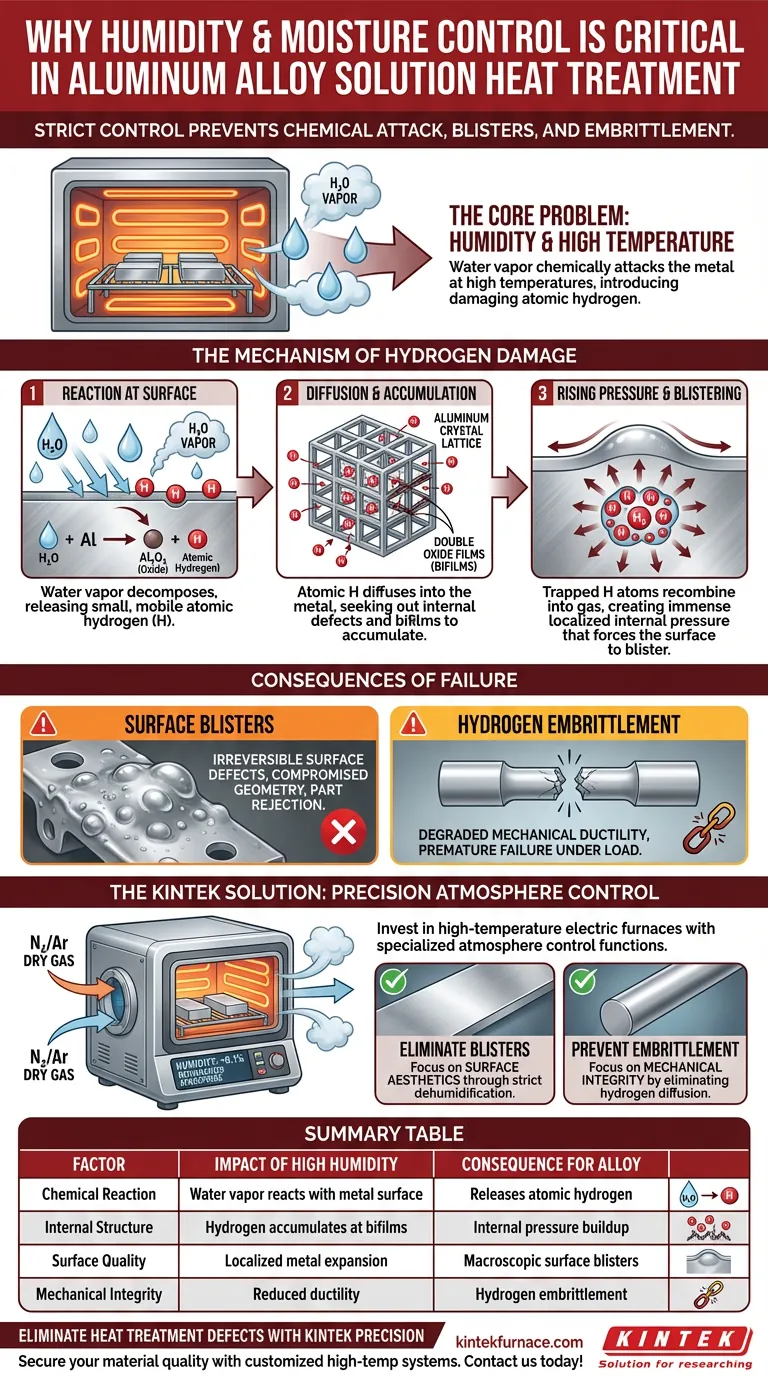
The Mechanism of Hydrogen Damage
The Reaction at the Surface
When aluminum alloys are exposed to high temperatures in a moist environment, water vapor reacts directly with the metal surface.
This chemical reaction decomposes the water molecules, releasing atomic hydrogen as a byproduct.
Diffusion into the Metal Lattice
Unlike gas molecules, atomic hydrogen is small enough to diffuse rapidly into the solid aluminum matrix.
Once inside, these atoms migrate through the lattice, seeking out internal imperfections.
Accumulation at Bifilms
The diffusing hydrogen atoms tend to gather at specific internal defects known as double oxide films (bifilms).
These microscopic films act as traps, collecting the hydrogen that has penetrated the surface.
From Internal Pressure to Surface Failure
Rising Internal Pressure
As hydrogen continues to accumulate at these bifilm sites, the concentration increases significantly.
The trapped atoms recombine into gas, causing a massive spike in localized internal pressure within the metal.
Formation of Macroscopic Blisters
The internal pressure eventually exceeds the strength of the material, forcing the metal near the surface to expand outward.
This manifests as macroscopic surface hydrogen blisters, a defect that compromises both the geometry and the structural integrity of the part.
Understanding the Trade-offs
Equipment Capability vs. Risk
To prevent this phenomenon, operators must utilize high-temperature electric furnaces equipped with precision atmosphere control functions.
While these systems may represent a higher initial capital investment, relying on standard furnaces without moisture regulation creates a high risk of part rejection.
The Cost of Embrittlement
Beyond visible blisters, the presence of hydrogen leads to hydrogen embrittlement.
Failing to control humidity does not just ruin the surface finish; it degrades the mechanical ductility of the alloy, potentially causing premature failure under load.
Making the Right Choice for Your Process
To ensure the viability of your aluminum components, you must align your equipment capabilities with your quality goals.
- If your primary focus is Surface Aesthetics: Ensure your furnace atmosphere is strictly dehumidified to prevent the chemical reactions that cause visible blistering.
- If your primary focus is Mechanical Integrity: Prioritize precision atmosphere control to eliminate hydrogen diffusion, thereby preventing internal embrittlement.
Control the atmosphere to control the material properties.
Summary Table:
| Factor | Impact of High Humidity | Consequence for Alloy |
|---|---|---|
| Chemical Reaction | Water vapor reacts with metal surface | Releases atomic hydrogen |
| Internal Structure | Hydrogen accumulates at bifilms | Internal pressure buildup |
| Surface Quality | Localized metal expansion | Macroscopic surface blisters |
| Mechanical Integrity | Reduced ductility | Hydrogen embrittlement |
Eliminate Heat Treatment Defects with KINTEK Precision
Don't let humidity compromise your aluminum components. Backed by expert R&D and manufacturing, KINTEK offers specialized Muffle, Tube, and Vacuum systems designed for rigorous atmosphere control. Whether you require standard or fully customizable high-temp furnaces, our solutions ensure the chemical stability and mechanical integrity your projects demand.
Ready to upgrade your thermal processing? Contact us today to secure your material quality!
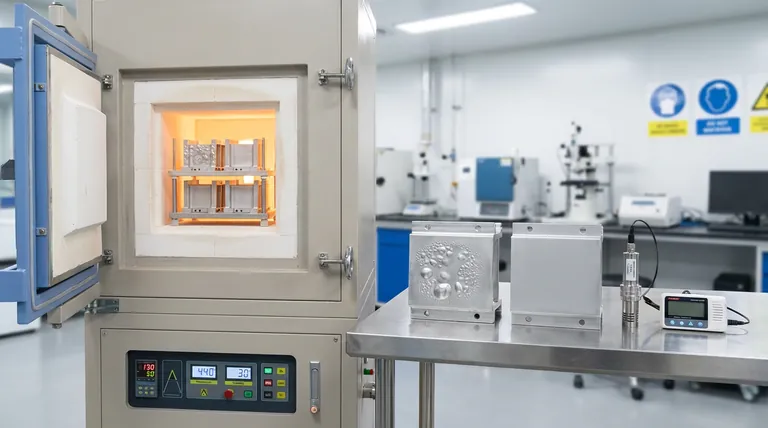
Visual Guide
References
- Time-Dependent Failure Mechanisms of Metals; The Role of Precipitation Cleavage. DOI: 10.20944/preprints202508.2134.v1
This article is also based on technical information from Kintek Furnace Knowledge Base .
Related Products
- Vacuum Heat Treat Sintering Furnace Molybdenum Wire Vacuum Sintering Furnace
- Vacuum Heat Treat Sintering and Brazing Furnace
- Vacuum Heat Treat Sintering Furnace with Pressure for Vacuum Sintering
- 2200 ℃ Graphite Vacuum Heat Treat Furnace
- 1700℃ High Temperature Laboratory Tube Furnace with Alumina Tube
People Also Ask
- What are the main structural components of a vacuum sintering furnace? Unlock Precision in High-Temperature Processing
- How does vacuum sintering improve dimensional tolerances? Achieve Uniform Shrinkage and Precision
- What is the purpose of setting a mid-temperature dwell stage? Eliminate Defects in Vacuum Sintering
- What are the key components of a vacuum sintering furnace? Essential Parts for Precision Material Processing
- How does vacuum sintering contribute to cost reduction in material processing? Lower Expenses with Superior Parts



















