
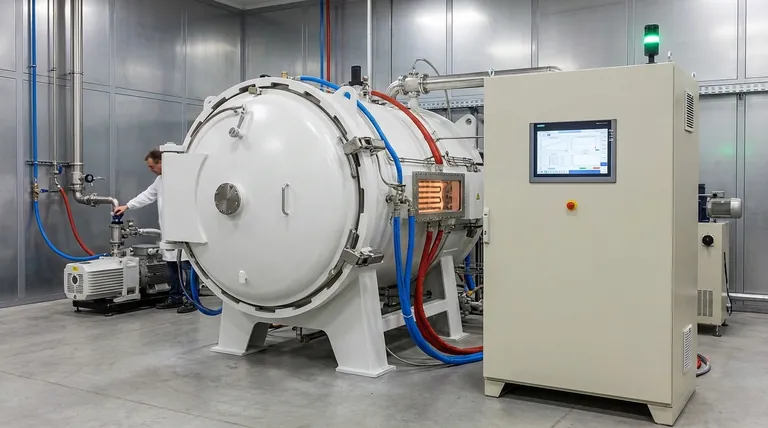
A vacuum sintering furnace is an advanced heat treatment system that sinters materials in a controlled, low-pressure environment. Its primary advantage is the ability to produce exceptionally pure, dense, and high-performance components by preventing atmospheric contamination like oxidation. However, this level of quality comes at a significant cost, both in the initial equipment investment and the specialized knowledge required for its operation.
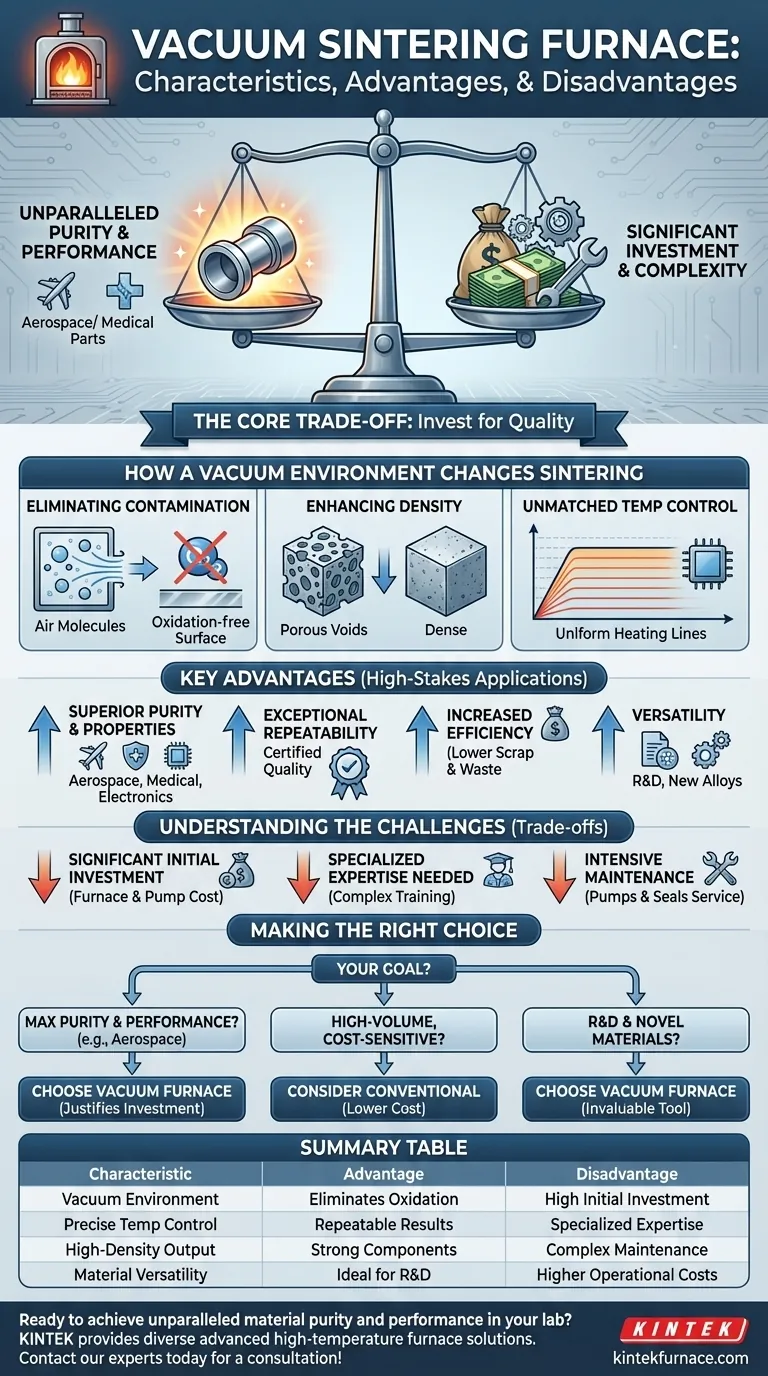
The core decision to use a vacuum sintering furnace is a trade-off: you are investing in a more complex and expensive process to achieve a level of material purity and structural integrity that is simply not possible with conventional atmosphere-based furnaces.
How a Vacuum Environment Changes Sintering
The defining characteristic of this furnace is the removal of air and other gases from the heating chamber. This fundamental difference from atmospheric furnaces creates several distinct advantages during the sintering process.
Eliminating Atmospheric Contamination
At high temperatures, most materials react with gases in the air, especially oxygen. This process, known as oxidation, can degrade material properties and create unwanted surface layers.
A vacuum furnace removes these reactive gases, creating a clean environment. This prevents oxidation, nitridation, and other unwanted chemical reactions, ensuring the final product is chemically pure and stable.
Enhancing Density and Structural Integrity
Trapped gases are a primary cause of porosity, or tiny voids, within a sintered part. These pores can act as stress points, weakening the final component.
By removing the air before heating, a vacuum environment significantly reduces the formation of bubbles and voids. This results in a final product with higher density, greater strength, and superior resistance to wear.
Achieving Unmatched Temperature Control
The vacuum minimizes heat loss through convection, allowing for highly efficient and uniform heating. Modern vacuum furnaces use advanced, computer-driven controllers to manage the process.
This enables extremely precise temperature profiles, with stable and repeatable heating and cooling cycles. This level of control is critical for processing sensitive materials and achieving consistent metallurgical results.
The Key Advantages for High-Stakes Applications
The unique process environment of a vacuum furnace delivers tangible benefits, making it the preferred choice for industries where material performance is non-negotiable.
Superior Material Purity and Properties
The absence of contamination results in cleaner end products with enhanced mechanical, thermal, and electrical characteristics. This is essential for applications in aerospace, medical implants, and advanced electronics where impurity can lead to catastrophic failure.
Exceptional Process Repeatability
Computer-controlled heating, cooling, and gas flow ensures that every production run is identical. This metallurgical repeatability is crucial for quality control and certification in regulated industries.
Increased Energy and Material Efficiency
Because a vacuum is a superb insulator, less energy is wasted heating the surrounding environment. The high-purity output also leads to lower scrap rates and reduced material waste, offsetting some of the higher operational costs.
Versatility Across Materials
Vacuum furnaces are highly adaptable and suitable for a wide range of materials and processes. They are an ideal tool for research and development of new alloys and advanced materials that cannot be processed in a standard atmosphere.
Understanding the Trade-offs and Challenges
While powerful, a vacuum furnace is not the right solution for every application. The benefits come with significant and practical considerations that must be weighed carefully.
Significant Initial Investment
Vacuum sintering furnaces are among the most expensive types of industrial furnaces. The cost includes the furnace itself, the powerful vacuum pumps, and the sophisticated control systems required to operate it.
The Need for Specialized Expertise
Operating and maintaining a high-vacuum system is far more complex than a standard furnace. It requires specialized knowledge of vacuum technology, leak detection, and process control, meaning operators need specific training.
Maintenance and Operational Demands
Vacuum systems have more components that can fail, such as pumps, seals, and sensors. Regular maintenance is more intensive and critical to ensure the system can achieve and hold the required low pressure for a successful sintering cycle.
Making the Right Choice for Your Goal
Selecting the right furnace depends entirely on the required quality of your final product and your operational constraints.
- If your primary focus is maximum material purity and performance (e.g., aerospace, medical): The benefits of eliminating contamination and improving structural integrity justify the investment.
- If your primary focus is high-volume, cost-sensitive production: The high capital cost and operational complexity may be prohibitive, and a conventional atmosphere furnace could be more suitable.
- If your primary focus is research and development: The precise control, versatility, and ability to work with novel materials make a vacuum furnace an invaluable tool.
Ultimately, choosing a vacuum furnace is a strategic decision to prioritize final component quality above all other factors.
Summary Table:
| Characteristic | Advantage | Disadvantage |
|---|---|---|
| Vacuum Environment | Eliminates atmospheric contamination (oxidation) | High initial investment in equipment and pumps |
| Precise Temperature Control | Enables uniform heating and repeatable results | Requires specialized operator expertise and training |
| High-Density Output | Creates strong, wear-resistant components with low porosity | Intensive, complex maintenance for pumps and seals |
| Material Versatility | Ideal for R&D and sensitive materials (aerospace, medical) | Higher operational costs compared to atmosphere furnaces |
Ready to achieve unparalleled material purity and performance in your lab?
Leveraging exceptional R&D and in-house manufacturing, KINTEK provides diverse laboratories with advanced high-temperature furnace solutions. Our product line, including Muffle, Tube, Rotary Furnaces, Vacuum & Atmosphere Furnaces, and CVD/PECVD Systems, is complemented by our strong deep customization capability to precisely meet unique experimental requirements.
Let's discuss how a KINTEK vacuum sintering furnace can be tailored to your specific application. Contact our experts today for a consultation!
Visual Guide
Related Products
- Vacuum Heat Treat Sintering Furnace Molybdenum Wire Vacuum Sintering Furnace
- Small Vacuum Heat Treat and Tungsten Wire Sintering Furnace
- 9MPa Air Pressure Vacuum Heat Treat and Sintering Furnace
- Vacuum Heat Treat Sintering Furnace with Pressure for Vacuum Sintering
- 2200 ℃ Tungsten Vacuum Heat Treat and Sintering Furnace
People Also Ask
- What are the main structural components of a vacuum sintering furnace? Unlock Precision in High-Temperature Processing
- What are the key components of a vacuum sintering furnace? Essential Parts for Precision Material Processing
- What is the purpose of setting a mid-temperature dwell stage? Eliminate Defects in Vacuum Sintering
- How does vacuum sintering improve dimensional tolerances? Achieve Uniform Shrinkage and Precision
- How does vacuum sintering contribute to cost reduction in material processing? Lower Expenses with Superior Parts



















