
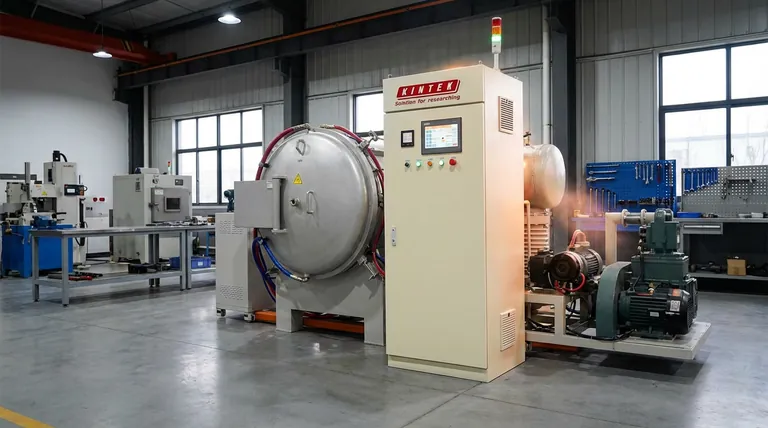
A high-temperature vacuum sintering furnace performs the critical final densification of permanent magnets by heating debinded "brown bodies" to temperatures exceeding 1000°C. Its primary function is to facilitate solid-phase diffusion, a process where powder particles fuse together at the atomic level. This eliminates internal pores and transforms the material into a dense metallic entity capable of sustaining high magnetic performance.
The sintering phase is the defining moment where potential becomes performance. It converts a porous, fragile shape into a solid magnet with high remanence and coercivity, achieving over 98% of the material's theoretical density.
The Physics of Densification
Creating the Protective Environment
The furnace creates a high-vacuum or high-purity protective atmosphere. This is essential to prevent oxidation and contamination during the high-heat phase.
Without this controlled environment, the reactive materials in the magnet would degrade before they could bond.
Facilitating Solid-Phase Diffusion
At temperatures exceeding 1000°C, the furnace induces solid-phase diffusion. Atoms migrate across particle boundaries, causing the individual powder particles to bond chemically and physically.
This diffusion is the mechanism that turns loose powder into a unified solid without melting the material completely.
Elimination of Porosity
As diffusion occurs, the voids (pores) between particles are filled or closed. The furnace removes the empty space left behind after the binding agents were removed in previous steps.
This reduction in porosity is directly responsible for the material's shrinkage and hardening.
Impact on Magnetic Properties
Achieving Theoretical Density
The ultimate goal of this furnace is to reach over 98% of the theoretical density. High density is non-negotiable for high-performance magnets.
Any remaining porosity acts as a barrier to magnetic flux, weakening the final product.
Unlocking Remanence and Coercivity
By achieving high density and a uniform metallic structure, the furnace ensures the magnet possesses high remanence (magnetic strength) and high coercivity (resistance to demagnetization).
These properties are physically impossible to achieve if the material remains porous or loosely bonded.
Distinguishing Sintering from Pre-Sintering
The Role of Atmospheric Pressure
It is important to distinguish this final stage from pre-sintering. Pre-sintering typically occurs in a muffle furnace at lower temperatures (around 800°C) under atmospheric pressure.
The vacuum sintering furnace, by contrast, requires a vacuum to drive the final densification that atmospheric furnaces cannot achieve.
Structural Integrity vs. Final Density
Pre-sintering is designed merely for preliminary bonding to improve structural integrity for handling or re-pressing.
Final vacuum sintering goes beyond simple bonding; it is a transformative process that finalizes the metallic and magnetic character of the component.
Making the Right Choice for Your Goal
To optimize your manufacturing process, you must align the furnace type with the specific stage of production.
- If your primary focus is handling strength: Utilize an atmospheric muffle furnace at lower temperatures to bond particles sufficiently for transport or high-pressure re-pressing.
- If your primary focus is magnetic performance: You must use a high-temperature vacuum furnace to eliminate porosity and achieve the density required for high remanence.
The vacuum sintering furnace is not just a heating element; it is the vessel that finalizes the magnet's physical reality and functional power.
Summary Table:
| Process Phase | Primary Mechanism | Key Outcome |
|---|---|---|
| Environment Control | High Vacuum/Inert Gas | Prevents oxidation and contamination |
| Heating (>1000°C) | Solid-Phase Diffusion | Atomic bonding of powder particles |
| Densification | Pore Elimination | >98% theoretical density achievement |
| Finalization | Structural Transformation | Maximized remanence and coercivity |
Maximize Your Magnetic Performance with KINTEK
Transitioning from 'brown bodies' to high-performance PEM magnets requires absolute precision in temperature and atmosphere. KINTEK provides industry-leading high-temperature vacuum sintering systems designed to deliver the 98% theoretical density your magnets demand.
Backed by expert R&D and manufacturing, we offer a comprehensive range of Muffle, Tube, Rotary, Vacuum, and CVD systems, all customizable to your specific lab or industrial requirements. Whether you are focused on structural integrity or final densification, our technical team is ready to help you optimize your heat treatment workflow.
Ready to upgrade your sintering process? Contact KINTEK today for a customized solution.
References
- Stefan Rathfelder, Carlo Burkhardt. Production of Permanent Magnets from Recycled NdFeB Powder with Powder Extrusion Moulding. DOI: 10.3390/jmmp8020081
This article is also based on technical information from Kintek Furnace Knowledge Base .
Related Products
- 2200 ℃ Tungsten Vacuum Heat Treat and Sintering Furnace
- 2200 ℃ Graphite Vacuum Heat Treat Furnace
- Molybdenum Vacuum Heat Treat Furnace
- Vacuum Heat Treat Sintering Furnace Molybdenum Wire Vacuum Sintering Furnace
- 600T Vacuum Induction Hot Press Vacuum Heat Treat and Sintering Furnace
People Also Ask
- How does a tungsten-heated vacuum sintering furnace prepare (TbxY1-x)2O3 ceramics? Achieve 99%+ Density & Purity
- What wear-resistance enhancements are achieved by powder coating? The Role of Vacuum Sintering Furnaces
- How do compaction pressure and vacuum sintering optimize porous ceramics? Maximize Density & Toughness
- What role does a high-temperature vacuum sintering furnace play in the densification of WC-10(Ni, Ni/Co) alloys?
- How does high-temp vacuum sintering influence Y-TZP mechanical properties? Achieve Max Toughness



















