
Precise thermal regulation is the mechanism by which a heat treatment furnace alters the internal structure of Iron-Copper (Fe-Cu) composites. By strictly controlling heating temperatures and holding times, the furnace drives phase transformations specifically within the iron skeleton, converting it into harder, more durable crystalline forms while leaving the conductive copper network intact.
The core objective is to transform the iron matrix from a base state into high-strength martensite via quenching, and then stabilize it into tough tempered sorbite via tempering. This two-step process significantly boosts mechanical performance without compromising the composite's conductivity.
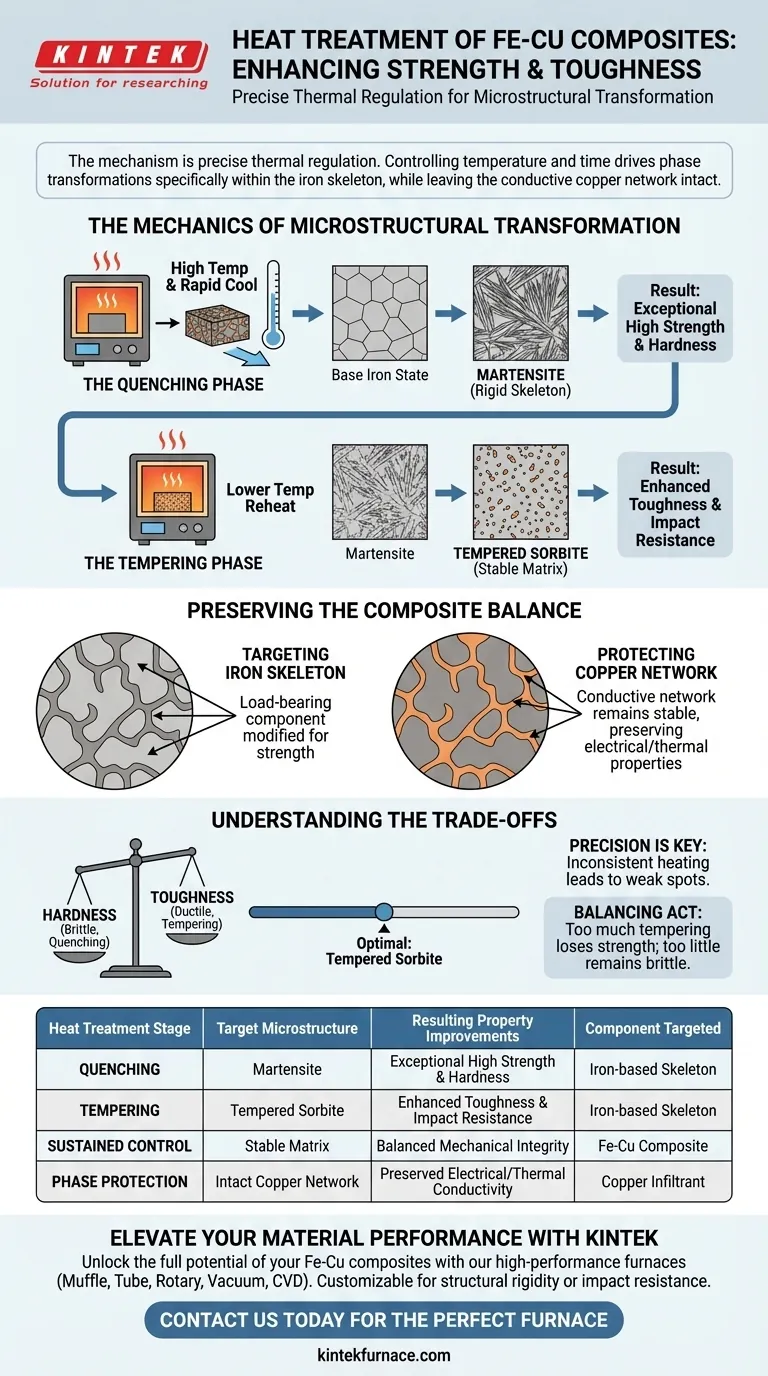
The Mechanics of Microstructural Transformation
The Quenching Phase
The first stage of the process involves heating the composite and then cooling it rapidly. This induces a dramatic phase change in the iron matrix.
The primary goal here is to transform the iron into martensite. Martensite is a supersaturated solid solution that provides the composite with exceptional high strength and hardness, forming a rigid skeleton.
The Tempering Phase
Following quenching, the material undergoes tempering, which involves reheating to a specific, lower temperature. This step is critical because pure martensite, while strong, can be brittle.
Tempering transforms the martensite into tempered sorbite. This microstructure creates a more stable matrix that retains high strength but gains significant toughness, allowing the material to withstand impact without fracturing.
Preserving the Composite Balance
Targeting the Iron Skeleton
The heat treatment furnace focuses its energy on the iron-based skeleton. The iron acts as the load-bearing component of the composite, and modifying its microstructure is the primary method for enhancing mechanical properties.
Protecting the Copper Network
A critical aspect of this process is that it enhances the iron matrix without disrupting the conductive copper network.
Because copper has different thermal properties and phase transition points, the specific temperatures used for treating iron allow the copper to remain stable. This ensures that while the material becomes stronger physically, it retains its essential electrical or thermal conductivity.
Understanding the Trade-offs
The Necessity of Precision
The effectiveness of this process relies entirely on precise control of temperature and time. If the heating is inconsistent, the phase transformation to martensite may be incomplete, resulting in weak spots within the composite.
Balancing Hardness and Ductility
There is an inherent trade-off between the hardness achieved during quenching and the toughness gained during tempering.
If the tempering process is cut short, the material may remain too brittle (too much martensite). Conversely, if held too long or too hot, the material may lose too much strength in favor of ductility. The furnace must maintain a strict regimen to achieve the optimal tempered sorbite state.
Making the Right Choice for Your Goal
To maximize the utility of Fe-Cu composites, you must tune the furnace parameters to your specific mechanical requirements.
- If your primary focus is Maximum Structural Rigidity: Prioritize the efficiency of the quenching phase to ensure a complete transformation to martensite before tempering.
- If your primary focus is Impact Resistance (Toughness): Ensure the tempering stage is sufficiently long to fully convert brittle phases into stable tempered sorbite.
By mastering these thermal cycles, you evolve the composite from a simple mixture into a sophisticated, high-performance material.
Summary Table:
| Heat Treatment Stage | Target Microstructure | Resulting Property Improvements | Component Targeted |
|---|---|---|---|
| Quenching | Martensite | Exceptional High Strength & Hardness | Iron-based Skeleton |
| Tempering | Tempered Sorbite | Enhanced Toughness & Impact Resistance | Iron-based Skeleton |
| Sustained Control | Stable Matrix | Balanced Mechanical Integrity | Fe-Cu Composite |
| Phase Protection | Intact Copper Network | Preserved Electrical/Thermal Conductivity | Copper Infiltrant |
Elevate Your Material Performance with KINTEK
Unlock the full potential of your Fe-Cu composites with the precision thermal control required for complex phase transformations. Backed by expert R&D and world-class manufacturing, KINTEK offers high-performance Muffle, Tube, Rotary, Vacuum, and CVD systems. Whether you are targeting structural rigidity or impact resistance, our lab high-temp furnaces are fully customizable to meet your unique metallurgical needs.
Ready to optimize your heat treatment process? Contact us today to speak with a specialist and find the perfect furnace for your laboratory.
Visual Guide
Related Products
- Vacuum Heat Treat Furnace with Ceramic Fiber Liner
- 2200 ℃ Graphite Vacuum Heat Treat Furnace
- 2200 ℃ Tungsten Vacuum Heat Treat and Sintering Furnace
- Vacuum Heat Treat Sintering Furnace Molybdenum Wire Vacuum Sintering Furnace
- Vacuum Heat Treat Sintering Furnace with Pressure for Vacuum Sintering
People Also Ask
- How does vacuum heat treating affect the grain structure of metal alloys? Achieve Precise Microstructure Control
- What are the benefits of using vacuum heat treating furnaces for metal alloys? Achieve Superior Metal Properties and Performance
- What is one of the most important uses of vacuum heat treating furnaces in aerospace? Achieve Superior Strength in Aircraft Alloys
- How does a vacuum heat treat furnace work? Achieve Pristine, High-Performance Results
- What is the difference between heat treat and vacuum heat treat? Achieve Superior Metal Properties with Pristine Finishes



















