
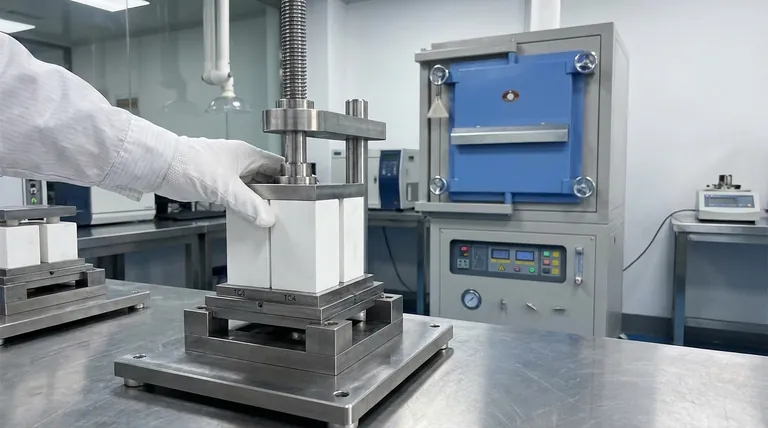
Zirconia (ZrO₂) ceramic blocks function as critical interface components during the vacuum brazing of TC4 titanium alloys, serving as a non-reactive bridge between the tooling and the workpiece. Their primary role is to transmit mechanical force uniformly to the brazing seam while acting as a chemical barrier to prevent the fixture from bonding to the titanium substrate.
The selection of ZrO₂ is driven by the need to apply significant pressure to the assembly without compromising the chemical integrity of the reactive titanium alloy at high temperatures.
Material Compatibility at High Temperatures
Chemical Inertness
Titanium alloys like TC4 are highly reactive at elevated temperatures. If standard metallic fixtures were used in direct contact with the substrate, they would likely react or diffuse into the titanium.
Preventing Unwanted Adhesion
ZrO₂ is chemically inert and does not react with the TC4 substrate. This property prevents the fixture from sticking to the workpiece, ensuring the components can be easily separated after the brazing cycle is complete.
Thermal Stability
Vacuum brazing requires sustained high temperatures to flow the filler metal properly. Zirconia ceramics possess exceptional thermal stability, maintaining their structural integrity and shape without degrading under these rigorous conditions.
Mechanics of Force Transmission
The Role of the Pressure Head
In the assembly, the ZrO₂ block is strategically placed between the pressure head and the TC4 substrate. It acts as the primary medium for transferring force from the machine to the part.
Ensuring Uniform Pressure
The ceramic block distributes the load evenly across the contact area. This uniformity is vital for preventing localized stress points that could warp the assembly or cause uneven brazing.
Optimizing Seam Contact
By transmitting pressure effectively, the block ensures close, consistent contact between the filler metal and the substrate. This contact is the prerequisite for a capillary action that results in a hermetically sealed, high-strength joint.
Understanding the Operational Trade-offs
Mechanical Brittleness
While ZrO₂ is strong in compression (taking the load), it is inherently brittle compared to metallic fixtures. These blocks must be handled carefully to avoid chipping or fracturing during assembly and disassembly.
Cost and Complexity
Using specialized ceramic fixtures introduces higher material costs than standard steel tooling. However, this cost is generally offset by the elimination of scrapped parts due to adhesion or surface contamination.
Ensuring Process Integrity
To maximize the effectiveness of your vacuum brazing process, consider the following regarding fixture selection:
- If your primary focus is Structural Integrity: Ensure the ZrO₂ blocks are machined flat to guarantee uniform pressure distribution across the entire brazing seam.
- If your primary focus is Surface Quality: Rely on the chemical inertness of ZrO₂ to maintain the surface brightness of the TC4 alloy without post-process grinding.
Correctly utilizing inert auxiliary fixtures is just as critical to the final joint quality as the selection of the brazing filler metal itself.
Summary Table:
| Feature | Function in TC4 Brazing | Benefit to Process |
|---|---|---|
| Chemical Inertness | Prevents diffusion and reaction | Avoids fixture-to-part adhesion |
| Thermal Stability | Maintains shape at high temp | Ensures consistent fixture geometry |
| Force Transmission | Distributes mechanical load | Achieves uniform filler metal flow |
| Surface Protection | Non-metallic interface | Preserves TC4 surface brightness |
Precision Solutions for Titanium Brazing
Elevate your manufacturing quality with high-performance laboratory solutions from KINTEK. Whether you are optimizing interface integrity for TC4 titanium alloys or scaling up specialized thermal processes, our expert R&D team provides the precision equipment you need.
KINTEK offers a comprehensive range of Muffle, Tube, Rotary, Vacuum, and CVD systems, all fully customizable to meet the rigorous demands of advanced materials research. Our expert-engineered high-temp furnaces ensure the uniform pressure and thermal stability required for complex brazing applications.
Contact KINTEK today to discuss your unique project needs
References
- Yibin Wu, Kun Liu. Effect of Brazing Temperature and Holding Time on the Interfacial Microstructure and Properties of TC4-Brazed Joints with Ti-Zr-Cu-Ni Amorphous Filler. DOI: 10.3390/ma18112471
This article is also based on technical information from Kintek Furnace Knowledge Base .
Related Products
People Also Ask
- What factors determine the quality of sintered zirconia restorations? Master Material, Equipment, and Technique
- How do conventional vs rapid sintering in dental furnaces affect zirconia? Optimize Efficiency Without Sacrificing Strength
- What is the purpose of dental sintering furnaces? Transform Zirconia into Durable, High-Quality Dental Restorations
- What precautions should be taken when sintering zirconia in the Fast Slow Dental Sintering Furnace? Master Key Steps for Perfect Results
- What temperature range is used for sintering zirconia ceramics? Achieve Optimal Strength and Translucency
