
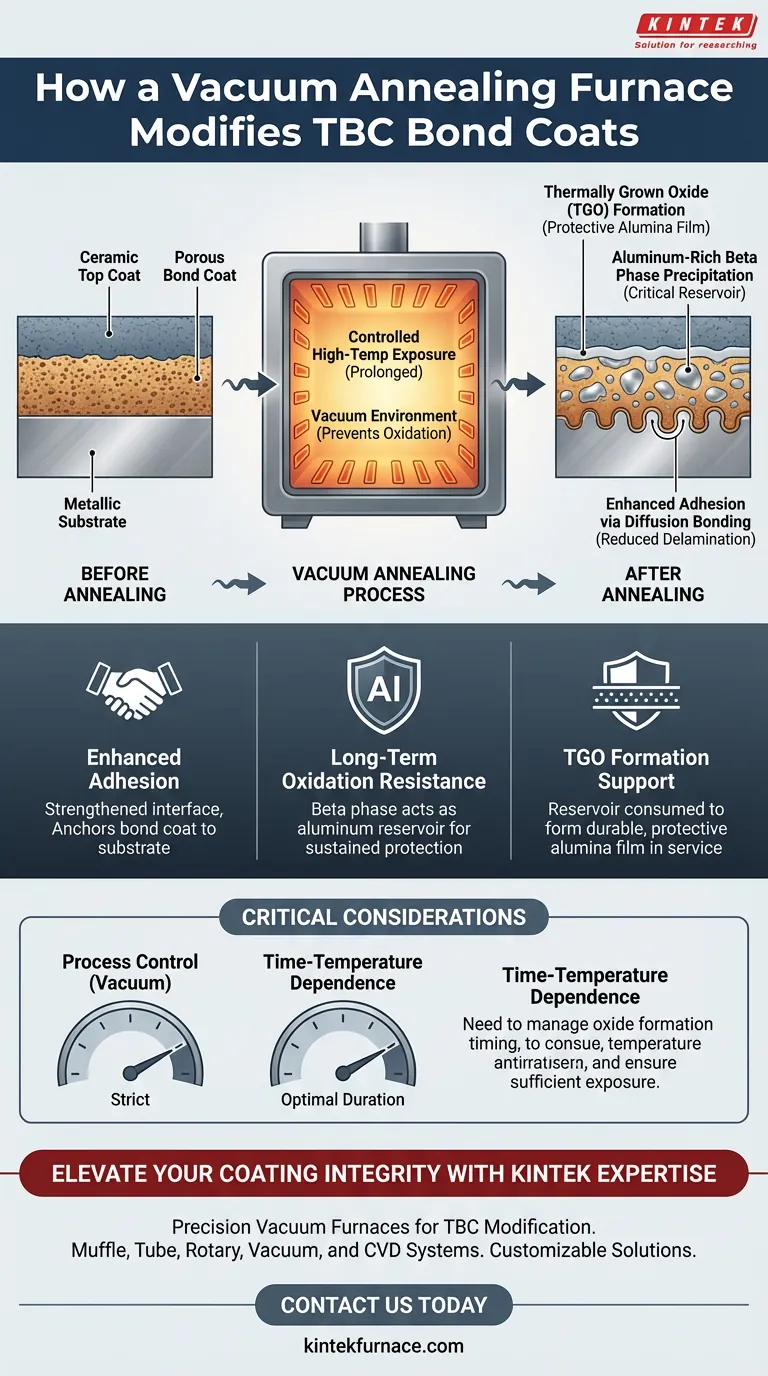
A vacuum annealing furnace modifies the bond coat by subjecting the Thermal Barrier Coating (TBC) system to prolonged heat treatment within a controlled vacuum environment. This process fundamentally alters the coating’s microstructure to enhance adhesion and prepare the system for long-term oxidation resistance.
The primary function of vacuum annealing is to induce the precipitation of an aluminum-rich beta phase within the bond coat. This phase acts as a critical reservoir for forming the Thermally Grown Oxide (TGO), which protects the component during service, while simultaneously enhancing the bond through diffusion.
The Mechanism of Modification
Controlled High-Temperature Exposure
The furnace performs these modifications through prolonged heat treatment. This is not a rapid thermal cycle, but a sustained process designed to drive chemical and structural changes deep within the coating.
The Necessity of a Vacuum Environment
The modification takes place in a high-temperature vacuum. This controlled atmosphere is essential to facilitate the necessary microstructural evolution without introducing contaminants or causing uncontrolled oxidation before the system enters service.
Structural and Chemical Changes
Promoting Diffusion Bonding
One of the immediate physical impacts of the process is the enhancement of the interface between layers. The heat treatment promotes diffusion bonding.
This occurs specifically between the substrate (the base metal) and the bond coat. By facilitating atomic diffusion, the furnace effectively anchors the bond coat to the substrate, reducing the risk of delamination.
Precipitation of the Beta Phase
The most critical chemical modification occurs within the bond coat itself. The annealing process induces the precipitation of aluminum.
This results in the formation of an aluminum-rich beta phase. This specific microstructural phase is the defining characteristic of a properly annealed bond coat.
The Purpose: Preparing for Service
Creating an Aluminum Reservoir
The beta phase formed during annealing is not merely a structural byproduct; it is a functional requirement. It serves as a stored "reservoir" of aluminum.
Forming the Thermally Grown Oxide (TGO)
This reservoir is utilized when the component is eventually put into service. The stored aluminum is consumed to form a dense, protective alumina film.
This film is known as Thermally Grown Oxide (TGO). The pre-service annealing ensures that the bond coat has the necessary chemical composition to sustain this protective layer over time.
Critical Considerations
The Importance of Process Control
While the goal is to create an oxide layer eventually, the annealing process itself requires a vacuum to manage when that oxide forms.
The environment must be strictly controlled to ensure that the aluminum precipitates into the beta phase reservoir rather than oxidizing prematurely during the manufacturing stage.
Time-Temperature Dependence
The quality of the bond coat modification is directly tied to the duration of exposure.
Because the process relies on diffusion and precipitation—both time-dependent mechanisms—insufficient heat treatment will fail to establish the robust beta phase required for long-term protection.
Making the Right Choice for Your Goal
Vacuum annealing is not just a finishing step; it is a synthesis step that activates the protective properties of the TBC system.
- If your primary focus is mechanical adhesion: Ensure the annealing profile allows sufficient time for diffusion bonding to secure the bond coat to the substrate.
- If your primary focus is long-term oxidation resistance: Verify that the process parameters have successfully maximized the precipitation of the aluminum-rich beta phase to support TGO formation.
Ultimately, the vacuum annealing furnace transforms the bond coat from a simple applied layer into a chemically active reservoir capable of sustaining high-temperature protection.
Summary Table:
| Process Mechanism | Physical/Chemical Change | Functional Outcome |
|---|---|---|
| High-Temp Vacuum Treatment | Sustained heat in controlled atmosphere | Prevents premature oxidation & contamination |
| Diffusion Bonding | Atomic migration at the substrate interface | Strengthened adhesion & reduced delamination |
| Beta Phase Precipitation | Formation of aluminum-rich reservoirs | Long-term source for protective TGO formation |
| Structural Evolution | Microstructural stabilization | Enhanced oxidation resistance during service |
Elevate Your Coating Integrity with KINTEK Expertise
Precision is non-negotiable when modifying critical Thermal Barrier Coating (TBC) systems. At KINTEK, we understand that the perfect bond coat requires rigorous process control and high-performance thermal environments.
Backed by expert R&D and manufacturing, KINTEK offers Muffle, Tube, Rotary, Vacuum, and CVD systems, along with other specialized lab high-temp furnaces—all fully customizable to meet your unique metallurgical needs. Whether you are optimizing diffusion bonding or maximizing aluminum-rich beta phase precipitation, our advanced vacuum technology ensures your components are service-ready.
Ready to achieve superior heat treatment results? Contact us today to consult with our specialists and find the ideal furnace solution for your laboratory or production line.
Visual Guide
References
- Jens Igel, Robert Vaßen. Extended Lifetime of Dual-Layer Yttria-Stabilized Zirconia APS/Gadolinium Zirconate SPS Thermal Barrier Coatings in Furnace Cycle Tests. DOI: 10.3390/coatings14121566
This article is also based on technical information from Kintek Furnace Knowledge Base .
Related Products
- Small Vacuum Heat Treat and Tungsten Wire Sintering Furnace
- Vacuum Heat Treat Sintering and Brazing Furnace
- Vacuum Heat Treat Sintering Furnace Molybdenum Wire Vacuum Sintering Furnace
- Vacuum Heat Treat Sintering Furnace with Pressure for Vacuum Sintering
- Vacuum Sealed Continuous Working Rotary Tube Furnace Rotating Tube Furnace
People Also Ask
- How does vacuum sintering improve dimensional tolerances? Achieve Uniform Shrinkage and Precision
- What are the key components of a vacuum sintering furnace? Essential Parts for Precision Material Processing
- What is the purpose of setting a mid-temperature dwell stage? Eliminate Defects in Vacuum Sintering
- What are the main structural components of a vacuum sintering furnace? Unlock Precision in High-Temperature Processing
- What are the main types of sintering furnaces? Find the Perfect Match for Your Materials



















